
 Chat with us on WhatsApp


Distillery Ownership Changes: Recent Sales, Acquisitions & What It Means
Distillery ownership changes can affect far more than the company name shown on a corporate website. A sale may alter distribution, production investment, stock management and the long-term direction of the whisky. However, it does not automatically change the liquid already maturing in the warehouse or make existing bottles more collectible.
Recent transactions have ranged from multinational groups increasing their stakes in established producers to investors rescuing distilleries from administration. For drinkers and collectors exploring Scotch whisky, the useful question is not simply who owns a distillery. It is what the new owner controls, what it intends to change and whether those changes affect production, provenance or future releases.
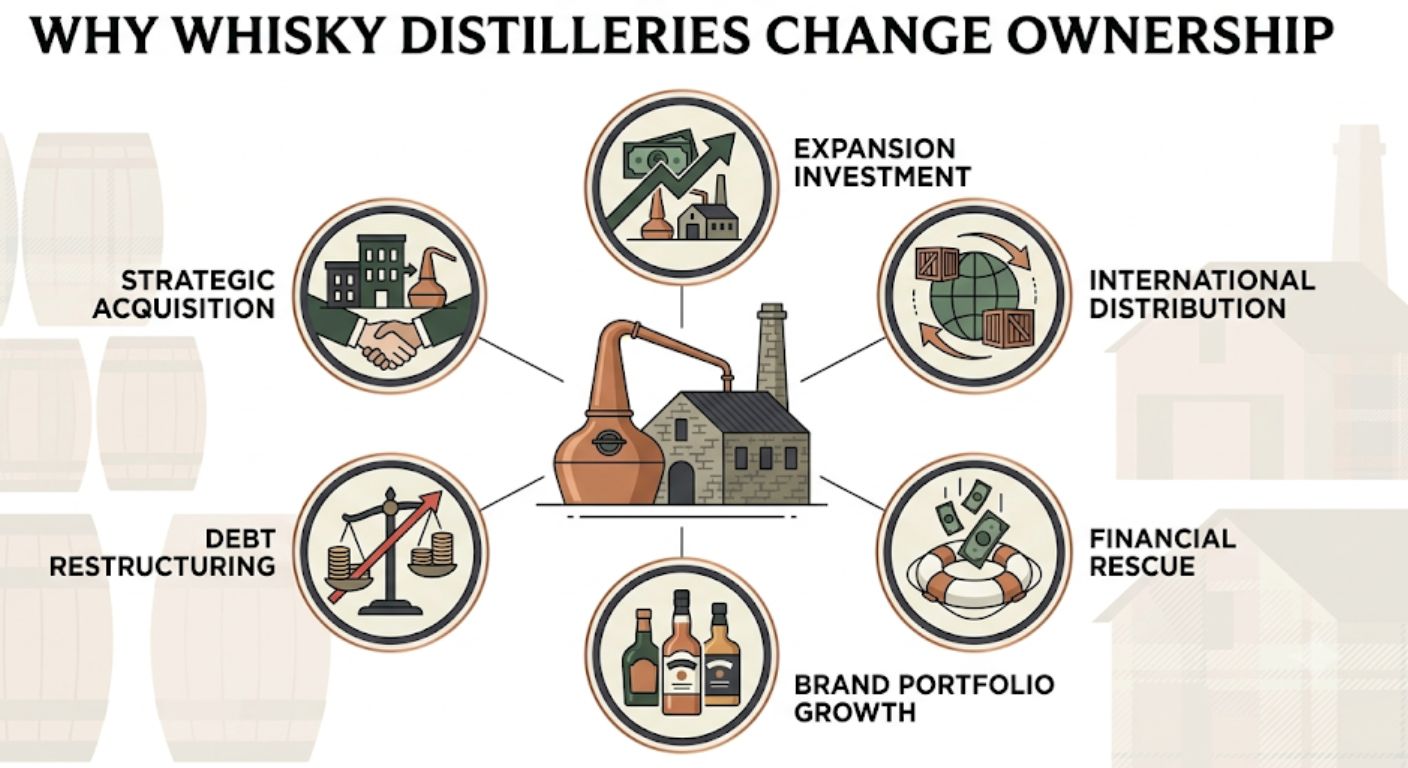
Why Whisky Distilleries Change Ownership
Whisky businesses are unusually capital-intensive. A distillery must fund raw materials, production, casks, warehouses and staff long before its mature whisky can be sold. A new single malt producer may wait at least three years before legally releasing whisky, while age-stated expressions require much longer.
This delay creates several common reasons for a sale or acquisition:
- Access to capital: A buyer can fund additional production, warehouses, visitor facilities or international expansion.
- Improved distribution: Larger drinks groups already have established routes into supermarkets, specialist retailers, bars and overseas markets.
- Portfolio expansion: A company may acquire a distillery to enter Scotch, Irish whiskey, English whisky or another growing category.
- Financial restructuring: An acquisition may protect assets and employment when the existing owner cannot meet its debts.
- Brand consolidation: Owners may sell brands that no longer fit their strategy while retaining the distilleries or production contracts behind them.
These distinctions matter. Buying a brand is not always the same as buying its distillery, warehouses and maturing stock. A transaction may cover the trademarks and distribution rights while production continues elsewhere under a separate agreement.
Recent Whisky Sales and Acquisitions
Bacardi Takes Full Ownership of Teeling Whiskey
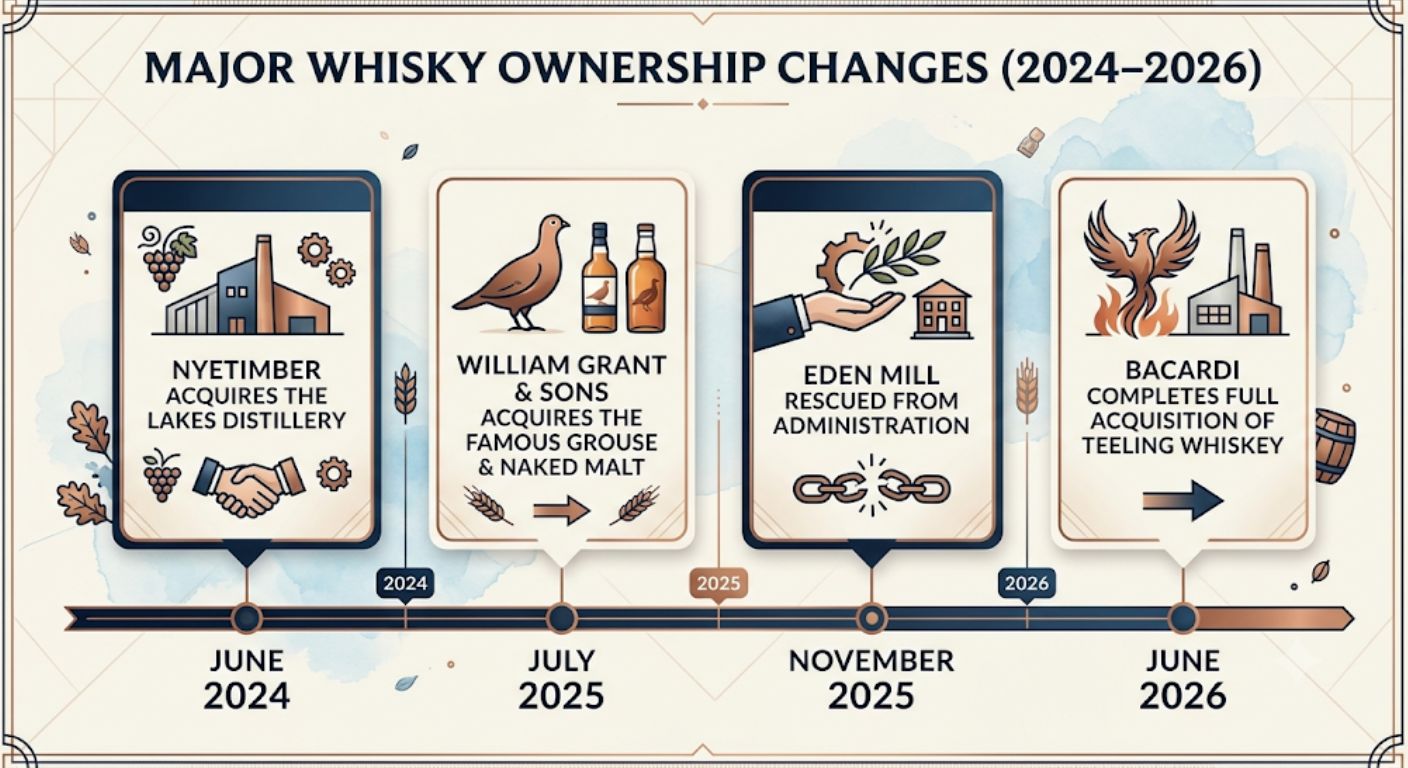
In June 2026, Bacardi completed a transaction that made it the sole owner of the Teeling Whiskey Company and its Irish whiskey brand. Bacardi had held a minority interest since 2017, so the deal represented the completion of an existing relationship rather than an unexpected takeover.
Founders Jack and Stephen Teeling remained involved as strategic advisers. That continuity is significant because ownership changes do not necessarily remove the people responsible for developing the brand. Bacardi gains full control and can provide international distribution and investment, while the founders retain a role in shaping its direction.
William Grant & Sons Acquires The Famous Grouse and Naked Malt
William Grant & Sons completed its acquisition of The Famous Grouse and Naked Malt from Edrington in July 2025. The transaction concerned established blended whisky brands rather than the purchase of a single operating distillery.
The deal demonstrates how ownership changes can redistribute brands between major Scotch producers. William Grant & Sons added two recognised blends to a portfolio that already included Glenfiddich, The Balvenie and Grant’s. Edrington, meanwhile, could concentrate resources on the remaining parts of its portfolio.
The UK Competition and Markets Authority reviewed the acquisition before clearing it in March 2025. This type of review considers whether consolidation could materially reduce competition, rather than assessing the flavour or production quality of the whisky itself.
Nyetimber Acquires The Lakes Distillery
Nyetimber completed its acquisition of The Lakes Distillery in June 2024. The transaction valued the English whisky and spirits producer at an enterprise value of approximately £71 million, including its debt.
This was a strategic move into premium spirits by a company primarily associated with English sparkling wine. For The Lakes, the acquisition provided access to a privately owned group with the capital and experience to support longer-term brand development.
It also reflects wider interest in world whisky categories outside Scotch. English whisky remains smaller than Scotch in production volume, but established producers with mature stock and recognised brands can be attractive acquisition targets.
Eden Mill Rescued from Administration
Eden Mill presents a different type of ownership change. The St Andrews-based distillery was acquired from administration by investors in November 2025 after its owner, St Andrews Brewers Limited, entered administration. The transaction preserved 42 jobs.
A rescue acquisition is primarily about stabilising the operating business and protecting viable assets. It may preserve the distillery, its stock and its workforce, but buyers should still distinguish between continuity of production and continuity of the previous company structure.
Why Are Distilleries Entering Administration?
Distilleries can enter administration when their immediate financial obligations exceed the cash available to meet them. The problem may be caused by excessive borrowing, construction costs, slower-than-expected sales or the long delay between distillation and the release of mature whisky.
Demand rose sharply across parts of the spirits market during and immediately after the pandemic. Some producers expanded capacity on the assumption that premium whisky sales would continue growing at the same rate. Subsequent destocking by distributors, weaker consumer demand and higher borrowing costs placed pressure on businesses carrying substantial debt or immature inventory.
Maturing whisky is an asset, but it does not always provide immediate cash. Stock may be too young to bottle, contractually restricted or difficult to sell without weakening the brand. A warehouse containing thousands of casks can therefore coexist with a serious short-term cash-flow problem.
What Changes After a Distillery Is Sold?
The immediate effect depends on what was included in the transaction. Buyers should look for confirmation of whether the sale covered the distillery site, trademarks, existing inventory, production contracts and distribution rights.
| Area | Possible Change | What Buyers Should Watch |
|---|---|---|
| Production | Capacity increases or revised production schedules | Changes to fermentation, still operation or spirit specification |
| Maturation | New cask policies or additional warehouse space | Whether established age statements and cask programmes continue |
| Distribution | Greater availability in more countries | Whether specialist releases remain available alongside core bottles |
| Pricing | Repositioning into a higher or lower price tier | Whether price rises are supported by changes to age, ABV or specification |
| Brand identity | New packaging, terminology or marketing | Whether provenance and production information remain transparent |
Production changes usually take years to become visible in mature whisky. A bottle released shortly after an acquisition was often distilled and filled into cask under the previous owner. Packaging and pricing can change quickly; the mature spirit cannot.
One thing our customers often notice is that a bottle can carry new branding while containing stock produced entirely before the ownership change, so the distillation and bottling dates matter more than the latest packaging.
Does Corporate Ownership Affect Whisky Quality?
Corporate ownership does not determine quality on its own. A large owner may provide better laboratories, cask purchasing power, warehouse management and international distribution. It may also have the financial strength to protect long-term stocks during a difficult market.
The possible disadvantage is that a large portfolio encourages standardisation. Owners may prioritise dependable high-volume releases, reduce experimental bottlings or reposition an established whisky at a higher price. Neither outcome is automatic, and changes should be assessed from the bottle specification rather than assumptions about the parent company.
Useful points to compare before and after a sale include:
- Age statement and bottling strength
- Natural colour or added colouring
- Chill-filtration policy
- Cask type and length of maturation
- Batch size or single-cask status
- Distillery and bottler named on the label
- Recommended retail price
What Ownership Changes Mean for Collectors
An acquisition does not automatically make bottles from the previous owner rare or valuable. Collectability depends on the number of bottles produced, the significance of the release, demand for the distillery and whether the whisky represents a genuinely distinct production period.
Pre-acquisition bottles may become historically interesting when the new owner changes the spirit specification, closes a production site or discontinues a recognised range. Older packaging alone is weaker evidence. A label redesign can create a clearly identifiable version without creating meaningful scarcity.
Collectors should record the bottle code, bottling date, ABV, age statement, cask information and packaging format. These details make it easier to establish whether a bottle belongs to the previous ownership period or was merely sold in an older-style box after the transaction.
Why Distilleries Sell Casks to Independent Bottlers
An independent bottler buys or otherwise obtains whisky from a distillery, selects the cask and releases the spirit under its own label. The distillery may be named, disclosed indirectly or withheld under the terms of the sale.
Distilleries sell casks for several reasons. New fillings can generate earlier cash flow, older parcels may no longer match the profile required for an official release, and selling selected stock can help manage warehouse capacity. Independent bottlings can also expose drinkers to unusual cask types, higher strengths and individual production periods that would not fit the owner’s core range.
Ownership changes may alter these relationships. A new owner might restrict third-party cask sales to protect the distillery name, or release more stock to improve short-term cash flow. Existing independent bottlings can therefore provide useful evidence of how widely a distillery previously traded its spirit.
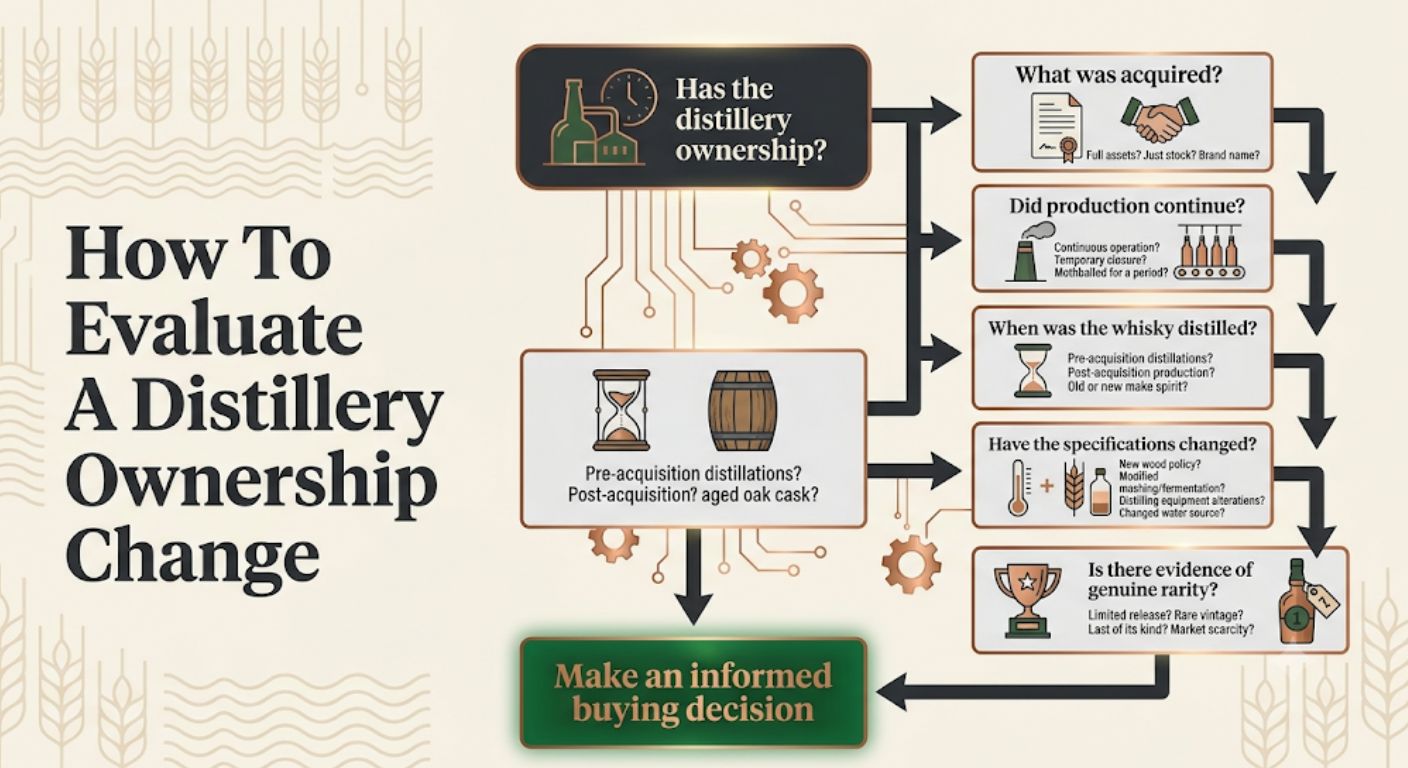
How to Assess a Distillery Ownership Change
An ownership change is most relevant when it affects what is produced, how transparently it is presented or whether the distillery can continue operating. Buyers should assess the transaction in a practical order:
- Confirm what was sold. Separate a brand acquisition from the purchase of the physical distillery and its stock.
- Check operational continuity. Establish whether production continued, stopped temporarily or moved to another site.
- Identify the production period. Compare the distillation date with the acquisition date.
- Review bottle specifications. Look for changes to age, ABV, cask policy, filtration and colouring.
- Ignore unsupported scarcity claims. Previous ownership does not make every bottle limited or collectible.
This approach makes particular sense for discontinued releases, independent bottlings and bottles produced around a closure or restart. It is less important for a widely available core expression when the production specification has remained unchanged.
Frequently Asked Questions
Does a distillery sale change the whisky immediately?
No. Whisky bottled soon after a sale was usually distilled and matured before the new owner took control. Packaging, distribution and pricing can change quickly, but changes to the new-make spirit may not appear in mature releases for several years.
Are bottles from before an acquisition more collectible?
Only when the earlier bottle represents a meaningful difference, such as a discontinued age statement, previous production method, closed site or clearly limited release. An old label or former owner’s name does not create collectability by itself.
Can a large company improve an independent distillery?
Yes. A larger owner can provide production investment, stronger quality control, improved warehousing and wider distribution. The trade-off may be less experimentation or a stronger focus on high-volume releases, but this depends on the strategy adopted after the acquisition.
Where can official Scotch whisky information be checked?
The Scotch Whisky Association provides industry information and explains the legal requirements governing Scotch whisky. Corporate filings, insolvency notices and Competition and Markets Authority decisions can provide additional evidence about specific transactions.
-
-
-
-
-
-
-
-
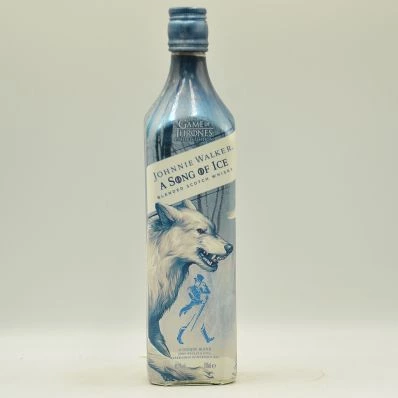
 Game of Thrones Whisky Johnnie Walker A Song Of FireSpecial Price £139.98 Regular Price £144.99 Inc VATSaving £5.01
 -
-
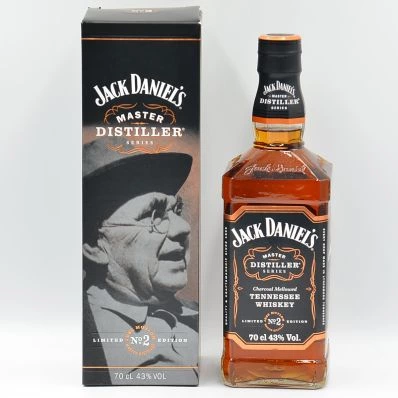 Jack Daniel's - Master Distiller Batch 2 Jess Motlow Limited Edition Bourbon Whiskey£164.99 Inc VATOut of stock
 -
-
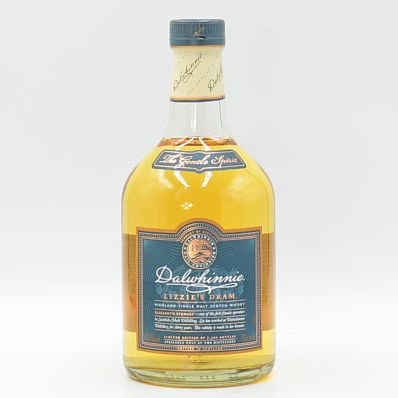
 Game Of Thrones Whisky Dalwhinnie Winter's Frost House StarkSpecial Price £104.98 Regular Price £134.99 Inc VATSaving £30.01Out of stock
Understanding the Bottle Behind the Ownership Change
Distillery ownership changes matter most when they affect production continuity, mature stock, bottle specifications or transparency. A sale can provide stability and investment, but it can also lead to portfolio restructuring, price changes or fewer specialist releases.
The owner’s name is therefore only the starting point. The distillation period, cask information, bottling strength and identity of the producer provide stronger evidence of what is actually in the bottle. Readers comparing ownership histories can continue through our Scotch distillery directory to place individual bottles within their wider production and company context.

Comments