
 Chat with us on WhatsApp

Scotch Whisky Statistics 2026: Industry Facts & Figures
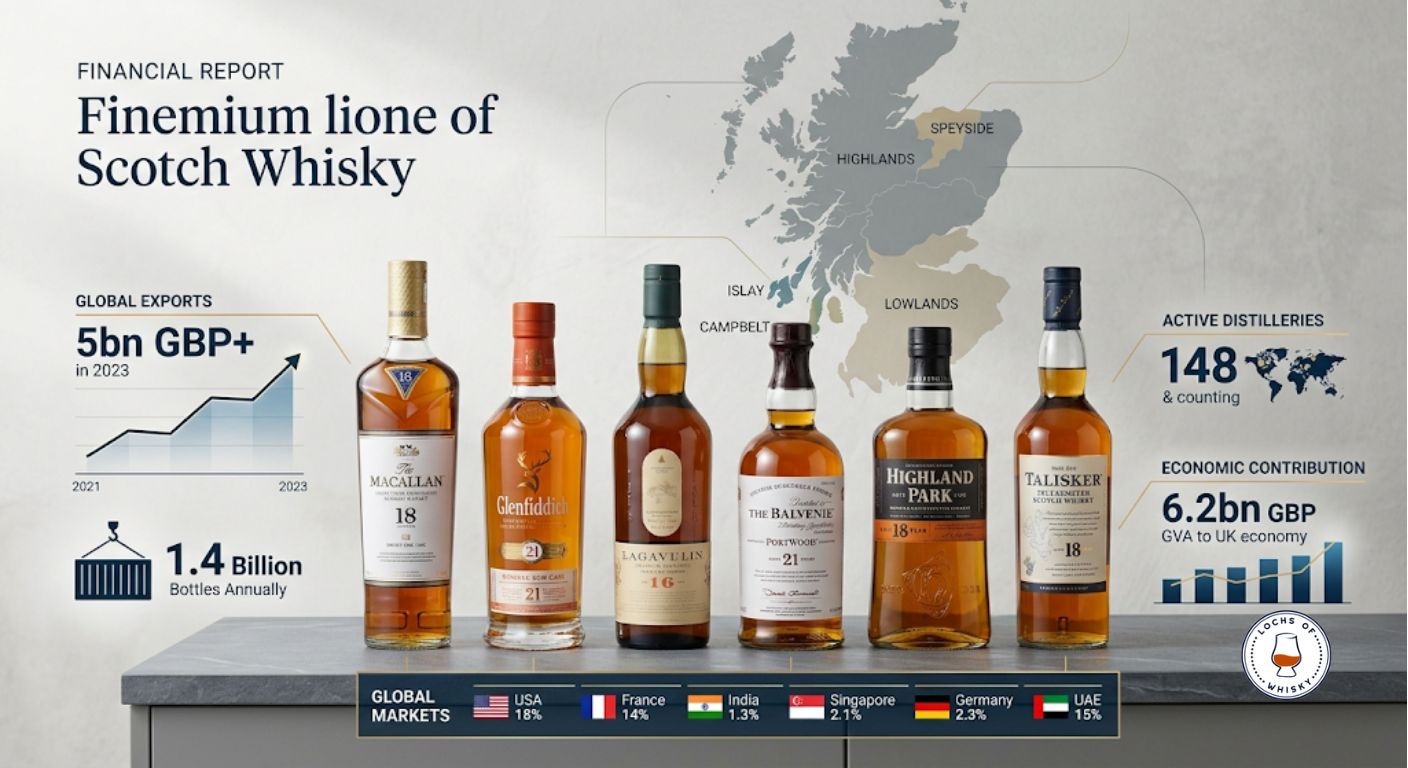
Scotch whisky statistics are useful only when they explain what is happening behind the numbers: production, exports, trade pressure, distillery activity, bottle categories and buyer behaviour. In 2026, the Scotch whisky industry remains globally important, but the market is less simple than “growth” or “decline”. Export value, tariff changes, softer demand, premium pricing and collectible whisky corrections all tell different parts of the same story.
This guide sets out the key figures clearly, with practical context for drinkers, collectors and buyers. It focuses on what the numbers mean when choosing Scotch: whether to compare single malt and blended whisky, how age statement and ABV affect price, and why provenance matters more when the market becomes more selective. For current bottle discovery, the main Scotch whisky selection remains the most useful starting point.
Scotch Whisky Industry Snapshot For 2026
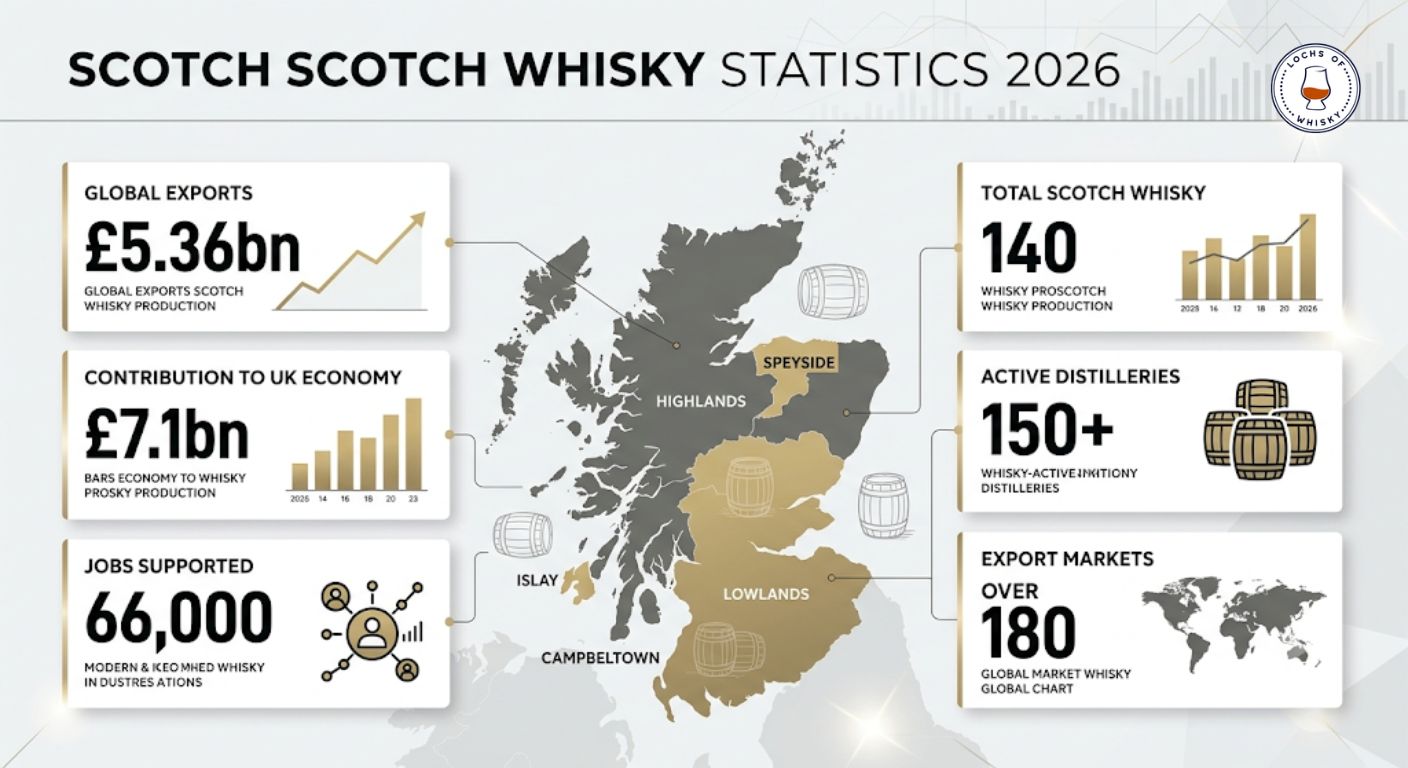
The headline position is mixed. Scotch remains one of the UK’s most important food and drink exports, but 2025 and early 2026 data show pressure from tariffs, weaker consumer demand and a more cautious premium market. The Scotch Whisky Association reported 2025 exports at around £5.36bn, with the United States still the largest value market despite tariff pressure.
- Economic contribution: around £7.1bn Gross Value Added to the UK economy.
- Employment impact: around 66,000 jobs supported across the UK.
- Key export pressure: US tariff impact reduced Scotch whisky exports by value and volume in 2025.
- Largest growth opportunity: India, helped by the UK-India tariff reduction from 150% to 75%, then towards 40% over ten years.
- Buyer trend: more scrutiny on provenance, age statement, ABV, cask type and realistic pricing.
For official economic context, the Scotch Whisky Association facts and figures remain the clearest industry-level reference.
Economic Impact: Why Scotch Still Matters
Scotch whisky is not only a drinks category. It is a manufacturing, export, tourism and rural employment sector. The industry’s £7.1bn contribution to the UK economy gives it unusual weight compared with many other premium drinks categories. Its impact is especially strong in Scotland, where distilling supports agriculture, logistics, packaging, warehousing, tourism and specialist retail.
That economic role matters because whisky is slow to make. A distillery cannot react instantly to demand changes. Spirit laid down today may not be sold as Scotch for at least three years, and often much longer. A 12-year-old single malt reflects production decisions made more than a decade earlier. This is why export disruption, interest rates and changing consumer confidence can create long-lasting pressure.
Exports, Tariffs And Global Demand
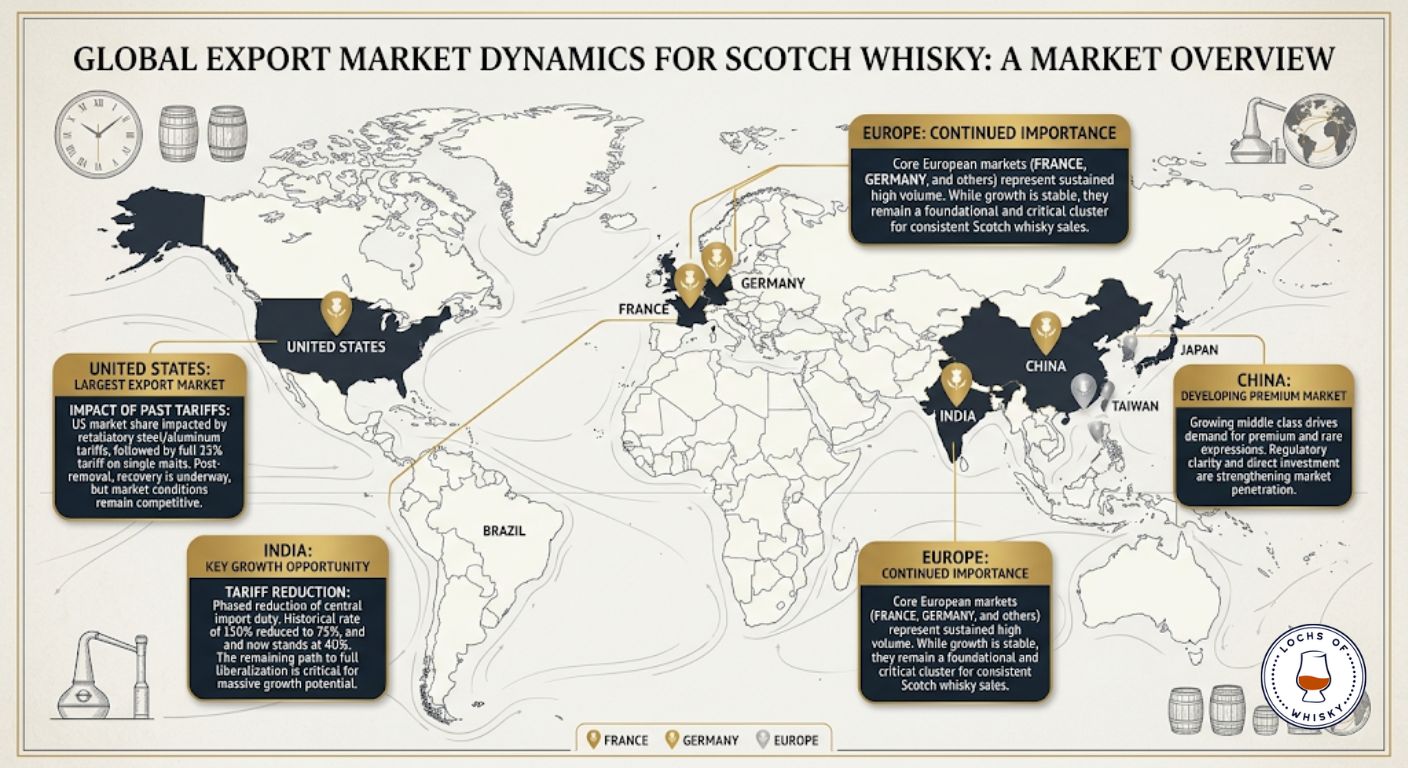
Trade barriers are one of the biggest statistical themes in Scotch whisky for 2026. The United States remains a high-value market, but tariff disruption in 2025 weakened performance. The SWA reported that exports to the US fell by value and volume, with the tariff period showing a sharper decline.
India is the opposite story. It is already one of the largest Scotch markets by volume, but high import tariffs have historically limited the premium opportunity. The UK-India trade deal reduces the tariff from 150% to 75% initially, with a staged move towards 40% over ten years. That does not guarantee instant price drops for every bottle, but it changes the long-term structure of the market.
The practical takeaway is simple: export statistics affect availability and pricing. If a market becomes more expensive to serve, producers may shift stock elsewhere. If tariffs fall, larger brands usually benefit first, while smaller distilleries and independent bottlers may see slower, more selective gains.
Single Malt, Blended Scotch And Market Segmentation
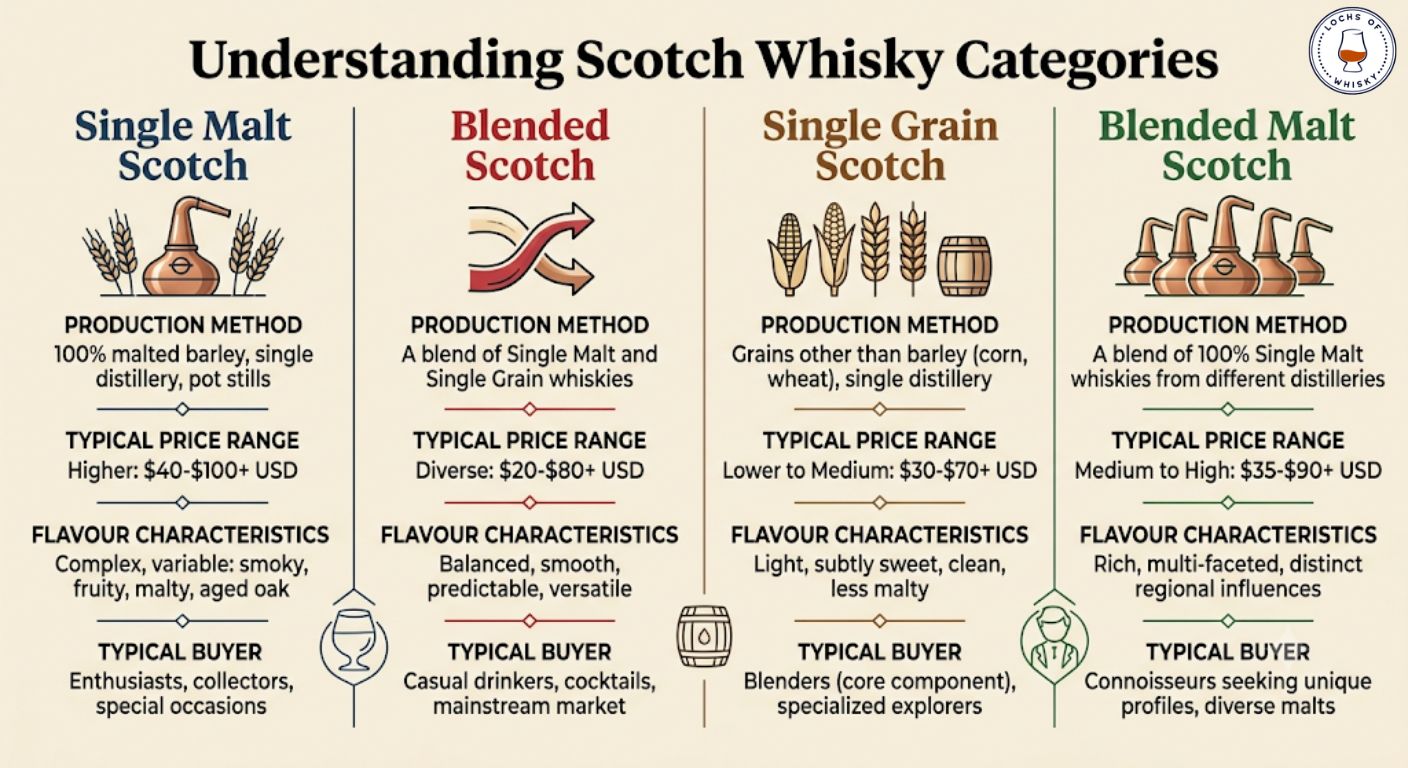
Scotch whisky statistics can be misleading if all categories are treated as one market. Blended Scotch still accounts for a large share of global volume, while single malt carries more premium and collector interest. Single grain, blended malt and independent bottlings sit between those two poles, often with smaller audiences but strong enthusiast appeal.
- Blended Scotch: usually broader volume, lower average price, and strong global recognition.
- Single malt Scotch: stronger distillery identity, higher average price, and more collector attention.
- Single grain Scotch: often lighter in profile and less understood by casual buyers.
- Blended malt: malt whisky from multiple distilleries, with no grain whisky included.
- Independent bottlings: often cask-led, higher ABV, smaller outturns and more variation.
This distinction matters for buyers. A £45 blended Scotch and a £95 single malt are not competing in the same way. One is usually bought for consistency and accessibility; the other is often chosen for distillery identity, cask influence or provenance.
Premium Whisky And The £100+ Bottle Market
The premium end of Scotch has become more selective. Buyers are still willing to pay above £100, but the bottle has to justify the price. Age statement, distillery reputation, cask type, ABV, bottler credibility and release size all matter. A high price alone is not a trust signal.
This is where the market has changed most clearly. During the strongest years of whisky collecting, limited releases could command attention simply because they were scarce. In 2026, buyers are more cautious. They want to know whether a bottle is genuinely distinctive or simply expensive.
Customers regularly ask us whether age statement really matters. After 12 years, the differences become more about cask quality than time in the barrel — we have seen 10-year-olds outclass 18-year-olds from less-active casks.
Active Distilleries And Production Capacity
Scotland now has more than 150 active Scotch whisky distilleries, depending on the exact counting method used. Some counts include only producing malt and grain distilleries; others include newer sites that have started production but do not yet have mature whisky on sale. That difference matters because Scotch must mature in oak casks in Scotland for at least three years before it can legally be sold as Scotch whisky.
A high distillery count does not automatically mean a balanced market. New distilleries add production capacity before they add mature stock. In a softer market, that can create pressure if too much spirit has been laid down against optimistic future demand. For buyers, the important point is not just how many distilleries exist, but which distilleries have established mature stock, credible cask management and a clear house style.
Regional Designation Still Shapes Buyer Choice
Scotch whisky regions are not strict flavour guarantees, but they remain useful buying shortcuts. Speyside is often associated with fruit, orchard sweetness and sherry-cask depth. Islay is strongly associated with peat smoke, maritime character and heavier phenolic styles. Highland whisky is broader and more varied, while Lowland and Campbeltown each have distinct historical and stylistic identities.
For a buyer choosing a bottle, region should be treated as a starting signal rather than a rule. A sherry-matured Highland single malt may feel richer than a bourbon-matured Speyside. A lightly peated mainland whisky may be easier to drink than a heavily peated Islay. Region helps, but cask type, ABV and distillery style usually decide the final character.
ABV, Age Statement And Cask Type: The Numbers Buyers Should Check
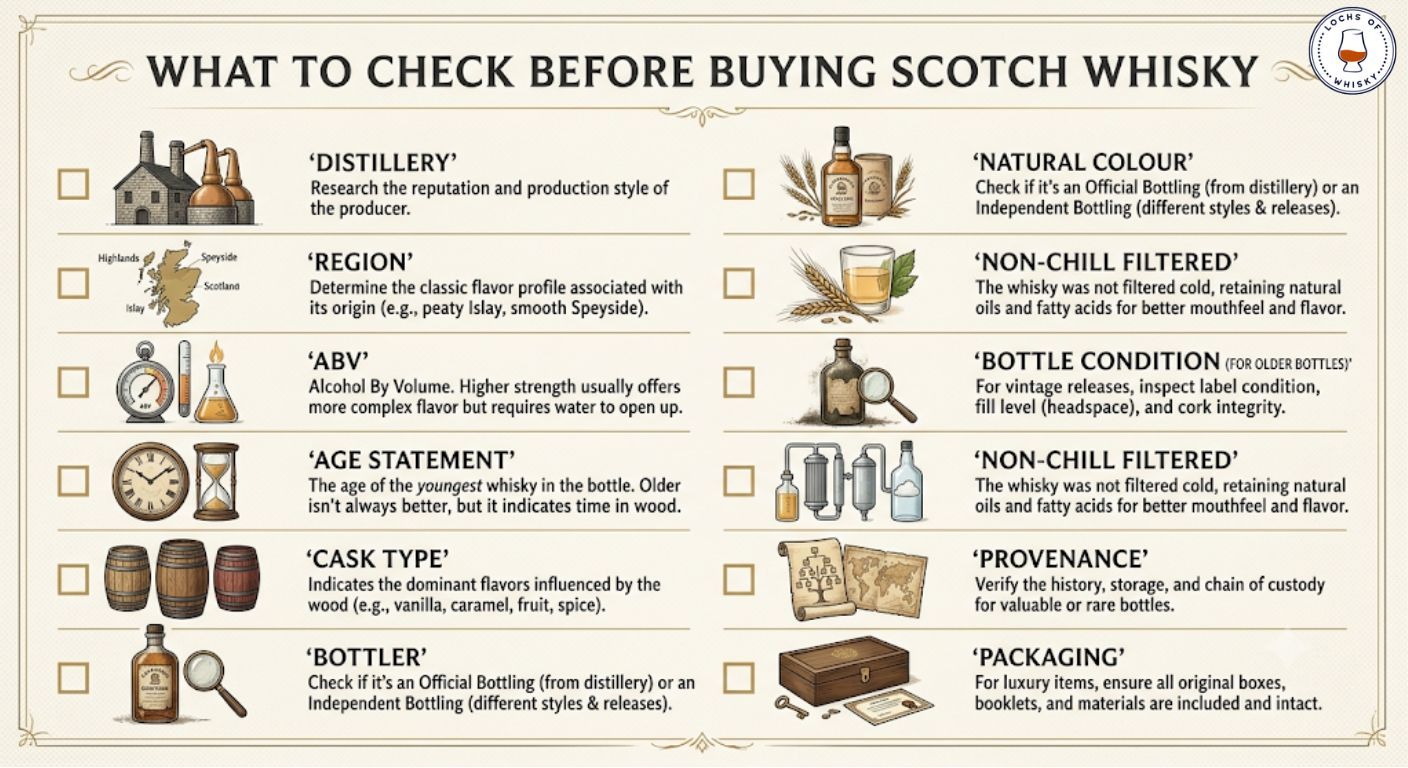
Three bottle details matter more than most statistics: ABV, age statement and cask type. They help explain both flavour and price.
- 40–43% ABV: usually approachable, lighter in texture and common in official bottlings.
- 46% ABV: often a useful quality marker, especially when non-chill-filtered.
- Cask strength: more intense, usually higher priced, and not always beginner-friendly.
- Age statement: useful, but not a guarantee of quality without cask context.
- Sherry cask: often richer, darker and more expensive than refill bourbon maturation.
- Bourbon cask: often cleaner, fruitier, vanilla-led and good for distillery character.
Older bottles and discontinued releases can add another layer of complexity. A closed distillery such as Glen Mhor has a different collector profile from an active major producer such as Glenmorangie or a modern independent-minded producer such as Nc'Nean.
Rare Whisky Prices And The 2026 Correction
Rare whisky prices have softened because supply, interest rates and buyer confidence have changed at the same time. More bottles have appeared at auction, capital is more expensive, and speculative demand has cooled. The result is not a collapse in whisky quality, but a correction in market expectations.
For collectors, the practical rule is to separate drinking value, collecting interest and resale speculation. A bottle can be excellent to drink while having limited secondary-market strength. Another bottle can be collectable because of distillery closure, age, condition or bottling history, even if it is not the best value for opening.
Silent distilleries, strong age statements, original packaging, credible storage history and higher-strength bottlings remain important. But the market is less forgiving of vague limited editions, weak provenance and inflated prices.
Decision Logic: How To Use Scotch Whisky Statistics When Buying
Statistics should support better decisions, not replace judgement. Use the numbers to understand market pressure, then use bottle details to choose well.
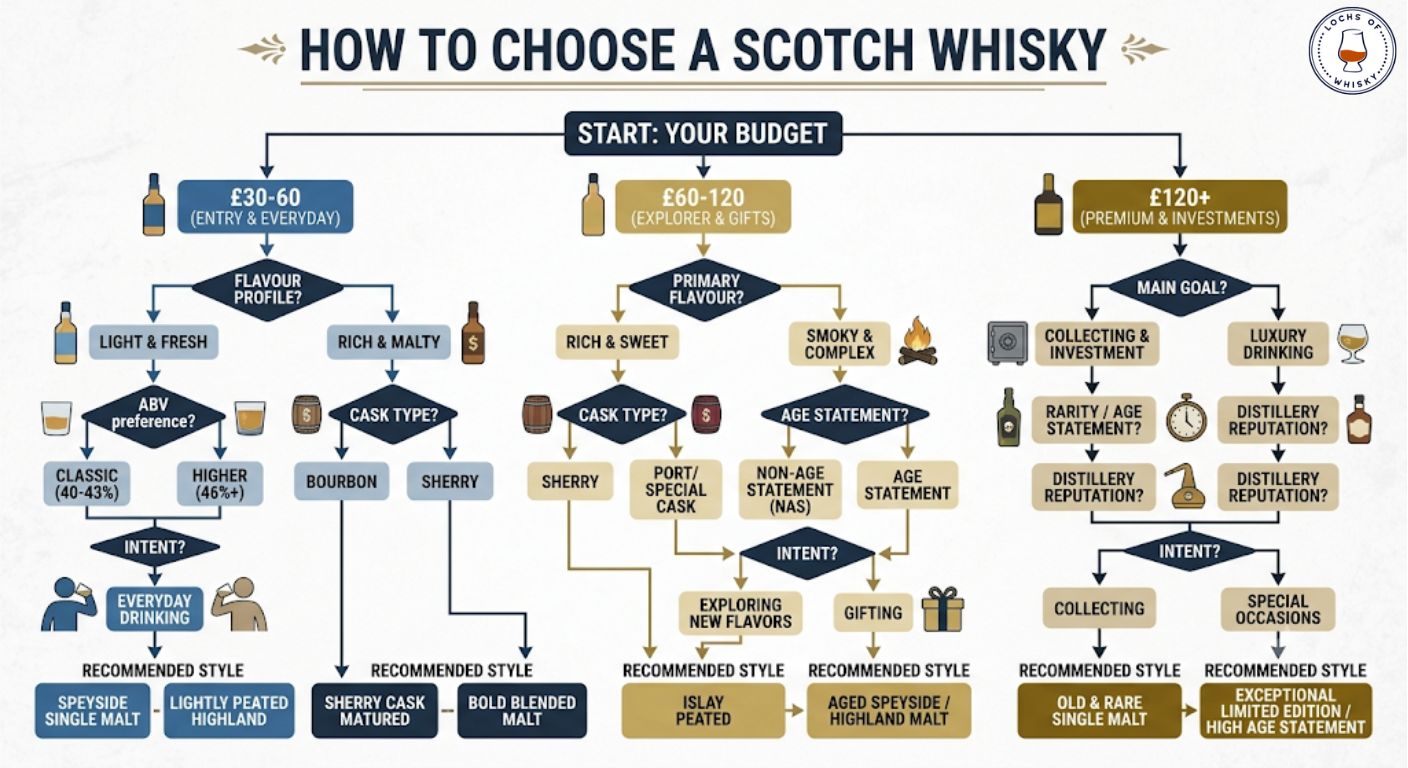
- If you are new to Scotch, start with a 40–46% ABV single malt from Speyside or the Highlands before moving into heavy peat or cask strength.
- If your budget is £30–60, avoid chasing age alone. Look for clear distillery identity, good cask information and a style you already enjoy.
- If your budget is £60–120, compare ABV, cask type and bottler credibility. This is where independent bottlings can be strong value.
- If you are buying above £100, check why the bottle costs more. Age, cask strength, limited outturn, closed distillery status or bottler reputation should explain the price.
- If you are buying to collect, prioritise condition, provenance, packaging and storage history over trend-driven scarcity claims.
- If you prefer lighter whisky, look for bourbon cask, refill cask or lower-peat styles.
- If you prefer richer whisky, look for sherry maturation, higher ABV and clear cask disclosure.
FAQ
How many active Scotch distilleries are in Scotland in 2026?
Scotland has more than 150 active Scotch whisky distilleries in 2026, depending on whether newer producers and recently commissioned sites are counted. The key point is that new-make spirit must mature in oak casks in Scotland for at least three years before it can legally be sold as Scotch whisky.
Why are rare whisky prices tumbling in 2026?
Rare whisky prices have softened because more stock has reached the secondary market while higher interest rates and weaker buyer confidence have reduced speculative demand. Strong bottles still attract attention, but vague limited editions, weak provenance and over-priced releases are under more scrutiny than they were during the market peak.
What is the UK-India trade deal whisky tariff reduction?
The UK-India trade deal reduces India’s Scotch whisky tariff from 150% to 75% initially, then towards 40% over ten years. This matters because India is already a major Scotch market by volume. The change should improve long-term access, although retail pricing will still depend on distribution, duties and local market structure.
How did US tariffs affect Scotch whisky exports?
US tariffs reduced Scotch whisky export performance in 2025, with the sharpest pressure seen after the tariff period began. The United States remains a major value market, but tariff disruption shows how quickly trade policy can affect bottle flows, producer confidence and category performance in key export regions.
What Scotch whisky statistics matter most to buyers?
The most useful buyer statistics are not headline export values. Check ABV, age statement, cask type, distillery, bottler, release size and market context. A 46% non-chill-filtered bottle with clear cask information often tells you more than a broad claim about premium growth or market value.
Is single malt always better than blended Scotch?
No. Single malt gives clearer distillery identity, while blended Scotch often offers consistency and accessibility. A good blended malt or blended Scotch can be better balanced than a weak single malt. The better choice depends on whether you value distillery character, price, consistency, age statement or cask influence.
What should collectors focus on in 2026?
Collectors should focus on provenance, condition, fill level, packaging, storage history, bottler credibility and whether the bottle has genuine distillery or release significance. Closed distilleries, older age statements and well-documented independent bottlings remain more defensible than generic limited editions with unclear reasons for scarcity.
Summary: The Key Scotch Whisky Rules For 2026
- Scotch remains economically important, but export performance is under pressure from tariffs and softer demand.
- Do not treat Scotch as one market: blended Scotch, single malt, grain whisky and independent bottlings behave differently.
- ABV matters: 46% and cask strength bottles often provide more texture, but they are not always easier to drink.
- Age statement helps, but cask quality and maturation history matter just as much.
- Sherry casks usually increase richness and price; bourbon casks often show cleaner distillery character.
- Rare whisky is more selective in 2026. Provenance and condition matter more than broad scarcity claims.
- For practical buying, match region, ABV, cask type and budget before reacting to market trends.
The common mistake is using industry statistics as buying advice on their own. Export value does not tell you whether a bottle suits your taste. Distillery context, cask detail and bottling information do. Once those details are clear, browsing the wider Scotch category becomes more useful and less speculative.

Related Products
-
-
-
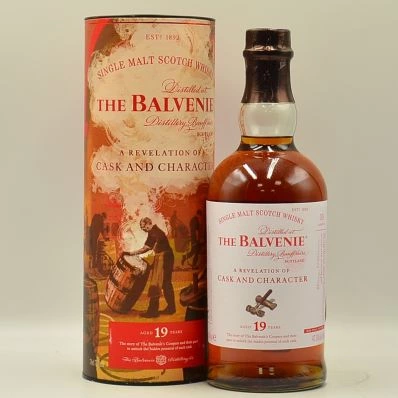 Balvenie 19 Year Old Whisky Revelation of Cask & CharacterSpecial Price £258.98 Regular Price £285.99 Inc VATSaving £27.01
Comments