
 Chat with us on WhatsApp


Your Guide To Irish Whiskey
Irish whiskey covers more styles than its reputation for light, easy-drinking blends might suggest. Buyers can choose between blended, grain, malt and single pot still whiskey, with important differences in grain recipe, still type, texture, cask influence and alcohol strength. Understanding those distinctions makes it easier to choose a bottle that matches your preferences rather than relying on brand recognition alone.
This Irish whiskey guide explains the legal definition, production methods, main styles, flavour profiles and label details that matter when choosing a bottle. It also clarifies common assumptions about triple distillation, smoothness, peat and age statements. Readers looking to compare available bottles can explore the wider Irish whiskey selection after identifying the style, strength and cask profile that suit them.
What Is Irish Whiskey?
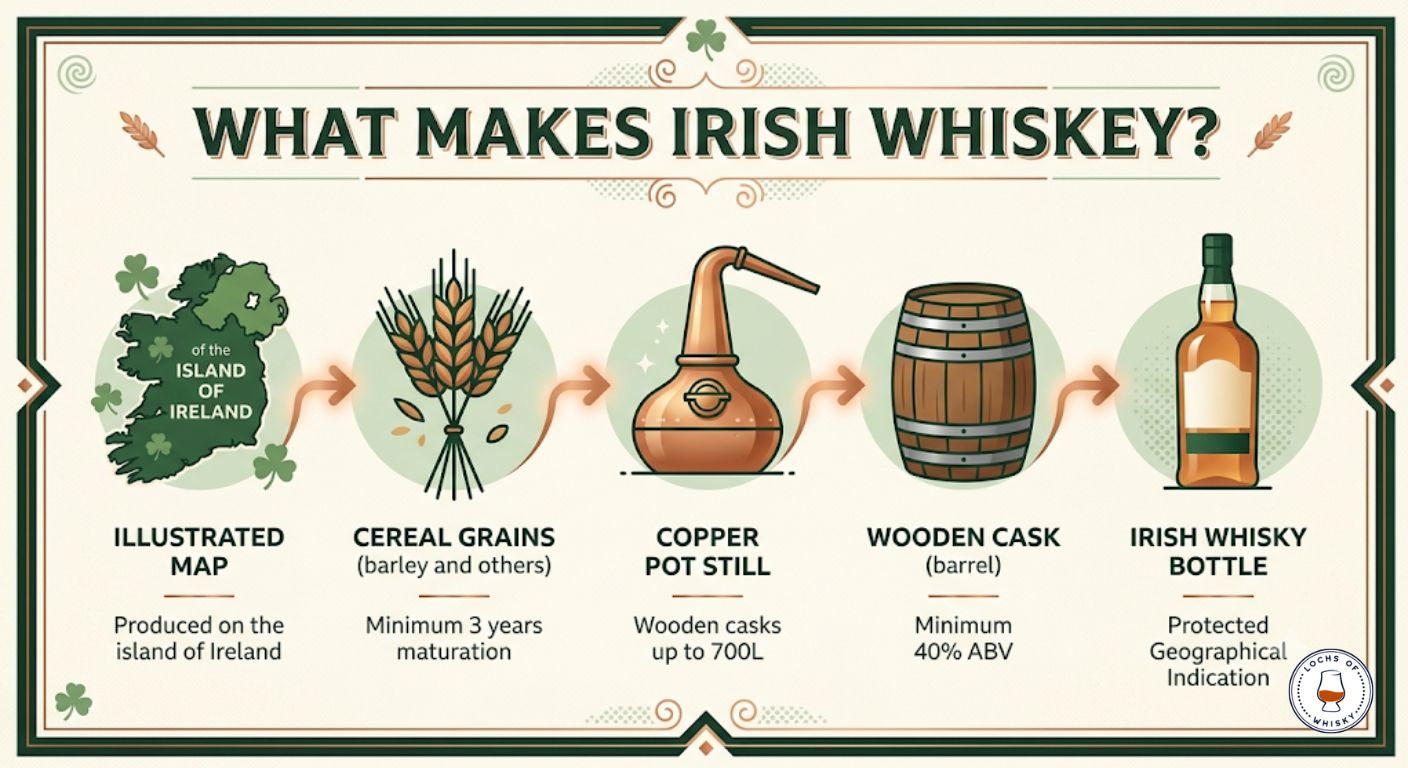
Irish whiskey is whisky produced on the island of Ireland in accordance with its protected geographical specification. It must be distilled from a fermented mash of cereals, matured for at least three years in wooden casks and bottled at a minimum strength of 40% alcohol by volume. Production may take place in either the Republic of Ireland or Northern Ireland.
The name is protected as a geographical indication. The official UK geographical indication register for Irish Whiskey confirms its protected status and identifies Ireland and Northern Ireland as its geographical origin.
The legal definition allows significant variety. Irish whiskey can be made from malted barley, unmalted barley, maize, wheat and other cereals. It may be distilled in traditional copper pot stills or continuous column stills, depending on the style being produced. It can also mature in several types of wooden cask rather than being restricted to one specific oak variety.
The legal requirements at a glance
- It must be produced on the island of Ireland.
- It must be made from a fermented mash of cereals.
- It must be distilled below 94.8% ABV so that the spirit retains characteristics derived from its ingredients.
- It must mature for at least three years in wooden casks with a capacity no greater than 700 litres.
- It must be bottled at no less than 40% ABV.
- Its colour, aroma and flavour must come from the raw materials, production process and maturation, although plain caramel colouring may be permitted for colour consistency.
Three years is the legal minimum, not a standard indication of quality. The condition and previous use of the cask can have more influence than the age number alone. A younger whiskey matured in active first-fill casks may show greater depth than an older whiskey held in less active wood.
A Brief History of Irish Whiskey
Distillation has a long history in Ireland, although early records do not describe a spirit identical to modern Irish whiskey. Commercial production became increasingly established from the seventeenth century onwards, with larger licensed distilleries developing during the eighteenth and nineteenth centuries.
Irish distillers became particularly associated with large copper pot stills and a mixed mash of malted and unmalted barley. The use of unmalted barley was partly shaped by taxation. A tax introduced on malt in the eighteenth century encouraged distillers to reduce the proportion of malted grain in their recipes. The resulting style developed a distinctive weight, spice and oily texture and later became known as Irish pot still whiskey.
During the nineteenth century, Irish whiskey held a strong international position. Dublin and Cork were important centres of production, and Irish distillers exported whiskey to Britain, the United States and other markets. The industry then contracted sharply through a combination of political disruption, trade restrictions, changing international demand, Prohibition in the United States and competition from blended Scotch whisky.
By the later twentieth century, production had consolidated into a small number of operating sites. The industry has since broadened again, with established producers expanding and new distilleries opening across the island. This revival has brought renewed attention to single pot still whiskey, Irish single malt, cask finishes and smaller-scale releases.
How Irish Whiskey Is Made
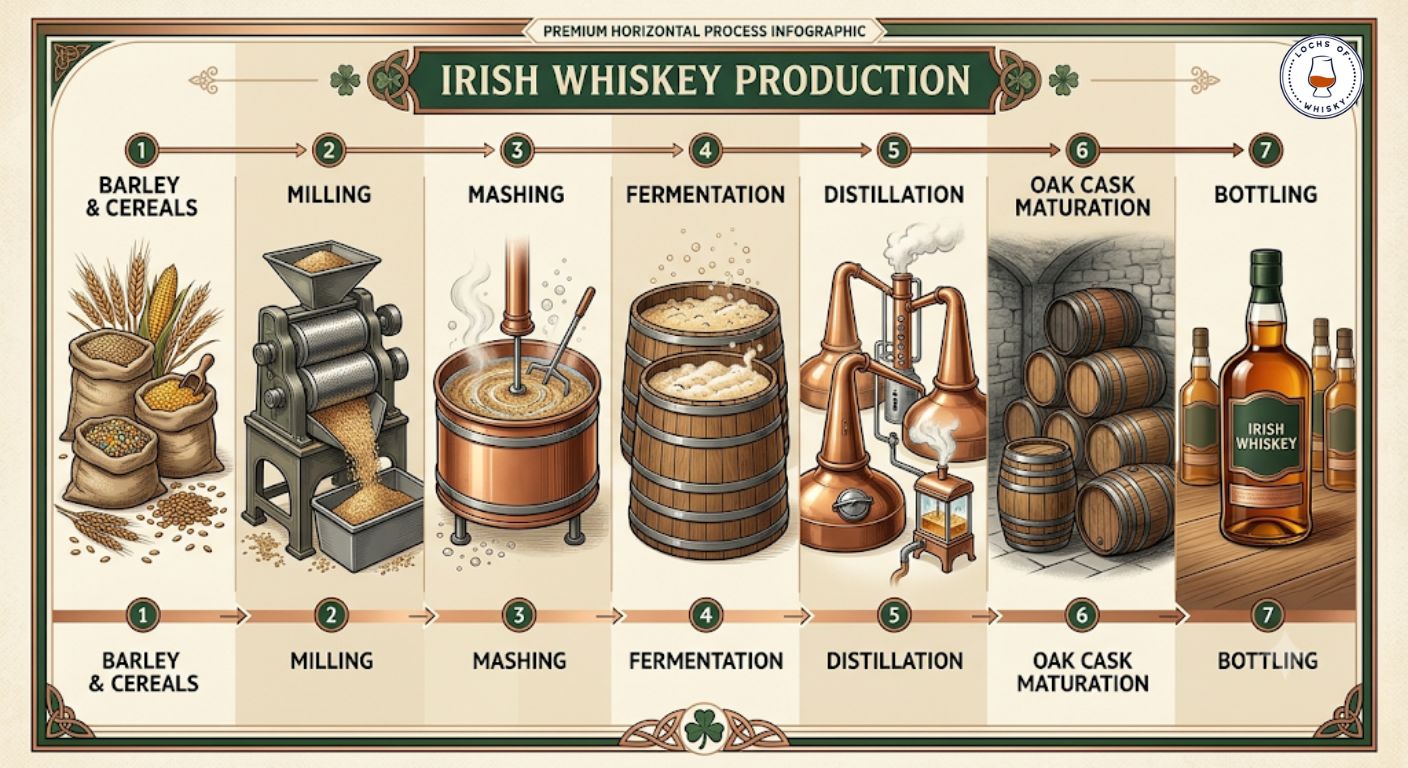
Irish whiskey begins with cereal grains that are milled, mixed with water and mashed to extract fermentable sugars. Yeast is then added to begin fermentation, producing a low-strength liquid often called wash. That wash is distilled before the resulting spirit is filled into casks for maturation.
The exact process depends on the whiskey style. Pot still and malt whiskeys are normally produced in copper pot stills, while grain whiskey is commonly made in continuous column stills. Blended whiskey is created by combining two or more qualifying whiskey styles after maturation.
Grain selection and mashing
The grain recipe, or mash bill, establishes the foundation of the whiskey. Malted barley tends to contribute cereal sweetness, fruit and biscuity notes. Unmalted barley can add spice, firmness and a creamy or oily texture. Maize and wheat are commonly used in grain whiskey to create a lighter and more neutral spirit suitable for blending.
Water and milled grain are combined during mashing. Enzymes from malted barley convert starches into fermentable sugars. The sugary liquid is separated from the spent grain and transferred to fermentation vessels.
Fermentation
Yeast converts the fermentable sugars into alcohol and creates flavour compounds that may remain identifiable after distillation. Fermentation length, yeast selection and the design of the fermentation vessels can all influence the fruitiness, weight and complexity of the resulting spirit.
Fermentation does not create a finished whiskey. It produces a low-alcohol liquid that must still be distilled and matured. However, many of the fruit and ester notes associated with Irish whiskey begin at this stage rather than developing solely in the cask.
Distillation
Irish whiskey is often associated with triple distillation, but triple distillation is not a universal legal requirement. Many well-known Irish whiskeys are distilled three times, while others are double distilled. Grain whiskey is normally produced through continuous distillation rather than a sequence of three pot-still runs.
Triple distillation generally produces a lighter, cleaner spirit because the liquid is refined through an additional distillation stage. This can reduce the concentration of some heavier compounds and raise the strength of the new make spirit. The final character still depends on the still shape, cut points, fermentation and cask maturation.
Maturation
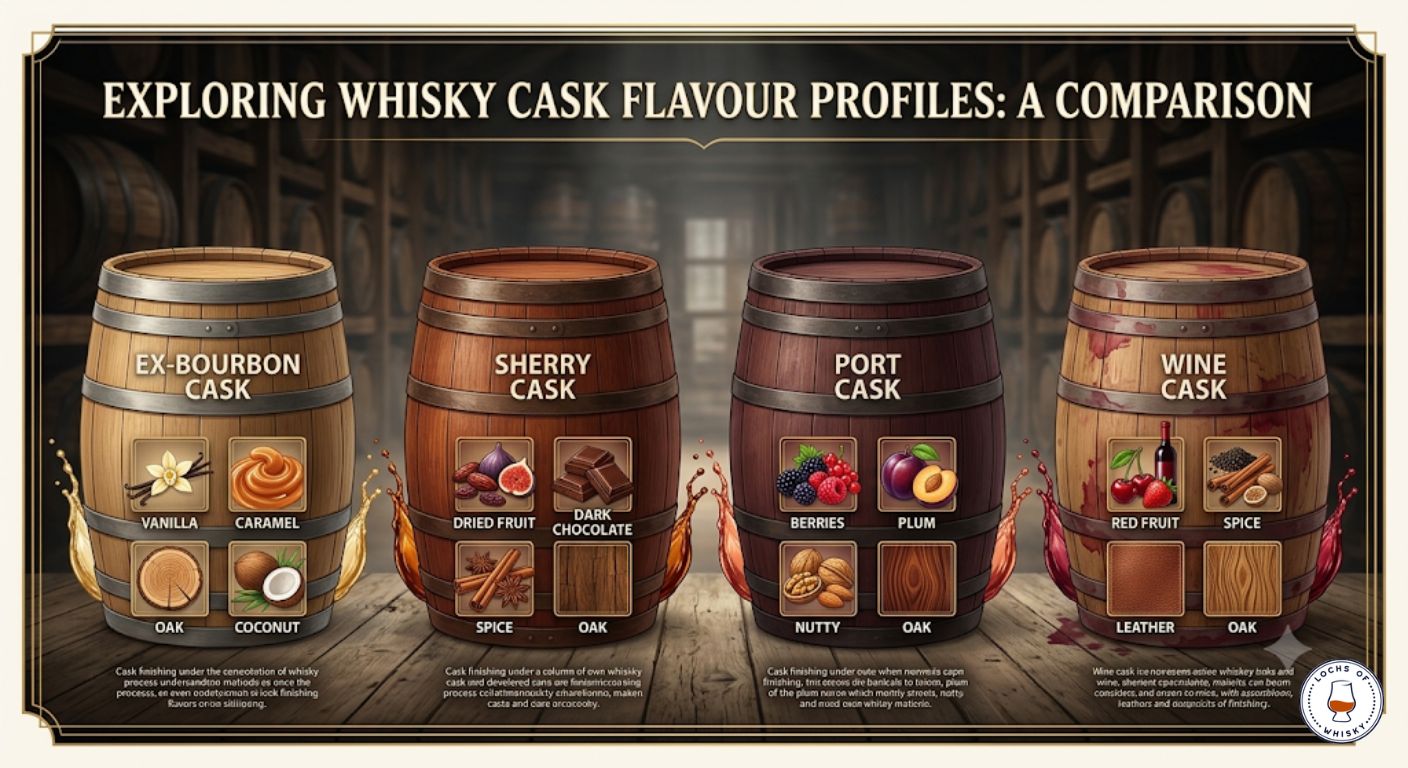
The new make spirit must mature for at least three years in wooden casks on the island of Ireland. Ex-bourbon barrels are widely used and commonly contribute vanilla, honey, coconut and light oak. Sherry-seasoned casks can add dried fruit, nuts and richer spice. Wine, port, rum and other seasoned casks may also be used for full maturation or finishing.
A finish means that whiskey has spent most of its maturation in one cask type before being transferred to another for a shorter period. It should not be confused with full-term maturation in the finishing cask. Our customers regularly ask whether a sherry-cask finish gives the same character as full sherry-cask maturation; it usually does not, because the length and intensity of the wood contact are different.
The Four Main Types of Irish Whiskey
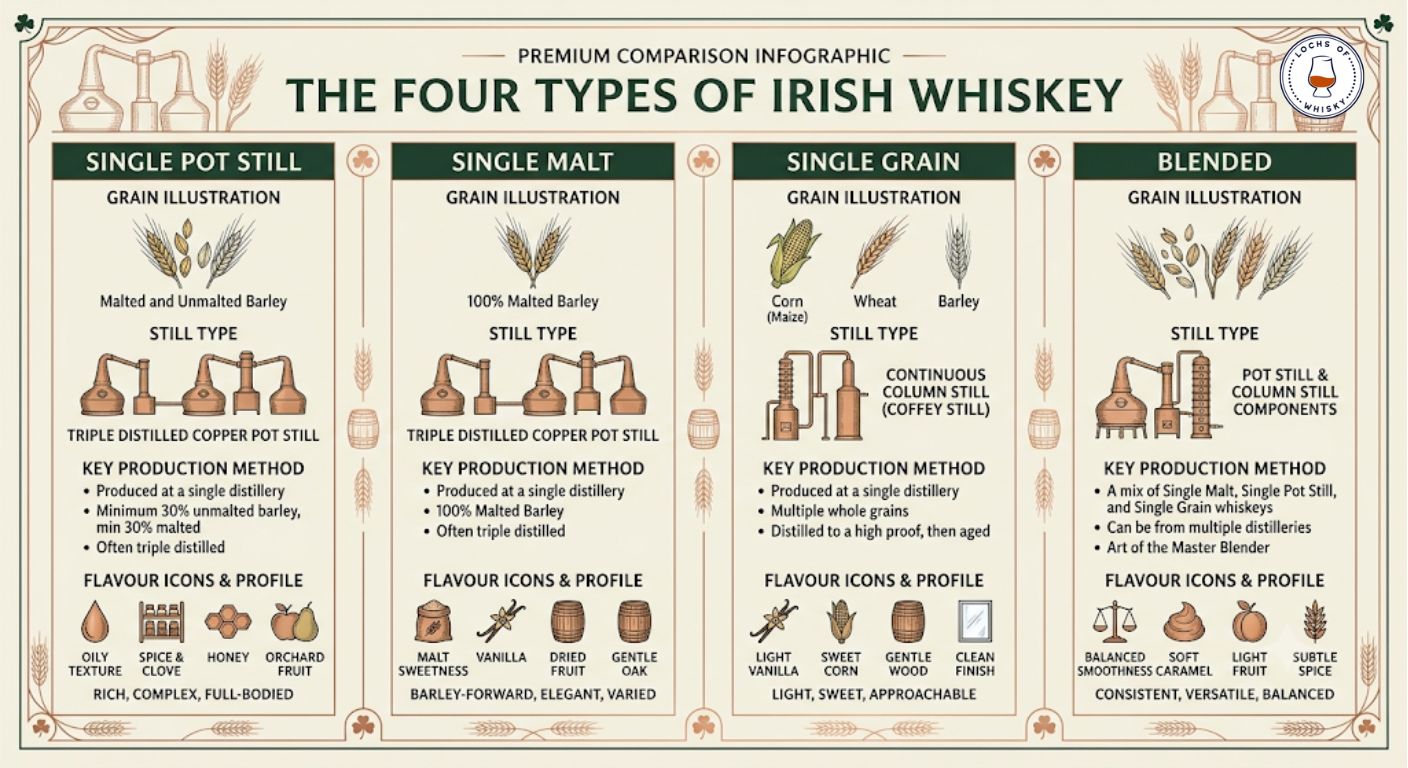
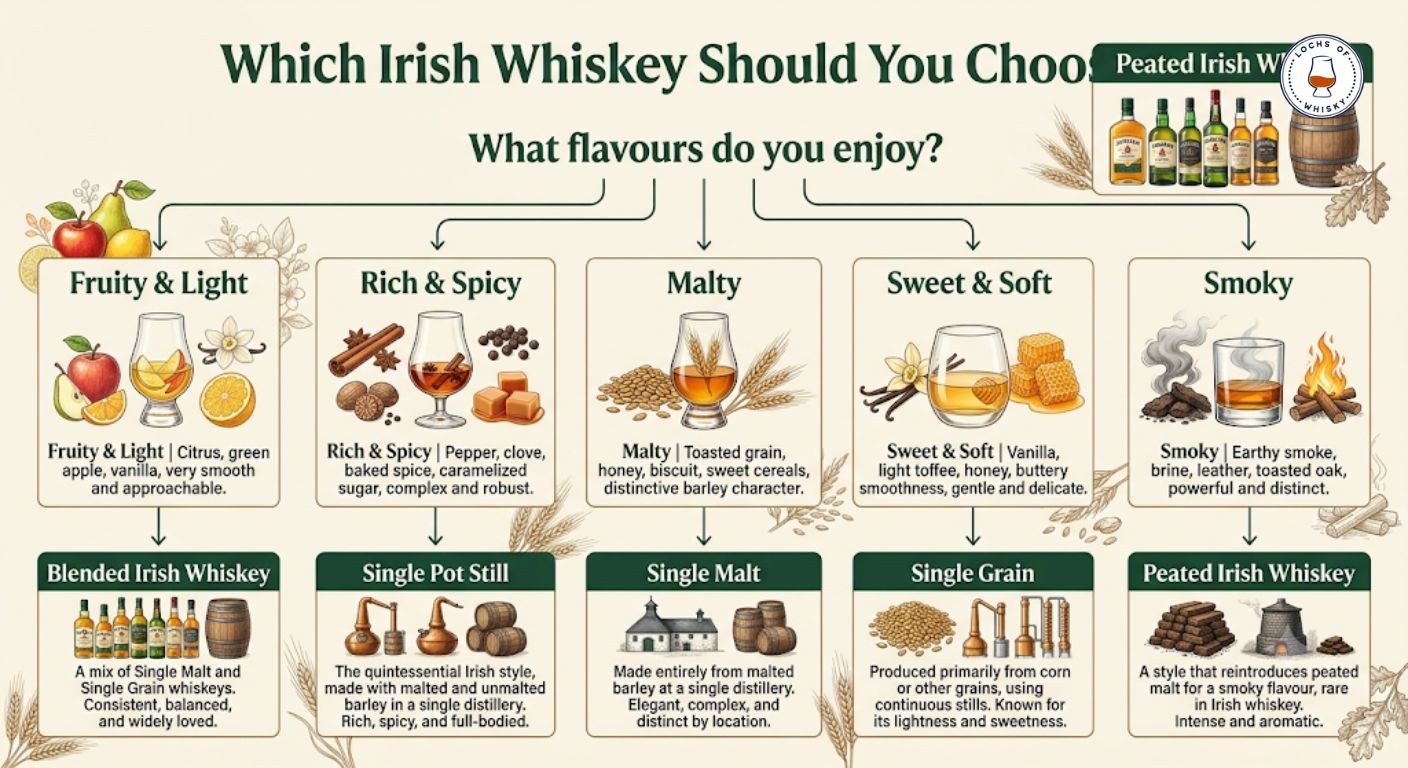
Irish whiskey is divided into four principal production styles: pot still, malt, grain and blended whiskey. The category shown on the label provides more useful information than broad descriptions such as “smooth” or “premium”. It tells the buyer which grains and distillation methods shaped the spirit.
Single Pot Still Irish Whiskey
Single pot still Irish whiskey is produced at one distillery from a mash containing both malted and unmalted barley and distilled in copper pot stills. Under the current specification, the mash must contain at least 30% malted barley and at least 30% unmalted barley, with other cereals permitted within defined limits.
The unmalted barley gives the spirit much of its distinctive identity. Typical characteristics include a creamy or oily texture, cooked fruit, cereal richness, pepper, baking spice and a slightly firm finish. Cask selection can move the style towards vanilla and orchard fruit or towards dried fruit, nuts and darker spice.
Single Malt Irish Whiskey
Single malt Irish whiskey is made entirely from malted barley at one distillery and distilled in pot stills. It follows the same broad grain principle as single malt made elsewhere, although the distillation regime, still design, maturation and production choices remain specific to each Irish producer.
Irish single malt commonly shows orchard fruit, honey, cereal, vanilla and citrus. Triple-distilled examples may feel light and polished, while double-distilled versions can carry more weight and malty structure. Sherry and wine casks can introduce dried fruit, chocolate, spice and tannin.
Single Grain Irish Whiskey
Single grain Irish whiskey is produced at one distillery and normally uses a mixture of cereals, including maize or wheat alongside malted barley. It is generally distilled in continuous column stills, creating a lighter spirit than pot-distilled malt or pot still whiskey.
Grain whiskey is an important component of many blends because it provides sweetness and a softer structure without overwhelming the pot-distilled elements. It can also be bottled on its own, where extended maturation or active casks may produce vanilla, caramel, coconut and polished oak notes.
Blended Irish Whiskey
Blended Irish whiskey combines at least two qualifying whiskey types. A blend might contain grain and malt whiskey, grain and pot still whiskey, or all three. Blending allows producers to balance lightness, fruit, spice, texture and cask influence across different batches.
Many widely available Irish whiskeys are blends. Jameson is closely associated with a combination of pot still and grain whiskey, designed to provide an approachable balance of fruit, spice and vanilla. Tullamore D.E.W. is known for blends that may combine grain, malt and pot still components.
Blended does not mean inferior. The quality depends on the maturity and character of the component whiskeys, the proportions used and the skill of the blending team. A well-constructed blend can offer greater consistency and balance than a poorly selected single-category release.
What Does Irish Whiskey Taste Like?
Irish whiskey is commonly associated with orchard fruit, honey, vanilla, cereal sweetness and a clean finish, but there is no single Irish flavour profile. Pot still whiskey may be creamy and spicy, malt whiskey can be fruity or cask-led, grain whiskey is often light and sweet, and peated releases can show clear smoke.
Several recurring flavour groups help buyers understand what to expect:
- Light and approachable: vanilla, honey, soft grain, citrus and fresh apple.
- Pot still character: creamy cereal, cooked fruit, pepper, clove and oily texture.
- Malt-led character: biscuit, pear, apple, malt, citrus and nuts.
- Ex-bourbon cask influence: vanilla, coconut, caramel and gentle oak.
- Sherry-cask influence: raisins, figs, walnuts, chocolate and baking spice.
- Peated character: smoke, earth, ash or medicinal notes, depending on the peat and production method.
Do not assume that a dark colour means an older or richer whiskey. Colour can be influenced by cask type, cask activity, previous cask contents and permitted caramel colouring. Age, colour and price should therefore be assessed alongside the whiskey style, ABV and maturation details.
Is Irish Whiskey Smoother Than Scotch?
Many Irish whiskeys taste lighter than many Scotch whiskies because triple distillation is common and peat is used less frequently. However, neither category has one fixed texture or flavour. Double-distilled Irish whiskey can be weighty, while triple-distilled Scotch can be light. Cask type, still design and bottling strength matter as much as national origin.
Triple distillation can remove a greater proportion of heavier compounds and produce a cleaner new make spirit. This often contributes to the soft, polished texture associated with mainstream Irish blends. Grain whiskey also lightens many blends, while the limited use of peat means smoke is less common than in some Scotch-producing regions.
Scotch whisky is often double distilled, although exceptions exist. It also includes a much wider public association with peated styles, particularly those from Islay. Irish whiskey is generally less smoky, but it is inaccurate to describe all Irish whiskey as smooth or all Scotch as powerful and peated.
Is All Irish Whiskey Triple Distilled?
No. Triple distillation is traditional and widely used in Irish whiskey, but it is not compulsory. Some Irish distilleries double distil part or all of their spirit, while grain whiskey is normally made in continuous stills. The number of distillations should therefore be treated as a production detail, not a legal definition of the category.
Triple distillation often gives producers a lighter and more refined spirit. Double distillation may retain more weight, cereal depth and heavier compounds. Neither method guarantees better whiskey. The quality of the raw materials, fermentation, cut points, casks and maturation management remain decisive.
Is All Irish Whiskey Unpeated?
No. Most modern Irish whiskey is made without peated malt, which explains the category’s reputation for fruit, cereal and sweetness rather than smoke. Peated Irish whiskey nevertheless exists. Connemara, produced at Cooley, is the best-established example and demonstrates that smoke is part of Irish whiskey’s production range.
Historically, fuel use and malting practices varied, and it is too simple to describe Irish whiskey as inherently smoke-free. For present-day buying, a bottle that does not state “peated” or “smoky” is unlikely to display strong peat character. Buyers who actively avoid smoke should still check the product description rather than relying only on country of origin.
How Casks Shape Irish Whiskey
Cask selection can change Irish whiskey more noticeably than the difference between double and triple distillation. Most Irish whiskey begins maturation in ex-bourbon barrels, but producers increasingly use sherry, port, wine, rum and fortified-wine casks to create different flavour directions.
Ex-bourbon casks
Ex-bourbon barrels are widely available and normally made from American oak. They often contribute vanilla, honey, caramel, coconut and light oak spice. They suit lighter blends and fruit-led malts because they can add sweetness without covering the distillery character.
Sherry-seasoned casks
Sherry-seasoned casks can contribute raisins, figs, walnuts, orange peel, chocolate and baking spice. First-fill casks usually exert greater influence than refill casks. A whiskey described as “sherry finished” may show less depth of sherry character than one matured in sherry casks for most or all of its age.
Wine, port and other finishes
Wine and fortified-wine casks may add red fruit, tannin, sweetness or drying spice. Rum casks can contribute molasses, tropical fruit and brown sugar. These effects depend on the previous liquid, cask preparation and finishing period. A named cask does not guarantee a particular flavour unless the underlying whiskey and maturation have been managed well.
How to Read an Irish Whiskey Label
An Irish whiskey label should help you identify the style, age, strength and producer. These details are more useful than broad marketing terms because they explain how the whiskey was made and how concentrated it is likely to taste.
- Style: Look for blended, grain, malt or pot still whiskey.
- Single: This means production at one distillery, not one cask.
- Age statement: The stated age refers to the youngest whiskey in the bottle.
- ABV: Standard bottlings are often 40–46% ABV. Higher-strength releases may require water and deliver more concentrated flavour.
- Cask information: Check whether the whiskey was fully matured or only finished in the named cask.
- Non-chill filtered: This indicates that the whiskey has not undergone aggressive chill filtration, although its absence does not automatically indicate poor quality.
- Single cask: The bottle comes from one individual cask and may differ substantially from standard batches.
Brand and distillery names can also differ. A brand may contain whiskey produced at a larger distillery rather than at a site bearing the brand name. Historic names such as Paddy therefore need to be understood within their wider production and ownership context.
How to Choose Irish Whiskey
Choose by production style first, then cask type, ABV and price. Buyers seeking a soft introduction should normally start with a blended whiskey at 40–43% ABV. Those wanting a distinctly Irish style should choose single pot still. Malt drinkers can look for single malt, while peat drinkers should seek an explicitly peated release.
If you want a light, accessible whiskey
Choose a blended Irish whiskey bottled around 40% ABV with a strong grain component and ex-bourbon cask maturation. Expect vanilla, honey, cereal sweetness and limited tannin. This style works neat, with ice, in a highball or in mixed drinks.
If you want something specifically Irish
Choose single pot still whiskey. The combination of malted and unmalted barley provides a creamy texture, cereal depth and peppery spice that separates it from single malt. Bottlings around 40–46% ABV provide a clear introduction without the intensity of cask strength.
If you normally drink single malt Scotch
Choose an Irish single malt and match the cask profile to your existing preferences. Ex-bourbon maturation suits drinkers who enjoy fruit, vanilla and clean malt. Sherry-cask maturation suits those who prefer dried fruit, nuts and richer spice.
If you prefer smoky whisky
Look for an explicitly peated Irish whiskey rather than assuming the category cannot provide smoke. Check the producer’s description because peat levels vary. Do not choose a standard blend expecting an Islay-style profile.
If you are buying within a set budget
- Below £30: Expect younger blends and entry-level bottlings. Prioritise clear style and ABV information over packaging.
- £30–£60: This range includes established blends, younger single malts and accessible pot still releases.
- £60–£100: Expect older age statements, more active casks, higher strengths or more specialised production styles.
- Above £100: Check whether the price reflects age, limited production, cask quality, discontinued status or packaging. Price alone does not establish quality.
If the whiskey is a gift
A blended Irish whiskey is the safer option when the recipient’s preferences are unknown. Choose single pot still for someone who already enjoys whisky and wants a style strongly associated with Ireland. Check whether the bottle includes a presentation box if appearance matters, and confirm the ABV before selecting a high-strength release.
How to Drink Irish Whiskey
Irish whiskey can be served neat, with water, over ice or in cocktails. There is no single correct method. The best approach depends on strength and style. Taste higher-strength whiskey neat first, then add small amounts of water. Use lighter blends for mixed drinks and assess older or cask-led releases before adding ice.
- Neat: Best for understanding the whiskey’s natural aroma, texture and finish.
- With water: Add a few drops at a time to higher-strength whiskey. Water can reduce alcohol heat and reveal additional aromas.
- Over ice: Cooling reduces alcohol intensity but can also suppress aroma and texture.
- In a highball: A lighter blend with soda water creates a clean, refreshing drink without masking the whiskey completely.
- In cocktails: Blended Irish whiskey works well in Irish coffee, whiskey sours and spirit-forward classics. Pot still whiskey adds greater weight and spice but may be unnecessary in recipes dominated by strong mixers.
Common Irish Whiskey Myths
Irish whiskey is only suitable for beginners
Irish whiskey includes accessible blends, but it also includes age-stated single malts, single pot still releases, single casks, cask-strength bottlings and complex cask programmes. Its softer entry-level expressions make the category approachable, but they do not define its full production or flavour range.
All Irish whiskey tastes the same
Pot still, malt, grain and blended whiskeys differ in grain composition, still type and texture. Distilleries also use different fermentation methods, still shapes and casks. A light grain-led blend and a cask-strength sherry-matured pot still whiskey may share little beyond their geographical origin.
Older Irish whiskey is always better
Age records time in cask, not quality. Older whiskey may show greater oak influence and integration, but it can also become dry or over-oaked. Younger spirit matured in active, well-selected casks may provide more balance and distillery character than an older but less carefully managed release.
Irish whiskey must be triple distilled
Triple distillation is common, not compulsory. Double-distilled and continuously distilled Irish whiskeys are also produced. The label or producer’s technical information should be checked when the distillation regime matters to your decision.
Frequently Asked Questions
What is the difference between single pot still and single malt?
Single pot still whiskey uses both malted and unmalted barley and must be produced at one Irish distillery in copper pot stills. Single malt uses only malted barley and is also made at one distillery. Pot still whiskey is usually creamier and spicier, while single malt often shows cleaner cereal, fruit and malt notes.
Why does Irish whiskey use unmalted barley?
Unmalted barley became prominent partly because eighteenth-century taxes made malted barley more expensive for distillers. Its use continued because it created a distinctive spirit. In modern single pot still whiskey, unmalted barley contributes cereal firmness, peppery spice and the creamy or oily texture associated with the style.
What is a good Irish whiskey style for a beginner?
A blended Irish whiskey at approximately 40% ABV is usually the most accessible starting point. Grain whiskey softens the blend, while pot still or malt components add fruit and spice. Buyers who already enjoy whisky but want a specifically Irish character should consider a single pot still bottling around 40–46% ABV.
Can Irish whiskey be smoky?
Yes. Most Irish whiskey is unpeated, but peat is not prohibited. Peated examples can provide smoke, earth and ash while retaining Irish fruit and cereal characteristics. Choose a bottle that specifically states it is peated, because standard Irish blends and pot still releases are usually made without strong smoke.
Does Irish whiskey have to mature in oak?
Irish whiskey must mature for at least three years in wooden casks no larger than 700 litres. The specification does not restrict maturation solely to oak, although oak remains dominant because of its strength, availability and proven effect on spirit. Ex-bourbon and sherry-seasoned oak casks are the most familiar choices.
What does an Irish whiskey age statement mean?
The age statement identifies the youngest whiskey in the bottle. A 12-year-old blend may contain older components, but none may be younger than 12 years. Age should be considered alongside cask type, ABV and whiskey style because a higher number does not automatically mean greater flavour or better balance.
Is 40% ABV enough for Irish whiskey?
Forty per cent is the legal minimum and is suitable for lighter blends intended to be approachable. Bottlings at 43–46% ABV often provide greater texture and flavour concentration. Cask-strength releases can exceed 50% ABV and may need water. The appropriate strength depends on the whiskey style and the drinker’s tolerance.
Should Irish whiskey be served with ice?
Ice is suitable when the aim is to reduce alcohol intensity and create a colder, lighter drink. It can also mute aroma and texture, particularly in older or lower-strength whiskey. Taste the whiskey neat first, then decide whether water or ice improves it. There is no requirement to drink it one particular way.
Irish Whiskey Guide: Key Rules and Decision Shortcuts
- Irish whiskey must be produced on the island of Ireland.
- It must mature for at least three years in wooden casks.
- The minimum bottling strength is 40% ABV.
- Triple distillation is common but not compulsory.
- Single pot still uses both malted and unmalted barley.
- Single malt uses only malted barley at one distillery.
- Grain whiskey is lighter and is commonly used in blends.
- Blended whiskey combines at least two qualifying whiskey styles.
- Most Irish whiskey is unpeated, but smoky examples exist.
- Ex-bourbon casks usually provide vanilla and honey; sherry casks usually add dried fruit and spice.
- An age statement refers to the youngest whiskey in the bottle.
- A cask finish is not the same as full maturation in that cask type.
Common buying mistakes
- Assuming every Irish whiskey is triple distilled.
- Treating “single” as meaning one cask rather than one distillery.
- Choosing by age alone without checking the cask or ABV.
- Assuming dark colour proves age or quality.
- Buying cask-strength whiskey without checking the alcohol level.
- Expecting all Irish whiskey to be completely smoke-free.
- Confusing single pot still with single malt.
Simple decision shortcuts
- If you want lightness and versatility, choose a blend around 40% ABV.
- If you want Ireland’s most distinctive traditional style, choose single pot still.
- If you enjoy fruit-led malt whisky, choose an ex-bourbon-matured Irish single malt.
- If you prefer dried fruit and spice, look for sherry-cask maturation.
- If you want smoke, choose a bottle explicitly labelled as peated.
- If you are unsure about a high-strength bottle, choose 43–46% ABV rather than cask strength.
Irish whiskey sits within a wider and increasingly varied landscape of international production. Once you understand how its pot still, malt, grain and blended styles differ, the wider world whisky category provides useful context for comparing Irish production with whiskies made elsewhere.


Comments