
 Chat with us on WhatsApp


How Is Bourbon Made? From Grain To Glass
Bourbon is made by combining a corn-led grain recipe with water and yeast, fermenting the resulting mash, distilling it and maturing the spirit in new charred oak containers. Each stage affects the final whiskey, but the mash bill, fermentation conditions, distillation strength and barrel maturation have the greatest influence on flavour.
The process is tightly controlled by American law, yet distilleries still have considerable freedom to create different styles. Understanding those production choices makes it easier to compare bottles across our Bourbon whiskey range and recognise why one expression may taste sweet and rounded while another is spicy, powerful or heavily influenced by oak.
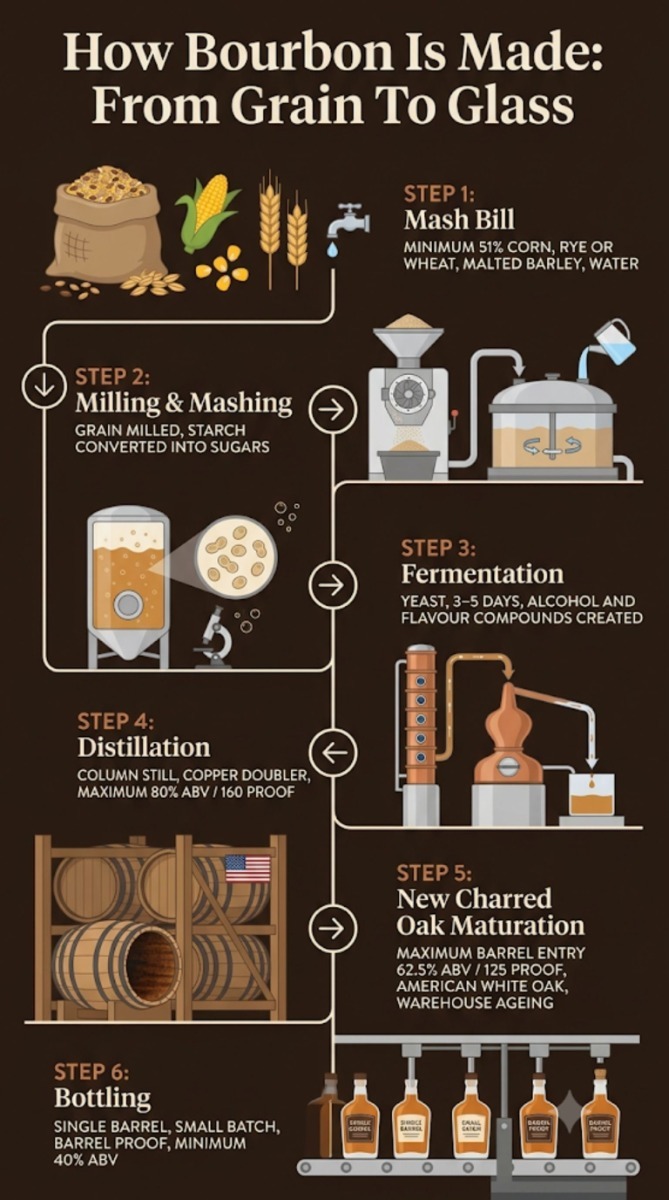
Bourbon Production In Six Steps
- Select and mill the grains.
- Cook the grains with water to create the mash.
- Add yeast and ferment the mash into distiller’s beer.
- Distil the liquid to concentrate the alcohol and flavour compounds.
- Fill new charred oak containers and mature the spirit.
- Empty, blend, adjust and bottle the finished Bourbon.
This basic sequence is used across the industry. The important differences lie in the precise grain proportions, yeast strain, fermentation time, still design, barrel entry proof, char level and length of maturation.
1. Selecting The Mash Bill
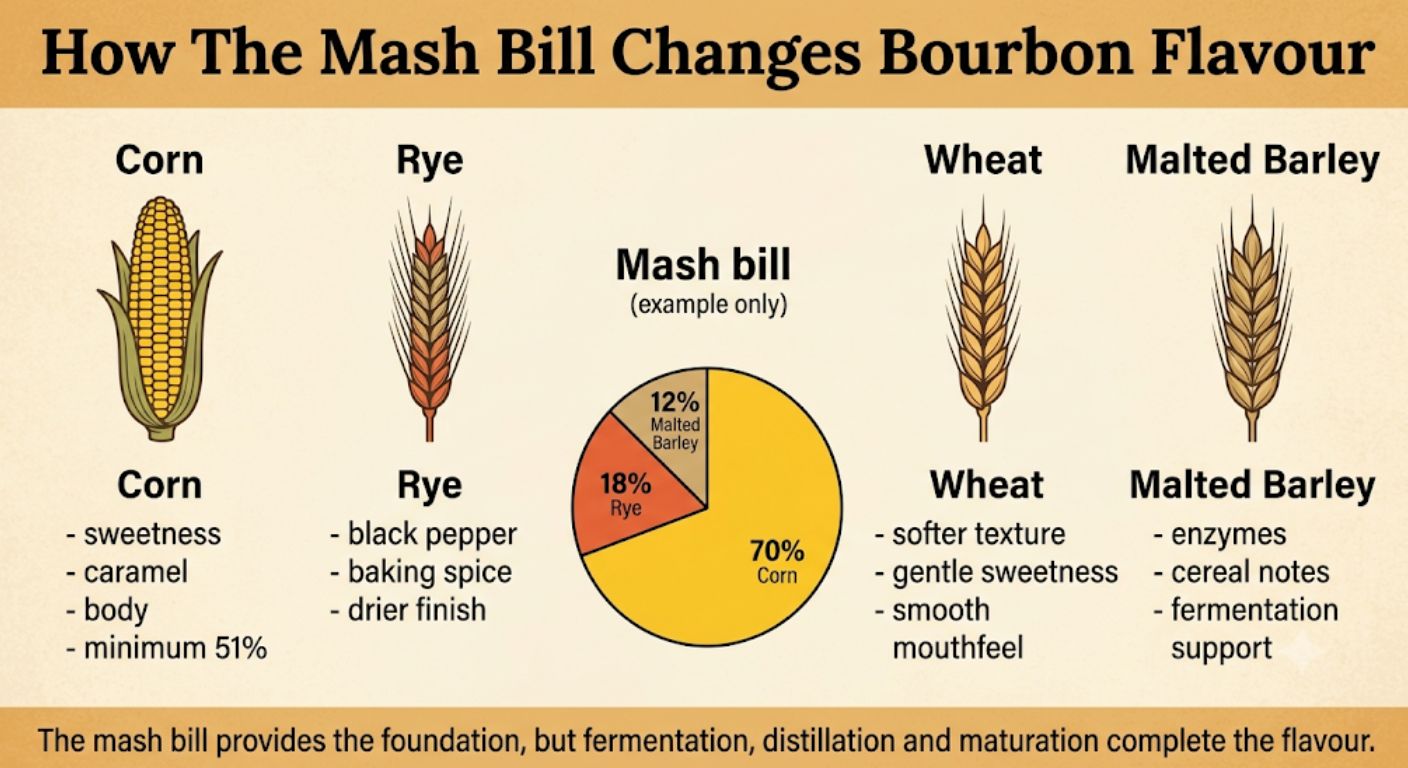
The mash bill is the distillery’s grain recipe. Bourbon must be produced from a fermented mash containing at least 51% corn. Many established recipes use a larger proportion, often around 65–80%, with rye, wheat and malted barley making up the remainder.
- Corn provides fermentable starch and usually contributes sweetness, body and notes associated with caramel or cooked grain.
- Rye can add pepper, baking spice, herbal notes and a drier finish.
- Wheat tends to create a softer, rounder profile with less obvious spice.
- Malted barley supplies enzymes that help convert starch into fermentable sugars, although commercial enzymes may also be used.
The mash bill does not determine flavour on its own, but it establishes the starting structure. A high-rye recipe can still taste sweet after years in active oak, while a wheated recipe can become dry and tannic if matured for too long.
Wheated producers such as W.L. Weller are useful reference points for understanding how wheat can soften the grain profile. Traditional rye-influenced examples from Old Forester show how a more assertive secondary grain can contribute spice and structure.
2. Milling And Mashing
The selected grains are milled to expose their starches and then combined with water in a cooker. The grains are normally added at different stages because corn, rye and malted barley respond differently to heat.
Corn requires relatively high temperatures to gelatinise its starch. The mash is then cooled before malted barley or enzymes are introduced. These enzymes break the starch into sugars that yeast can consume during fermentation.
Water composition also matters. Kentucky’s limestone-rich water is often discussed because limestone can filter out iron while contributing calcium and magnesium. Iron can disrupt fermentation and create undesirable flavours, while calcium can support yeast performance. Limestone water is useful, but it is not a legal requirement and Bourbon can be produced elsewhere in the United States.
What Is Sour Mash?
Sour mash is a production method in which some acidic liquid left after a previous distillation is added to a new mash. This liquid, commonly called backset, helps control pH and creates more stable conditions for yeast. It supports consistency and reduces the risk of unwanted bacterial activity; it does not mean the finished Bourbon tastes sour.
Sweet mash production starts without backset and relies on carefully cleaned equipment and close control of each fermentation. It may allow different fermentation characteristics, but it requires greater attention to sanitation and pH stability.
3. Fermentation
Once the cooked mash has cooled, yeast is added. The yeast consumes fermentable sugars and produces alcohol, carbon dioxide and a wide range of flavour compounds known as congeners.
Fermentation commonly lasts around three to five days, although the exact period varies. At the end of this stage, the liquid is often called distiller’s beer or wash. It normally sits at roughly 7–10% ABV and contains grain solids, yeast and fermentation-derived aromas.
Yeast selection is one of the less visible differences between distilleries. Proprietary strains may be maintained for decades because they help produce a recognisable balance of fruit, spice and cereal character from one batch to the next.
From years of discussing bottles with our customers, we find that many people expect the barrel to create every flavour, but much of Bourbon’s fruit and spice character is already being formed during fermentation.
4. Distillation
Distillation heats the fermented liquid so that alcohol and volatile flavour compounds evaporate and can be condensed into a more concentrated spirit. Under the official US standards of identity for whisky, Bourbon cannot be distilled above 160 proof, equivalent to 80% ABV.
This ceiling prevents Bourbon from being distilled to near-neutral strength. Some grain-derived and fermentation-derived character must remain in the spirit.
Column Still And Doubler Production
Many large Bourbon distilleries use a continuous column still for the first distillation. This method is efficient and can maintain a consistent spirit character across substantial production volumes.
The resulting spirit may then pass through a doubler or thumper for a second distillation. These are often copper vessels that refine the spirit further before it enters the barrel.
Pot Still Production
Some smaller producers use pot stills. Pot distillation works in batches and gives the distiller direct control over the separation of the heads, heart and tails. It can produce a heavier or more textured new make spirit, although still shape, heating method and cut points matter more than the still category alone.
Copper contact is important in either system. Copper reacts with sulphur compounds created during fermentation, helping to produce a cleaner and more stable spirit.
5. Filling New Charred Oak
After distillation, the spirit may be reduced with water before entering the barrel. Bourbon cannot enter oak above 125 proof, or 62.5% ABV. Producers may use a lower entry proof when they want to change the balance of extraction or preserve a particular spirit character.
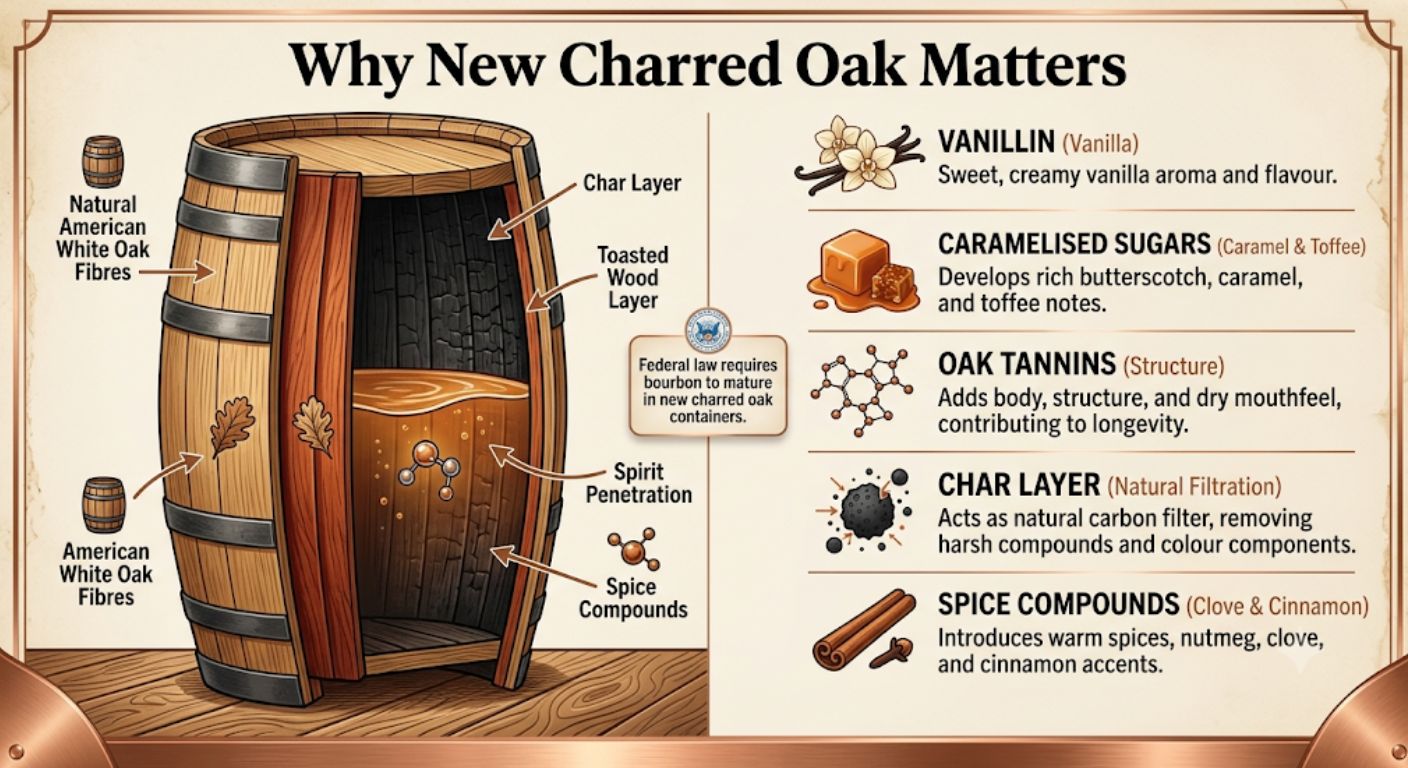
The container must be new and charred, although the regulations do not require a specific species of oak or traditional barrel volume. In practice, American white oak barrels are widely used because they are readily available, structurally suitable and rich in flavour-producing compounds.
Why Is Bourbon Aged In New Charred Oak?
New oak provides a strong supply of wood compounds because it has not previously matured another spirit. Toasting and charring break down parts of the oak, making compounds associated with vanilla, caramel, spice and toasted wood easier for the spirit to extract. The charred surface can also help filter some harsher compounds during maturation.
Common char levels run from a lighter No. 1 char to the deeply cracked No. 4 “alligator” char. A heavier char does not automatically create better Bourbon. Barrel seasoning, warehouse position, maturation time and the character of the new make spirit all affect the result.
Historic names such as Old Crow also show how long-established production identities can remain relevant even when ownership, facilities and methods change over time.
6. Maturation In The Rickhouse
Filled barrels are stored in warehouses commonly known as rickhouses. Seasonal temperature changes cause the spirit to move into and out of the oak. Warmer periods increase interaction with the wood, while cooler periods change the rate and balance of extraction.
Warehouse position can create considerable variation. Barrels stored on hotter upper floors may mature more quickly and lose more liquid through evaporation. Lower positions are generally cooler and may develop more gradually.
Bourbon has no universal minimum maturation period simply to carry the Bourbon designation, but it must spend time in new charred oak. To be labelled straight Bourbon, it must be matured for at least two years. Straight Bourbon aged for less than four years must display an age statement.
Longer maturation is not automatically better. Extended exposure can deepen vanilla, oak and spice, but it can also create excessive dryness or tannin. The distillery must decide when the spirit, wood and alcohol are properly balanced.
7. Emptying, Blending And Bottling
When the barrels are ready, they are emptied. A standard release may combine many barrels to maintain a consistent profile. A small-batch release may use a more limited selection, while a single-barrel bottling comes from one barrel and naturally shows greater variation.
The whiskey may be filtered to remove char particles and other sediment. Some Bourbons are chill filtered to prevent cloudiness at lower temperatures, while others are bottled without chill filtration to retain more oils and texture.
Water is commonly added to reduce the whiskey to its intended bottling strength. Bourbon must be bottled at no less than 80 proof, or 40% ABV. Barrel-proof and cask-strength releases are bottled closer to the strength at which they leave the wood, although those terms do not guarantee one fixed ABV.
How Production Choices Affect The Bourbon You Buy
The production process provides useful clues when comparing bottles:
- Choose a wheated recipe when you prefer softer spice, rounded sweetness and a gentler grain profile.
- Choose a high-rye recipe when you want pepper, herbal notes and a firmer finish.
- Check the ABV when you are sensitive to alcohol heat. A 50% ABV or barrel-strength Bourbon will usually feel more concentrated than one bottled at 40–46%.
- Treat age as context, not a quality score. Older Bourbon can offer deeper oak influence, but younger spirit may retain more fruit and grain character.
- Consider filtration and batch format when texture or consistency matters. Single-barrel releases vary more, while larger batches are generally designed to remain consistent.
These details make most sense when considered together. Mash bill alone cannot predict the final taste, just as a high age statement cannot guarantee balance.
-
 Arran Cask Finishes Port Scotch WhiskySpecial Price £87.98 Regular Price £97.99 Inc VATSaving £10.01
 -
-
-
-
-
-
-
 Chivas Regal 12 Year Old Scotch Whisky 75 Proof 1970sSpecial Price £47.98 Regular Price £59.99 Inc VATSaving £12.01
 -

From Grain To Glass
Bourbon begins with a corn-led mash, but its identity is built through the interaction of fermentation, controlled distillation and maturation in new charred oak. The legal framework establishes the boundaries; decisions made inside those boundaries create the differences between producers and bottles.
Once those stages are understood, the wider American whiskey category becomes easier to navigate, particularly when comparing grain recipes, proofs, maturation periods and distillery styles.

Comments