
 Chat with us on WhatsApp

Midleton Very Rare: The Story Behind Ireland's Premium Whiskey
Midleton Very Rare whiskey sits in a specific part of the Irish whiskey market: annual-release, premium blended Irish whiskey with a strong collector following. The decision problem is simple. Buyers need to understand whether the bottle matters because of flavour, provenance, release history, collectibility, or all three.
This guide explains what Midleton Very Rare is, how it connects to Midleton Distillery, why single pot still and grain whiskey matter in the blend, and what to check before buying an older or limited bottle. It also places the range within the wider Irish whiskey category, without treating every release as automatically equal.
If you are comparing premium Irish whiskey, older annual editions, or collectible bottles, this guide should help you judge the bottle more clearly. For wider browsing, Lochs of Whisky keeps premium and historic examples within Rare World Whisky.
What Is Midleton Very Rare?
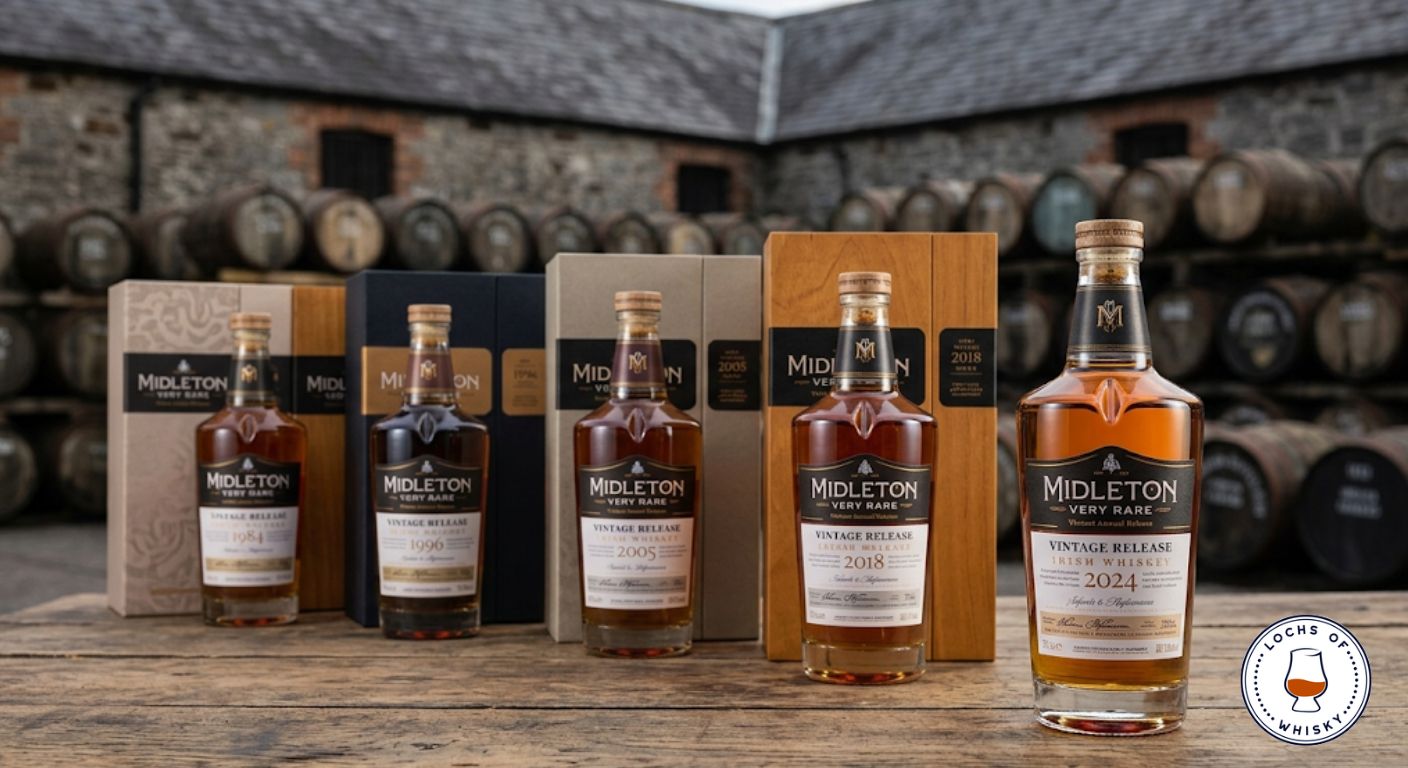
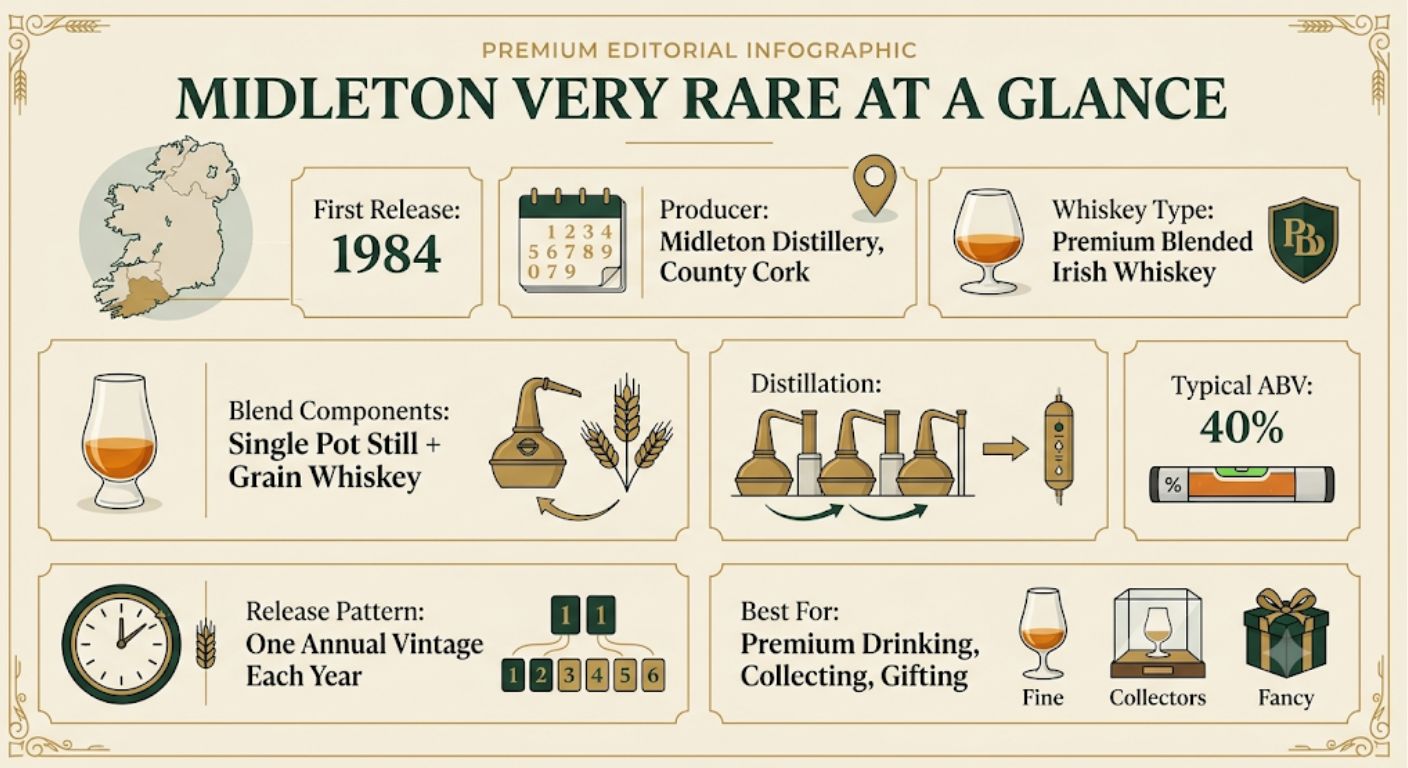
Midleton Very Rare is an annual-release premium Irish whiskey produced at Midleton Distillery in County Cork. It is a blended Irish whiskey made from selected pot still and grain whiskeys, usually matured in carefully chosen oak casks and bottled at 40% ABV.
The range began in 1984 under Master Distiller Barry Crockett. Since then, each annual vintage has carried the signature of the Master Distiller responsible for the selection. That makes the series different from a standard permanent-release bottle: each edition is tied to a specific year, production judgement, and cask selection.
The word “rare” should be understood carefully. Midleton Very Rare is not a single-cask release, and it is not rare in the same way as a silent distillery bottling. Its rarity comes from controlled annual production, collector demand, vintage continuity, and the fact that older editions naturally become harder to find in good condition.
Where Midleton Very Rare Is Made
Midleton Very Rare is produced at Midleton Distillery in County Cork, one of the most important production sites in Irish whiskey. The modern New Midleton Distillery opened in 1975, replacing older production arrangements and becoming the central home for several major Irish whiskey styles and brands.
The wider Midleton site has deeper historic roots. The Old Midleton Distillery dates to the 19th century and is associated with one of the largest pot stills ever built, a 31,618-gallon still installed in 1825. That scale matters because it shows how industrial Irish whiskey production had become long before the modern revival.
Midleton’s significance is not just size. It is also technical range. The distillery produces pot still whiskey, grain whiskey and blended whiskey components, allowing releases such as Midleton Very Rare to draw on different spirit types rather than one narrow production style.
How Midleton Very Rare Is Made
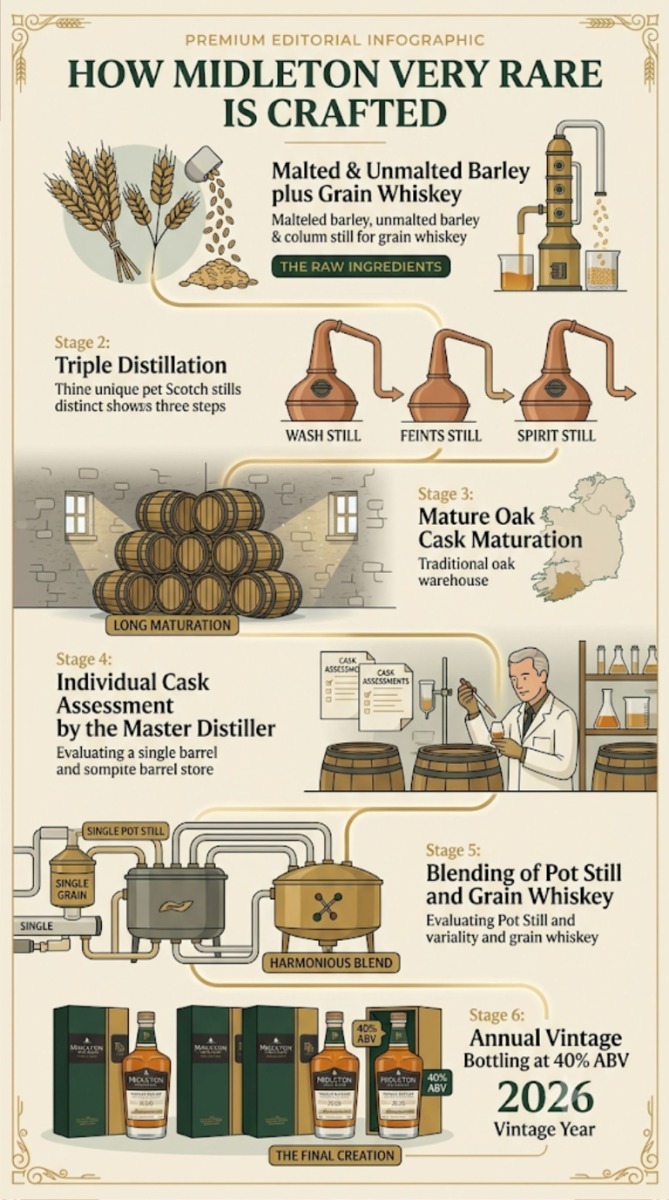
Midleton Very Rare is built from a combination of single pot still and grain Irish whiskeys. The final recipe changes by release, but the core idea remains consistent: selected mature casks are blended to produce a polished, balanced, premium Irish whiskey.
Single pot still whiskey brings weight, spice, texture and depth. Grain whiskey brings softness, sweetness and lift. The skill is not simply choosing old casks. It is choosing casks that work together without losing the recognisable Midleton Very Rare profile.
Irish whiskey must meet defined production rules. The official Irish Whiskey Technical File states that Irish whiskey must be produced on the island of Ireland and bottled at a minimum alcoholic strength of 40% ABV. It also recognises pot still, malt and grain Irish whiskey categories within the wider protected indication: Irish Whiskey Technical File.
Single Pot Still And Grain Whiskey In The Blend
Single pot still Irish whiskey is made in Ireland from a mash that includes both malted and unmalted barley, distilled in pot stills. The unmalted barley gives the spirit a fuller texture, creamy weight, nutty sweetness and a more assertive spice than many lighter malt or grain styles.
This matters because Midleton Very Rare is not simply “smooth Irish whiskey” in a generic sense. Its quality depends on how pot still character and grain whiskey elegance are balanced. Too much grain can feel light. Too much pot still weight can dominate the blend. The best editions feel integrated rather than divided into parts.
Irish whiskey buyers often compare single pot still with single malt. Single malt uses malted barley only, while single pot still uses both malted and unmalted barley. In practical terms, single malt often reads cleaner and more cereal-led, while single pot still tends to bring more oiliness, spice and mouthfeel.
Why Irish Whiskey Uses Unmalted Barley
Irish whiskey’s use of unmalted barley is rooted partly in history. The 1785 British Malt Tax made malted barley more expensive, so Irish distillers used unmalted barley as part of the mash. What began as a tax response became a defining feature of single pot still Irish whiskey.
For drinkers, unmalted barley is not just a historical detail. It changes the spirit. It can add a creamy texture, peppery spice, cereal weight and a slightly oily mouthfeel. That is one reason Midleton’s pot still component matters so much in a premium blend.
Triple Distillation And Midleton’s Style
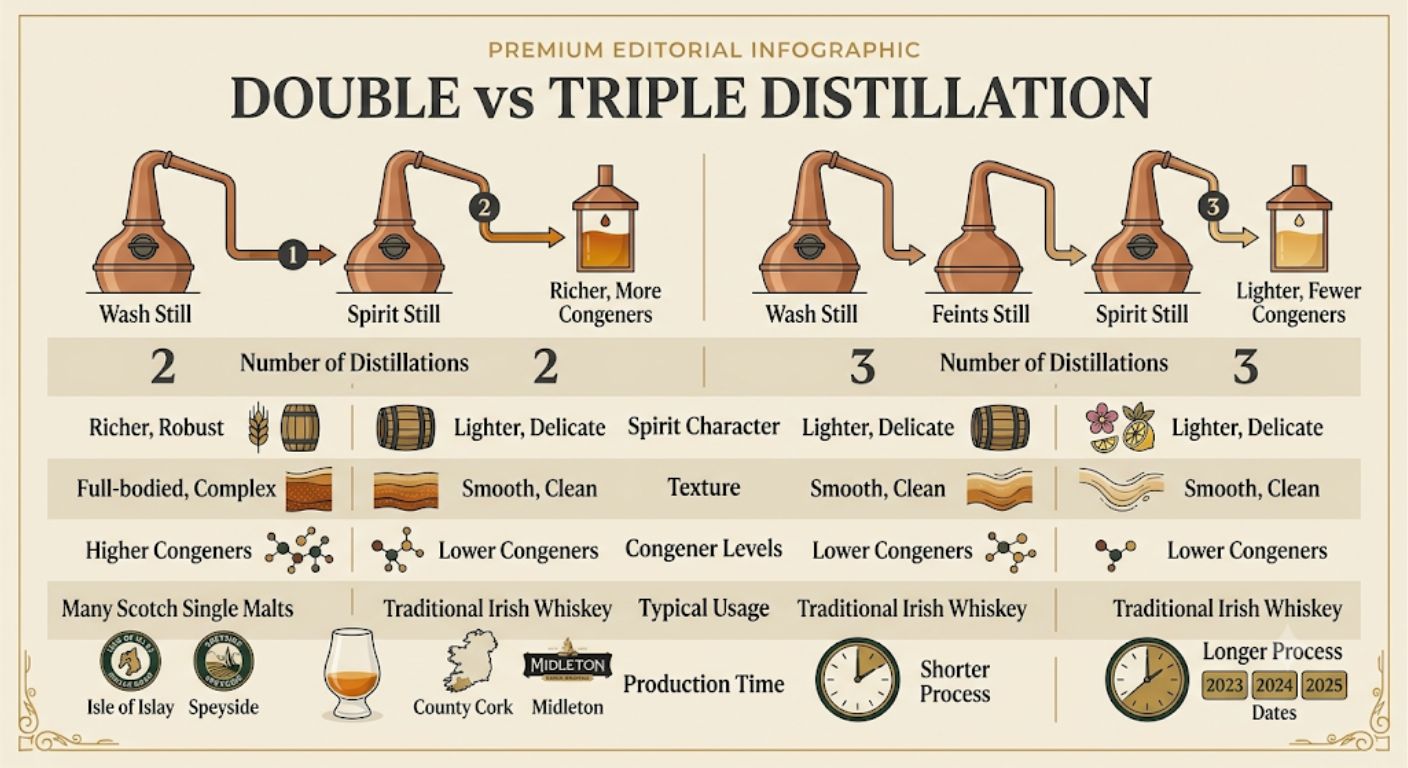
Triple distillation is common in Irish whiskey, though it is not the only method used by every Irish producer. It usually creates a lighter, smoother spirit by removing more congeners than double distillation. The trade-off is that some heavier flavour compounds may also be reduced.
| Aspect | Double Distillation | Triple Distillation |
|---|---|---|
| Typical texture | Heavier and more robust | Lighter and smoother |
| Congener levels | Usually higher | Usually lower |
| Flavour direction | More weight and intensity | More polish and softness |
| Production effect | Less distillation time | More distillation stages |
For Midleton Very Rare, the point is not that triple distillation automatically means better whiskey. It means the spirit is shaped towards elegance, balance and approachability. Cask selection then adds depth, sweetness and maturity.
Cask Maturation And Age Profile
Irish whiskey must mature for at least three years, but Midleton Very Rare is built from more mature stock than the legal minimum. The annual releases commonly include well-aged pot still and grain components selected for balance rather than a single stated age.
Most Midleton Very Rare editions do not carry a front-label age statement. That can confuse buyers who are used to Scotch single malts led by 12, 18 or 21-year-old age markers. Here, the edition year and Master Distiller selection are usually more important than a declared age statement.
Cask type matters. Ex-bourbon oak often brings vanilla, honey, orchard fruit and soft spice. Sherry-influenced casks can add dried fruit, richer sweetness and deeper colour. The key buying point is that older does not automatically mean better; cask quality and blend balance matter more.
Our customers often ask whether an older annual edition is always the better bottle, but with Midleton Very Rare the cleaner question is whether the condition, release year, fill level and provenance justify the price.
Why Collectors Value Midleton Very Rare
Collectors value Midleton Very Rare because the range combines annual vintage releases, Master Distiller signatures, consistent premium positioning and a long release history starting in 1984. Complete vertical collections are difficult to assemble, especially when earlier bottles are required in strong condition.
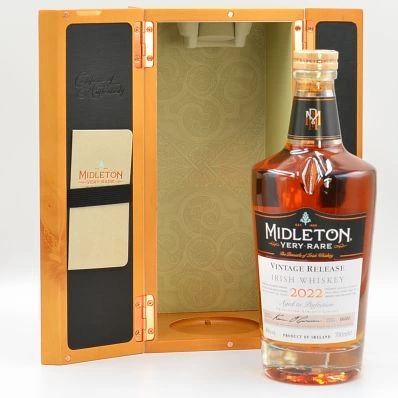
The most sought-after editions tend to be older releases, significant transition years, low-availability vintages and bottles with complete packaging. Condition matters heavily. A clean label, intact capsule, correct box or certificate, and a strong fill level can separate a desirable bottle from a compromised one.
This guide does not treat Midleton Very Rare as a guaranteed financial asset. Collector interest is real, but value depends on edition, condition, demand, provenance and market timing. If you are buying to collect, the bottle needs to stand on its own as a properly documented whiskey first.
How To Verify Midleton Very Rare Authenticity
To verify a Midleton Very Rare bottle, check the label details, Master Distiller signature, edition year, packaging, certificate where present, capsule condition and any unique numbering or release information. Provenance matters most when buying older or higher-value bottles.
Do not rely on one feature alone. Labels can age differently depending on storage. Boxes may be separated from bottles. Certificates can be missing. A sensible authenticity check looks at the whole bottle: glass, closure, fill level, label printing, packaging consistency and seller credibility.
For older bottles, photographs should be clear enough to inspect the capsule, neck, front label, rear label and base. Blurred images or missing packaging details should reduce confidence, especially when the asking price reflects collector value rather than drinking value.
Midleton Very Rare Compared With Other Irish Whiskey
Midleton Very Rare sits above everyday blended Irish whiskey and apart from most single pot still releases. It is not a direct substitute for Redbreast, Green Spot, Yellow Spot or Powers John’s Lane, because those bottles are primarily bought for a specific pot still style rather than annual-release collectibility.
It is also different from newer craft Irish whiskey releases. Many newer producers focus on farm provenance, cask experimentation or small-batch identity. Midleton Very Rare is more established, more polished and more closely tied to continuity across release years.
If you are exploring the category rather than chasing a specific annual edition, start with broader Irish Whiskey first. That gives better context before moving into premium annual releases and older bottles.
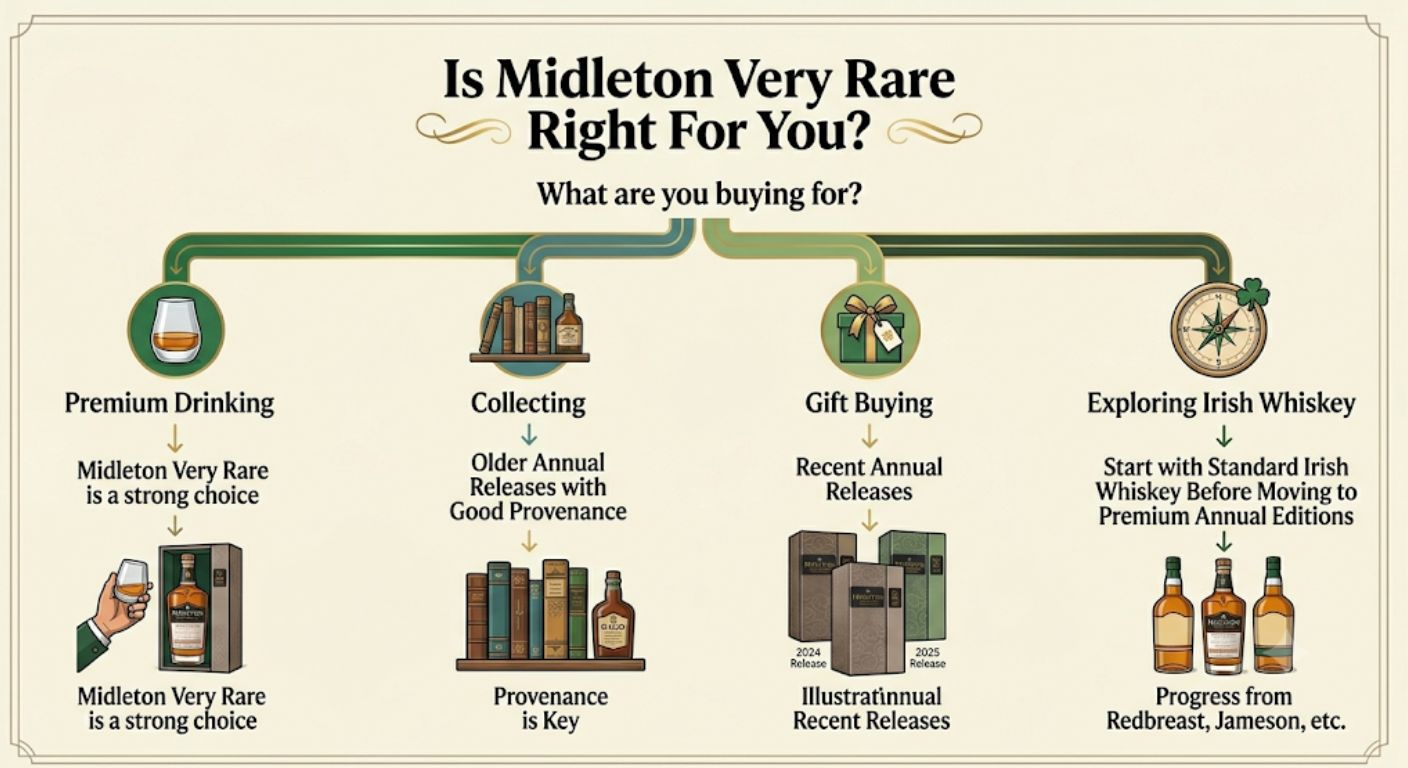
Decision Logic: Should You Buy Midleton Very Rare?
If you want a polished premium Irish whiskey with a recognised annual-release structure, Midleton Very Rare is a strong fit. It makes most sense for buyers who value provenance, presentation, balance and release history.
- If you want drinking value under £100, Midleton Very Rare is usually not the most efficient choice. Look at quality single pot still Irish whiskey instead.
- If you want a gift bottle, a recent Midleton Very Rare edition works well because the packaging and name recognition are strong.
- If you collect Irish whiskey, older annual releases matter most when condition and packaging are strong.
- If you prefer bold, sherried Scotch, Midleton Very Rare may feel lighter and more polished than expected.
- If you prefer soft, elegant whiskey, the range is likely to make more sense than heavily peated or high-ABV bottles.
Common Buying Mistakes
The first mistake is assuming every annual edition is equal. They share a family style, but bottle age, release year, market demand and condition all affect desirability.
The second mistake is ignoring packaging. With collectible Irish whiskey, the box, booklet or certificate can materially affect buyer confidence. A loose bottle may still be perfectly drinkable, but it will usually be judged differently by collectors.
The third mistake is treating Midleton Very Rare like a Scotch single malt. It is a premium blended Irish whiskey, not a single malt. The blend structure is part of the identity, not a weakness.
The fourth mistake is overpaying for age without checking condition. A bottle from the 1980s or 1990s deserves closer inspection than a recent release because storage history has had more time to affect label, capsule and fill level.
Frequently Asked Questions
What makes Midleton Very Rare different from other Irish whiskeys?
Midleton Very Rare is different because it is an annual premium release made from selected pot still and grain Irish whiskeys. Each edition is tied to a specific release year and Master Distiller selection. That gives it more collector structure than standard blended Irish whiskey.
Is Midleton Very Rare a single malt?
No. Midleton Very Rare is not a single malt. It is a blended Irish whiskey made from selected pot still and grain whiskey components. That blend structure is central to its style, giving it both texture from pot still whiskey and softness from grain whiskey.
Is Midleton Very Rare worth drinking or keeping sealed?
It depends on the bottle. Recent editions can be bought to drink if the price is sensible. Older editions, especially with complete packaging and strong condition, are often treated more as collector bottles. The decision should depend on release year, condition, price and your purpose.
What ABV is Midleton Very Rare?
Most standard Midleton Very Rare annual releases are bottled at 40% ABV. That places the whiskey at the legal minimum strength for Irish whiskey, but the range is designed around balance and polish rather than high-strength intensity.
Why does Irish whiskey use unmalted barley?
Unmalted barley became important after the 1785 British Malt Tax made malted barley more costly. Irish distillers used unmalted barley as part of the mash, and it became central to single pot still whiskey. It adds creamy texture, spice and weight.
How can you tell if a Midleton Very Rare bottle is authentic?
Check the edition year, Master Distiller signature, label quality, capsule condition, packaging, certificate where included, and any numbering or release details. For older bottles, ask for clear photographs of the front, back, neck, closure and box before making a decision.
Is Midleton Very Rare good for collectors?
Yes, it is one of the more established collectible Irish whiskey ranges, especially older annual editions in strong condition. Collector appeal is strongest when the bottle has clean packaging, good fill level, clear provenance and a desirable release year.
Structured Summary
- Category: premium blended Irish whiskey, not single malt.
- Producer: Midleton Distillery, County Cork.
- Typical ABV: 40% for standard annual releases.
- Core components: selected pot still and grain Irish whiskeys.
- Main buying factors: release year, condition, packaging, provenance and price.
- Common mistake: assuming every edition has the same collector value.
- Best fit: buyers who want premium Irish whiskey with strong release history and collector recognition.
For buyers comparing older bottles, annual editions and premium non-Scotch releases, Midleton Very Rare belongs within the broader rare world whisky conversation rather than general supermarket Irish whiskey. Browse relevant bottles through rare and collectible world whisky when comparing availability, condition and provenance.

Comments