
 Chat with us on WhatsApp

The Complete Guide To Indian Whisky
Indian whisky has changed sharply in the last two decades. For a long time, much of what was sold as Indian whisky was mass-market spirit made with molasses or neutral alcohol. That still exists, but it is not the category serious whisky drinkers now mean when they ask: is Indian whisky good?
The answer is yes, when you are talking about genuine Indian single malt. These whiskies are made from malted barley, distilled in copper pot stills, and matured in India’s hot climate, where cask influence develops quickly. For UK buyers, the easiest place to start is the current Indian whisky selection, especially if you already enjoy Scotch but want a different maturation profile.
What Makes Indian Whisky Good?
Indian single malt stands out because of climate, barley, and cask speed. India’s heat and humidity push the spirit into and out of the oak more aggressively than in Scotland. That does not make a three or four-year-old Indian whisky the same as a 12-year-old Scotch, but it can give younger whisky a surprising level of colour, spice, fruit, and oak weight.
The strongest Indian malts usually show:
- rich tropical fruit and baked orchard fruit
- firm oak influence at a younger age
- spice from six-row Indian barley
- good texture, often slightly oily or weighty
- clear cask character from bourbon, sherry, wine, or multi-cask maturation
That makes Indian whisky especially interesting for drinkers who want flavour intensity without always moving into older or more expensive Scotch.
Indian Whisky vs Scotch Whisky
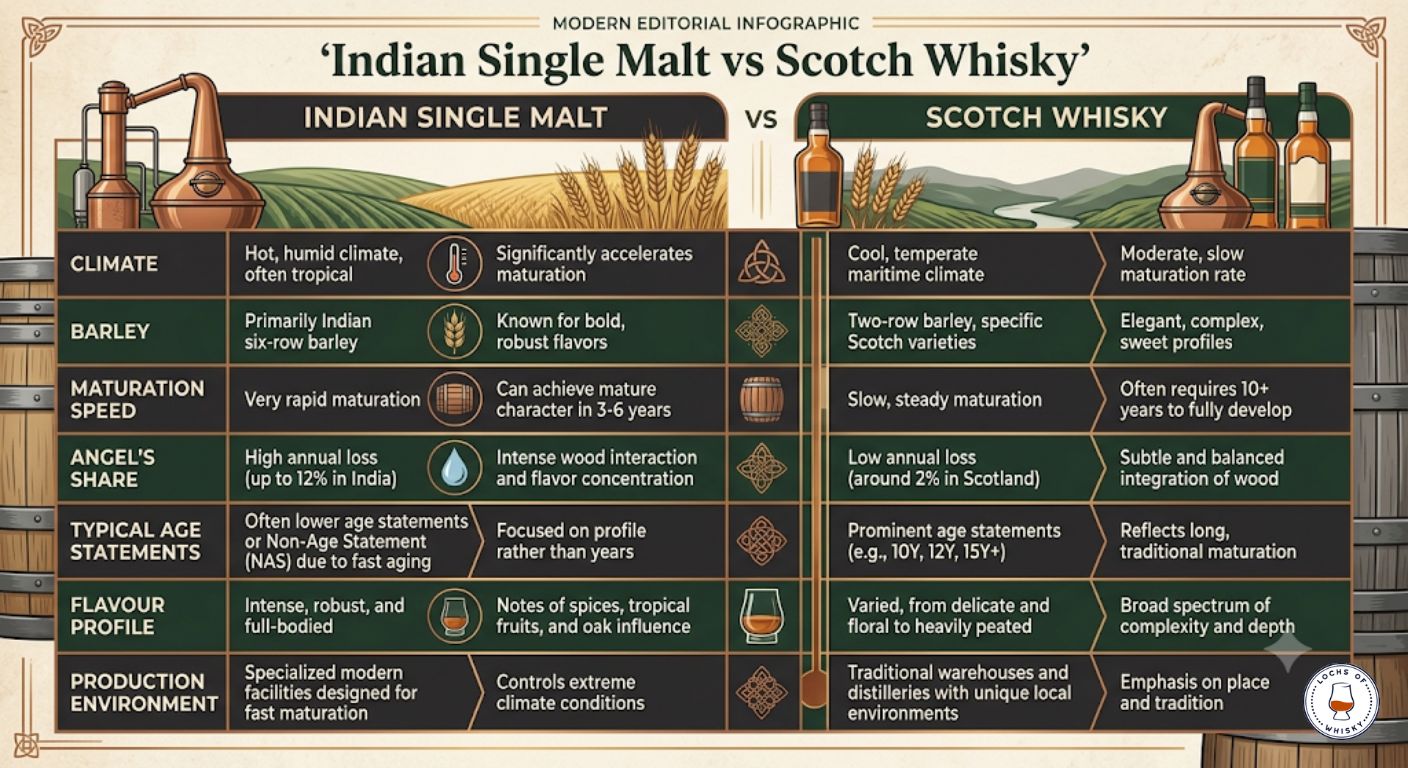
Indian single malt and Scotch single malt share some production ideas, but they mature in very different conditions. Scotch is defined by long, cool maturation. Indian whisky is defined by fast, tropical maturation.
| Factor | Indian Single Malt | Single Malt Scotch |
|---|---|---|
| Climate | Hot, humid, fast maturation | Cool, slow maturation |
| Barley | Often Indian six-row barley | Usually two-row malted barley |
| Typical age | Often younger, with strong cask impact | Often older, with slower development |
| Angel’s share | Often around 8–12% per year, sometimes higher | Usually around 2% per year |
| Flavour direction | Fruit, spice, oak, intensity | Varies widely by region, cask, and distillery |
Why Does Indian Whisky Age Faster Than Scotch?
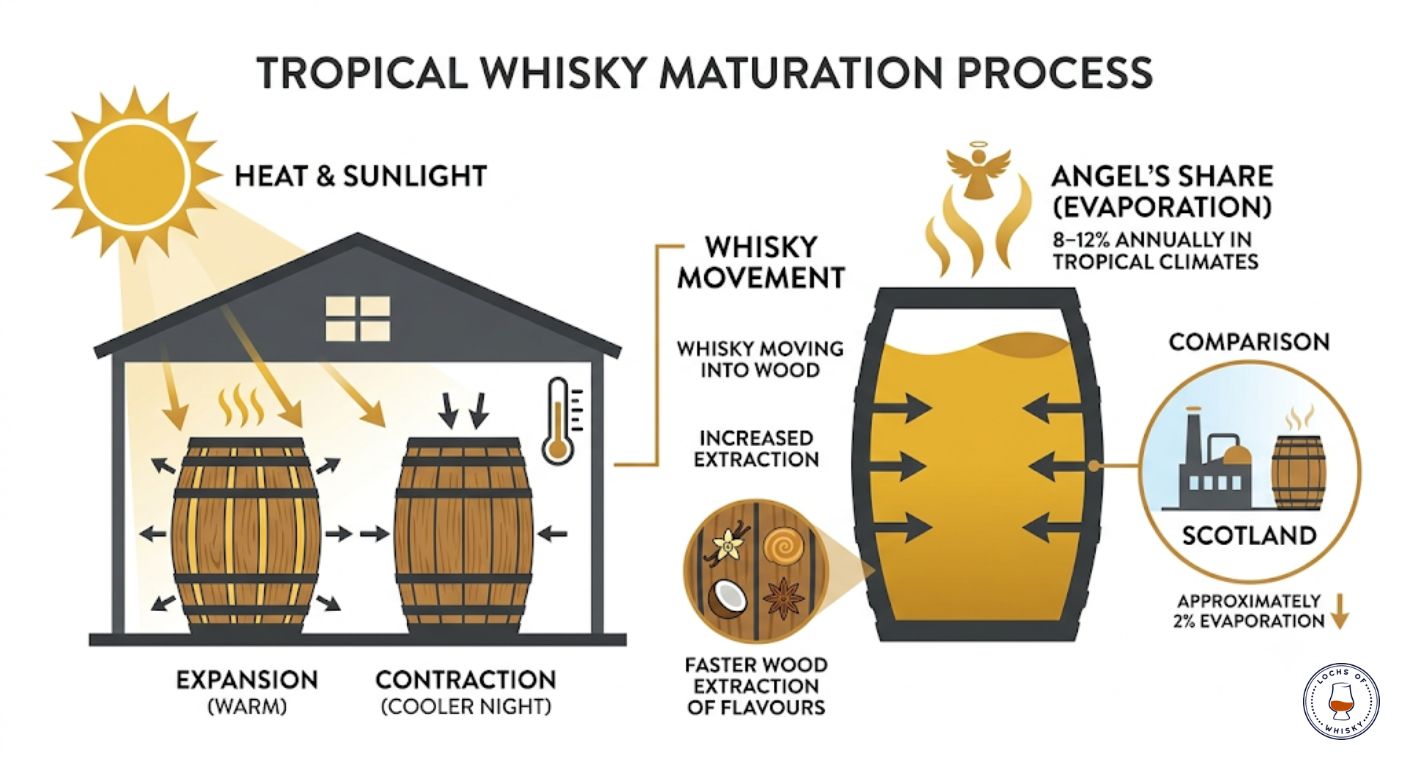
Indian whisky ages faster because heat increases the interaction between spirit and oak. The cask expands and contracts more aggressively, drawing whisky into the wood and pulling flavour compounds back into the spirit. Evaporation is also much higher, which concentrates the remaining liquid.
This evaporation is known as the angel’s share. In Scotland, it is often around 2% per year. In India, it can commonly reach 8–12%, and in hotter areas it may go higher. That is why Indian whisky producers cannot simply mature spirit for decades in the same way as Scotch producers. Too much liquid would be lost.
Is Indian Single Malt Made From Molasses?
No, proper Indian single malt is not made from molasses. It is made from malted barley. The confusion comes from older and cheaper Indian whisky categories, where molasses-based spirit has historically been common.
This distinction matters. Indian Made Foreign Liquor, often shortened to IMFL, can include molasses or neutral spirit. Indian single malt is a different proposition: malted barley, pot still distillation, and cask maturation. The Indian Malt Whisky Association has set out stricter standards for genuine Indian single malt, including 100% malted barley, copper pot stills, single-distillery production, and oak maturation, as reported by The Spirits Business.
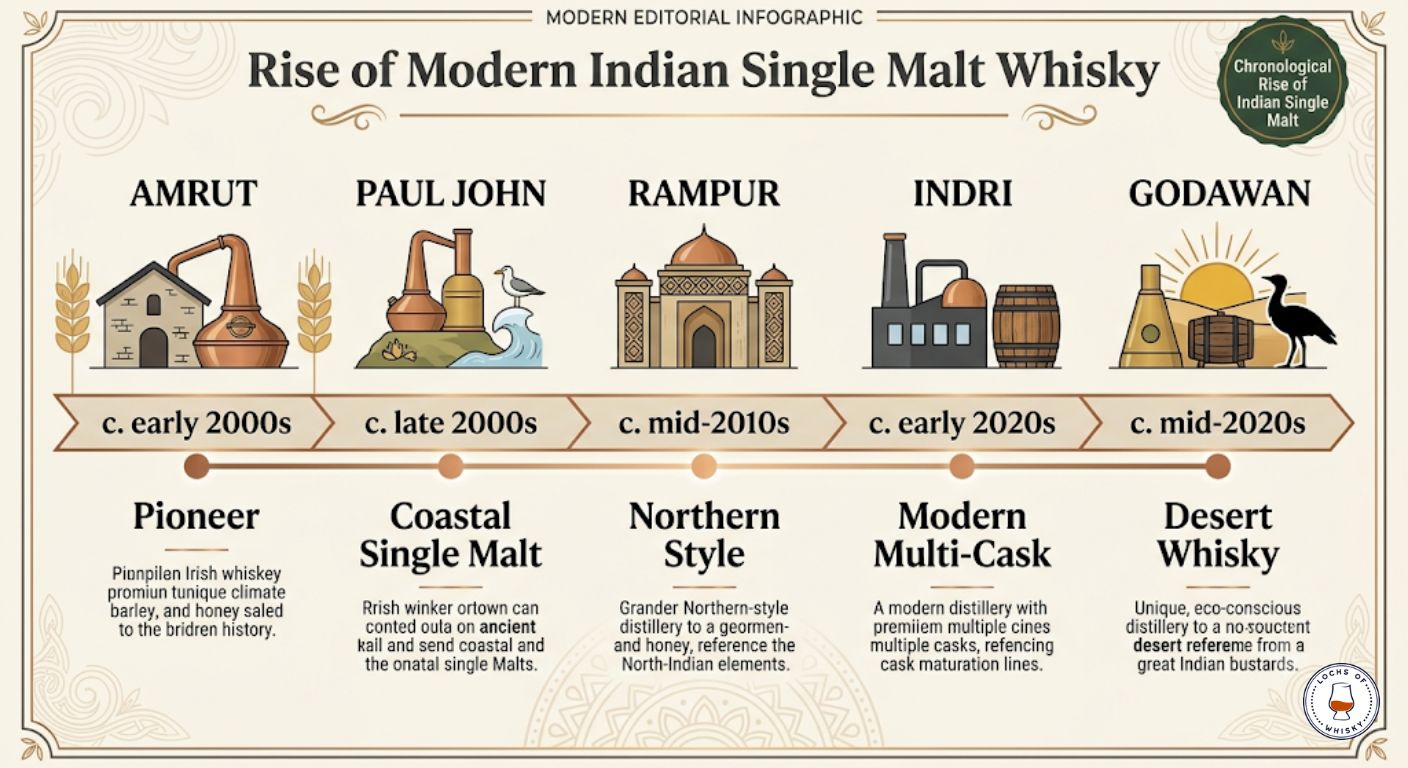
The Main Indian Whisky Distilleries To Know
The category is still smaller than Scotch, but a few producers have shaped how Indian whisky is understood internationally.
Amrut
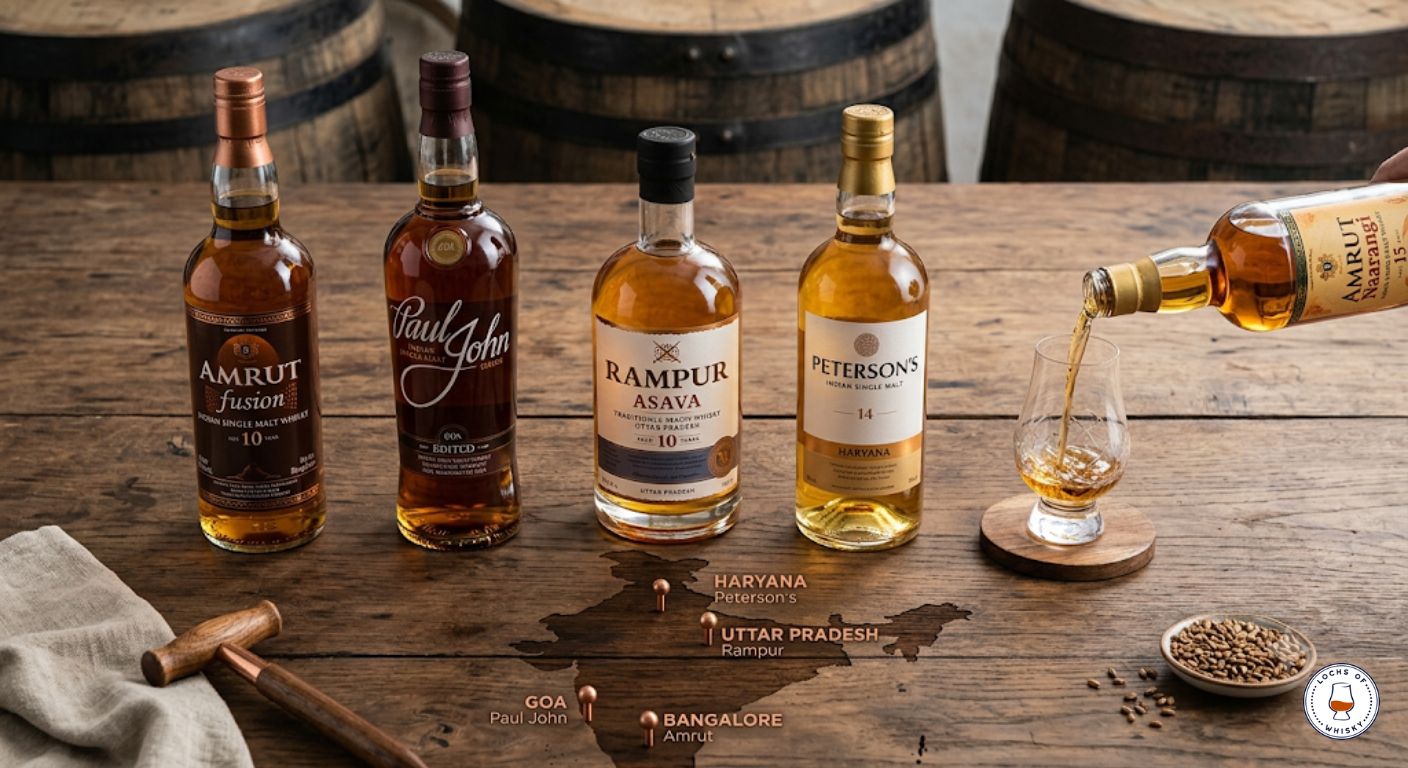
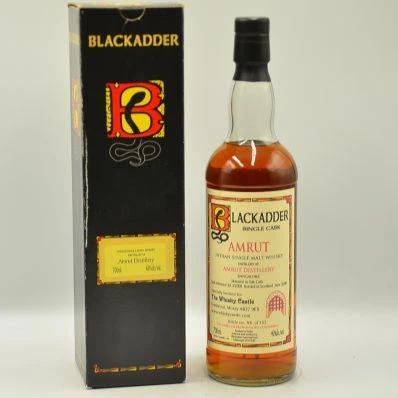
Amrut, based in Bangalore, is widely viewed as the pioneer of modern Indian single malt. It helped establish the category outside India and showed that Indian whisky could compete seriously in blind tastings and specialist retail.
Paul John
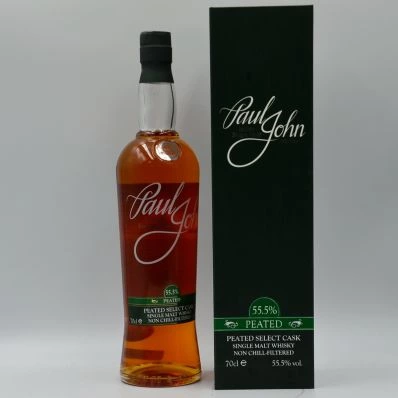
Paul John is based in Goa and is known for accessible single malts with fruit, honey, spice, and in some releases, peat. Bottles such as Brilliance are often good entry points for Scotch drinkers trying Indian whisky for the first time.
Rampur
Rampur comes from Uttar Pradesh and often presents a softer, fruit-led style. It can suit drinkers who want richness without heavy smoke or aggressive oak.
Indri
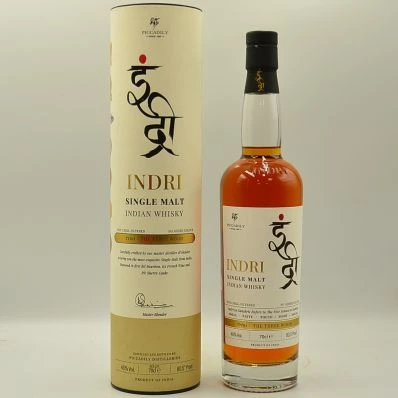
Indri has become one of the most visible newer Indian whisky names in the UK, especially through multi-cask expressions such as Trini. It is a useful starting point if you want a modern Indian single malt with clear fruit, spice, and cask influence.
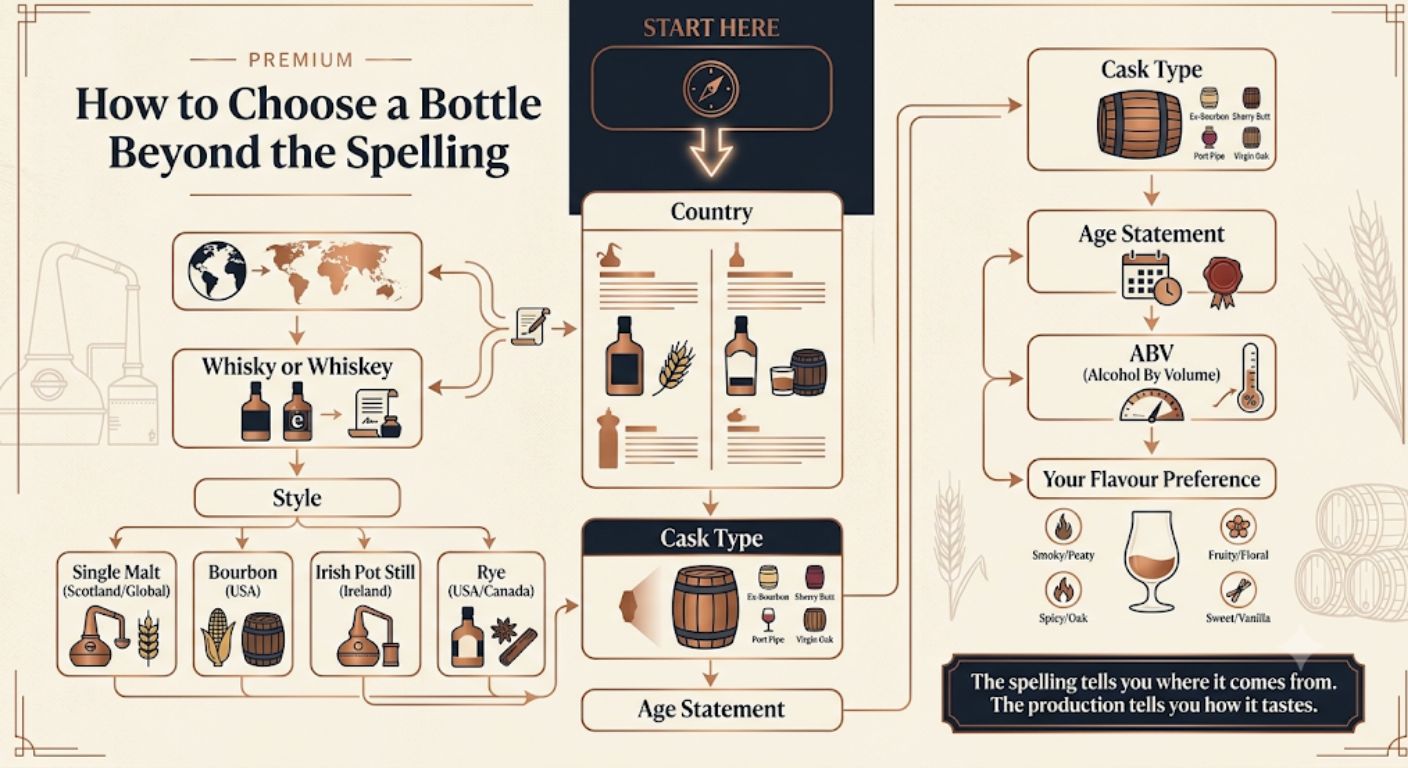
One thing we see with our customers is that Indian whisky often performs best when buyers stop judging it by the age statement and start judging it by cask balance, ABV, and distillery style.
Is Indian Whisky Worth Buying?
Indian whisky is worth buying if you want full-flavoured single malt with strong cask character and a clear point of difference from Scotch. It makes most sense for drinkers who already understand malt whisky and want to explore beyond Scotland, Ireland, Japan, and America.
It may not suit you if you only want very old age statements, extremely delicate refill-cask profiles, or heavily regulated Scotch-style consistency. Indian whisky’s appeal is not that it copies Scotch. It is that the same broad whisky principles behave differently under Indian conditions.
If you are exploring the wider category, the world whisky section is the natural next step, covering Indian whisky alongside other non-Scotch producing regions.
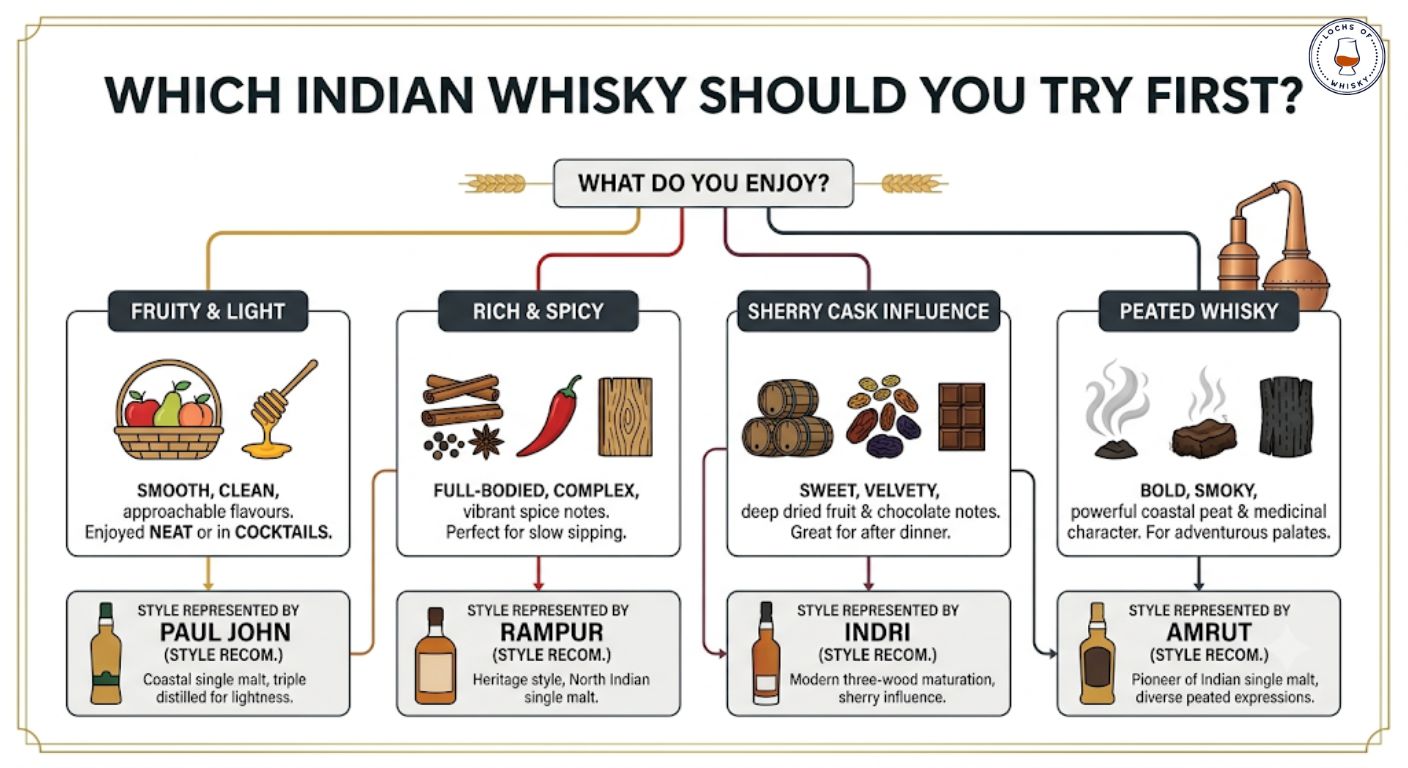
Best Indian Whisky For Beginners
For a first bottle, look for approachable single malts around the £45–£65 range. These usually give enough quality to show what the category can do without pushing into collector pricing.
- Paul John Brilliance: good for fruit, honey, malt, and gentle spice.
- Indri Trini: useful for understanding multi-cask Indian whisky with fruit and oak depth.
- Amrut Fusion: a stronger, more established benchmark with malt weight and cask intensity.
Scotch drinkers who enjoy Speyside or Highland malts may find the fruitier Indian single malts easiest. Drinkers who prefer peat should look at peated releases from producers such as Amrut or Paul John.
FAQ
How Good Is Indian Whisky?
Indian whisky can be very good when it is genuine single malt rather than molasses-based mass-market spirit. The best examples show strong fruit, spice, oak, and texture. They are usually younger than comparable Scotch, but India’s climate gives them a level of cask influence that can surprise Scotch drinkers.
Why Is Indian Whisky Younger Than Scotch?
Indian whisky is usually younger because the climate matures spirit faster and evaporates more liquid each year. A cask left for too long in hot conditions can lose too much whisky or become over-oaked. Producers often bottle younger because the spirit reaches useful flavour intensity earlier.
What Is The Angel’s Share In Indian Whisky?
The angel’s share is the whisky lost to evaporation during cask maturation. In India, this can commonly sit around 8–12% per year, compared with roughly 2% in Scotland. That higher loss concentrates flavour but also makes long ageing more difficult and expensive.
Is Indian Whisky As Good As Scotch?
Indian whisky can be as enjoyable as Scotch, but it should not be judged as a direct replacement. Scotch offers regional depth, long heritage, and broad stylistic range. Indian single malt offers tropical maturation, bold cask influence, and a different barley character. The better choice depends on what style you want.
Final Thoughts
Indian whisky is good when you focus on proper single malt producers and understand why the category tastes different. The key factors are tropical maturation, high angel’s share, six-row barley, and the move away from molasses-based whisky into serious malt production.
For UK buyers, Indian whisky is best approached as part of the wider world whisky conversation: not a Scotch substitute, but a distinct style with its own production logic. Start with a recognised single malt, check the ABV and cask details, and use the category as a way to understand how climate changes whisky in the glass.



Comments