
 Chat with us on WhatsApp

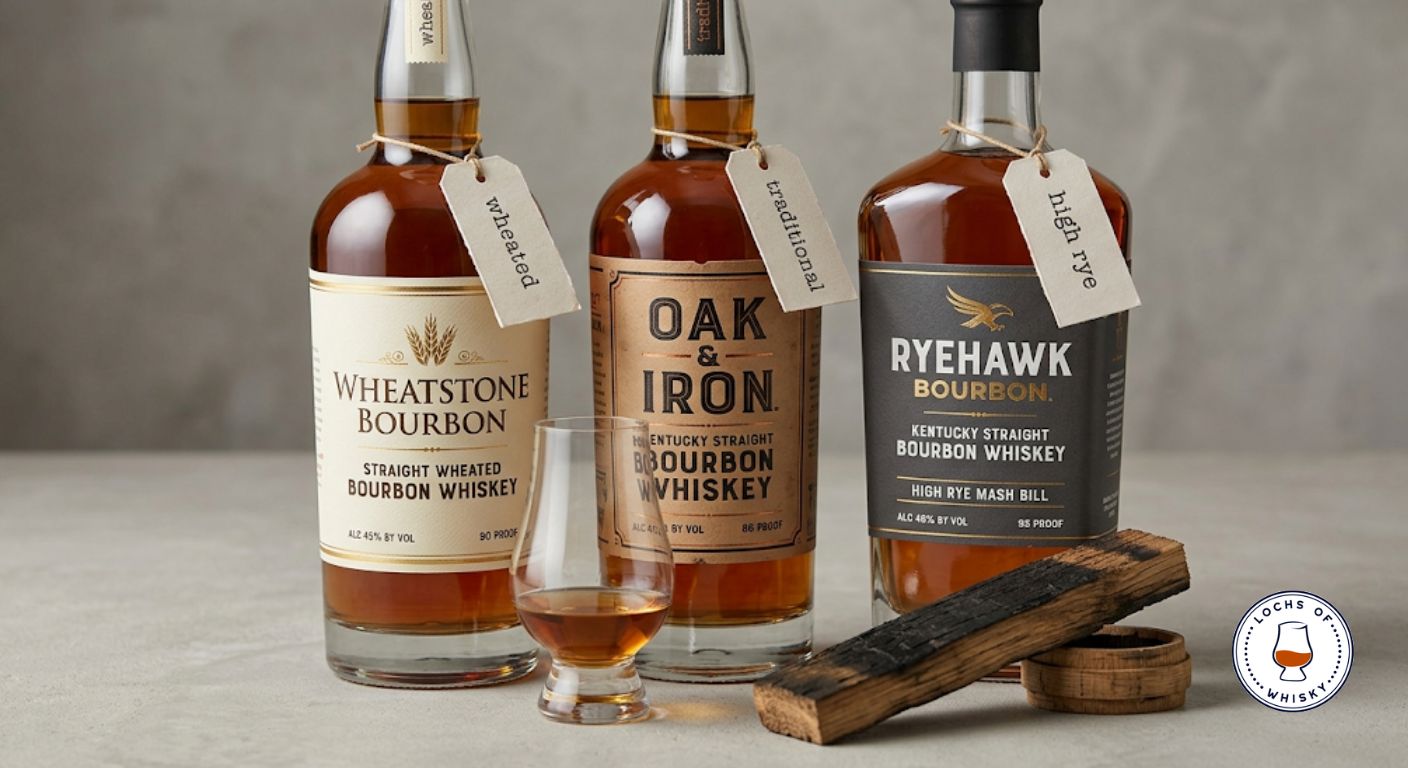
Best Bourbon for Beginners: Where to Start
Choosing the best bourbon for beginners is mainly about avoiding the wrong first bottle. Bourbon can be sweet, soft, spicy, oaky, high-strength, cheap, expensive, simple or complex. The problem is not lack of choice. The problem is knowing which details matter before you buy.
This guide explains how to choose a first bourbon by looking at strength, mash bill, flavour style, age, price and how you plan to drink it. It is written for UK buyers who may already know Scotch whisky but are less familiar with American whiskey. If you want to browse the wider category while reading, start with the American whiskey selection, then narrow down by style once you know what suits you.
The aim is simple: help you choose a bottle that tastes approachable, gives you a useful reference point, and does not waste money on hype, allocation or strength you are not ready for.
What Makes Bourbon Different From Other Whiskey?
All bourbon is whiskey, but not all whiskey is bourbon. Bourbon must be made in the United States, use a mash bill of at least 51% corn, be distilled within legal strength limits, and be matured in new charred oak containers. The full legal framework is set out in the US standards of identity for whisky.
Those rules explain why bourbon often tastes sweeter and more oak-driven than many Scotch whiskies. Corn gives body and sweetness. New charred oak gives vanilla, caramel, spice, coconut, toasted wood and colour quickly. That does not mean every bourbon is soft. High rye content, high ABV and long maturation can all make a bourbon feel sharper, drier or more intense.
For a beginner, the key point is this: bourbon is not just “sweet American whisky”. The bottle you choose depends on grain recipe, strength and oak influence.
What Should Beginners Look For In A First Bourbon?
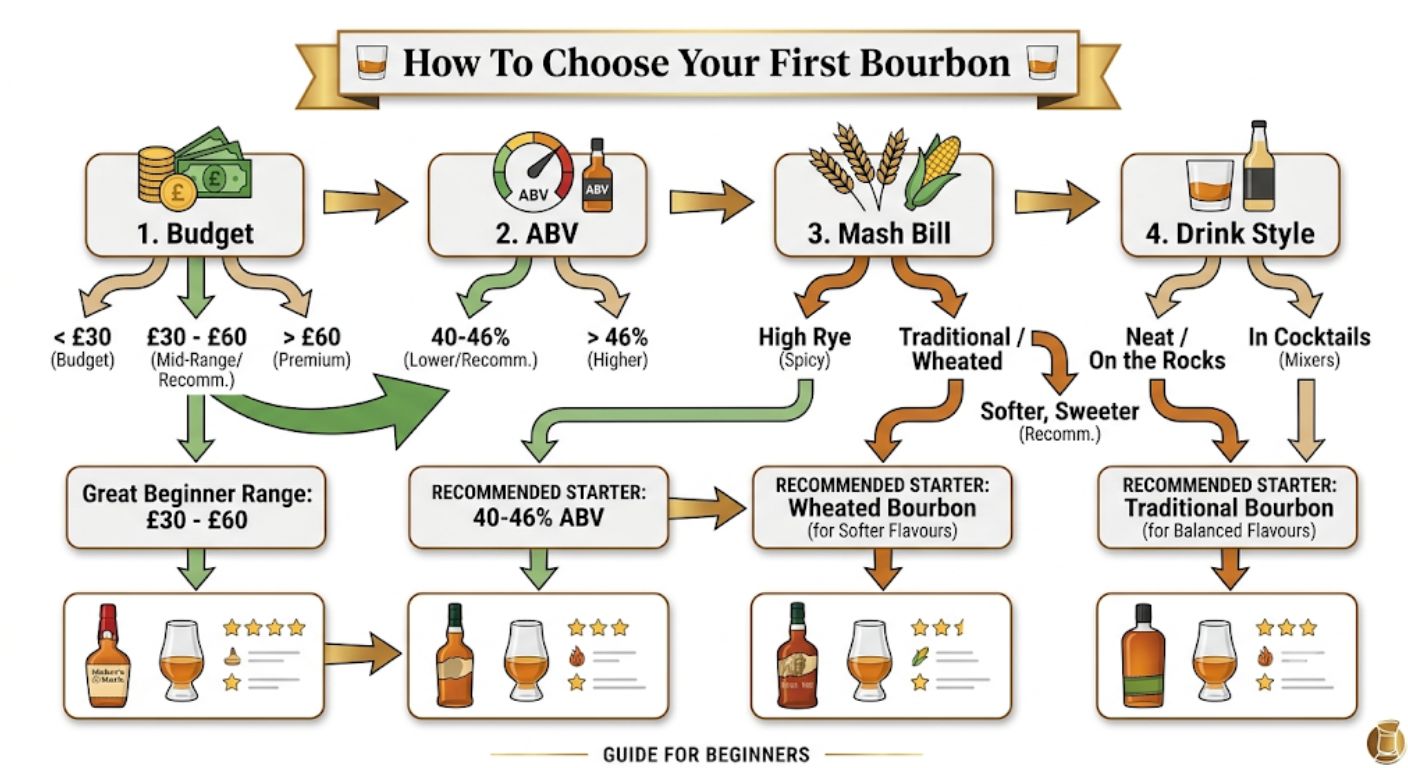
The safest first bourbon usually sits between 40% and 46% ABV, has a clear flavour profile, is widely recognised, and does not rely on extreme strength or rarity. Most beginners do not need a cask-strength release, a heavily oaked special edition or an expensive allocated bottle.
Use these first-bottle rules:
- ABV: start around 40–46% if drinking neat or with ice.
- Mash bill: choose wheated or traditional bourbon before high-rye bourbon if you want a softer start.
- Price: in the UK, £30–£60 is the practical beginner range for a credible bottle.
- Age: do not assume older is automatically easier to drink.
- Style: avoid barrel proof or heavily charred expressions until you know your preference.
If you are moving across from Scotch, bourbon may feel sweeter at first because of the corn and new oak. If you usually drink Speyside or Highland single malt, start softer. If you enjoy rye spice, peat, cask strength or sherried intensity, you can move more quickly into higher-proof or high-rye bourbon.
Smooth Bourbon For Beginners: What Does Smooth Actually Mean?
For beginners, “smooth” usually means low alcohol burn, rounded sweetness and a finish that does not feel sharp. It does not mean the bourbon is better. It means the balance of ABV, grain recipe and oak makes the whiskey easier to approach.
Most first-time bourbon buyers use “smooth” to describe three things:
- less heat on the first sip
- clear vanilla, caramel or honeyed sweetness
- a finish that does not feel bitter, peppery or aggressive
Wheated bourbon is often a good starting point because wheat replaces some or all of the rye grain in the mash bill. That usually gives a softer, rounder profile. Traditional bourbon, with rye as the secondary grain, is still accessible but may feel slightly spicier. High-rye bourbon is better for drinkers who already enjoy pepper, spice and a drier finish.
| Bourbon style | Main secondary grain | Typical beginner experience |
|---|---|---|
| Wheated bourbon | Wheat | Softer, sweeter, rounded, lower perceived spice |
| Traditional bourbon | Rye | Balanced caramel, vanilla, oak and mild spice |
| High-rye bourbon | Higher rye content | Spicier, drier, more peppery and assertive |
| Double-oaked bourbon | Varies | Richer oak, deeper vanilla, toasted sugar and wood spice |
ABV And Proof: Why Strength Matters So Much
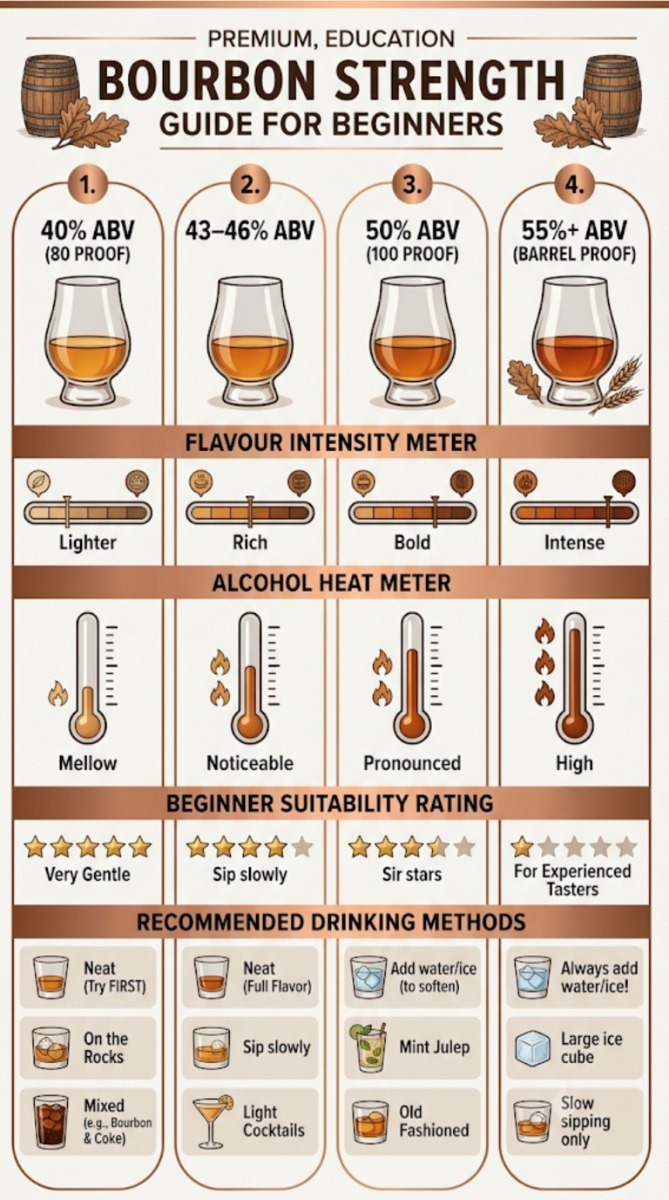
ABV is one of the most important details on a bourbon label. American whiskey often uses “proof”, which is double the ABV. An 80 proof bourbon is 40% ABV. A 100 proof bourbon is 50% ABV. A barrel proof bourbon can go much higher.
Beginners usually do best below 46% ABV when drinking bourbon neat. That range gives enough flavour without making alcohol heat the main feature. Bourbons at 50% ABV can still be excellent beginner bottles if you plan to add ice, water or use them in cocktails, but they can feel forceful neat.
One thing our customers often underestimate is that a jump from 40% to 50% ABV does not sound dramatic on paper, but in the glass it can completely change how approachable a bourbon feels.
Use this as a practical guide:
- 40% ABV: softest entry point, easy to compare and drink neat.
- 43–46% ABV: more flavour, still manageable for most beginners.
- 50% ABV: good with ice, water or cocktails; stronger neat.
- 55%+ ABV: usually better after you understand your palate.
If your first sip tastes like fire, the bourbon may not be bad. Your palate may simply be adjusting to the strength. Take a smaller sip, let it sit briefly, and add a little water or one large ice cube if needed.
Mash Bill: Wheated, Traditional Or High Rye?
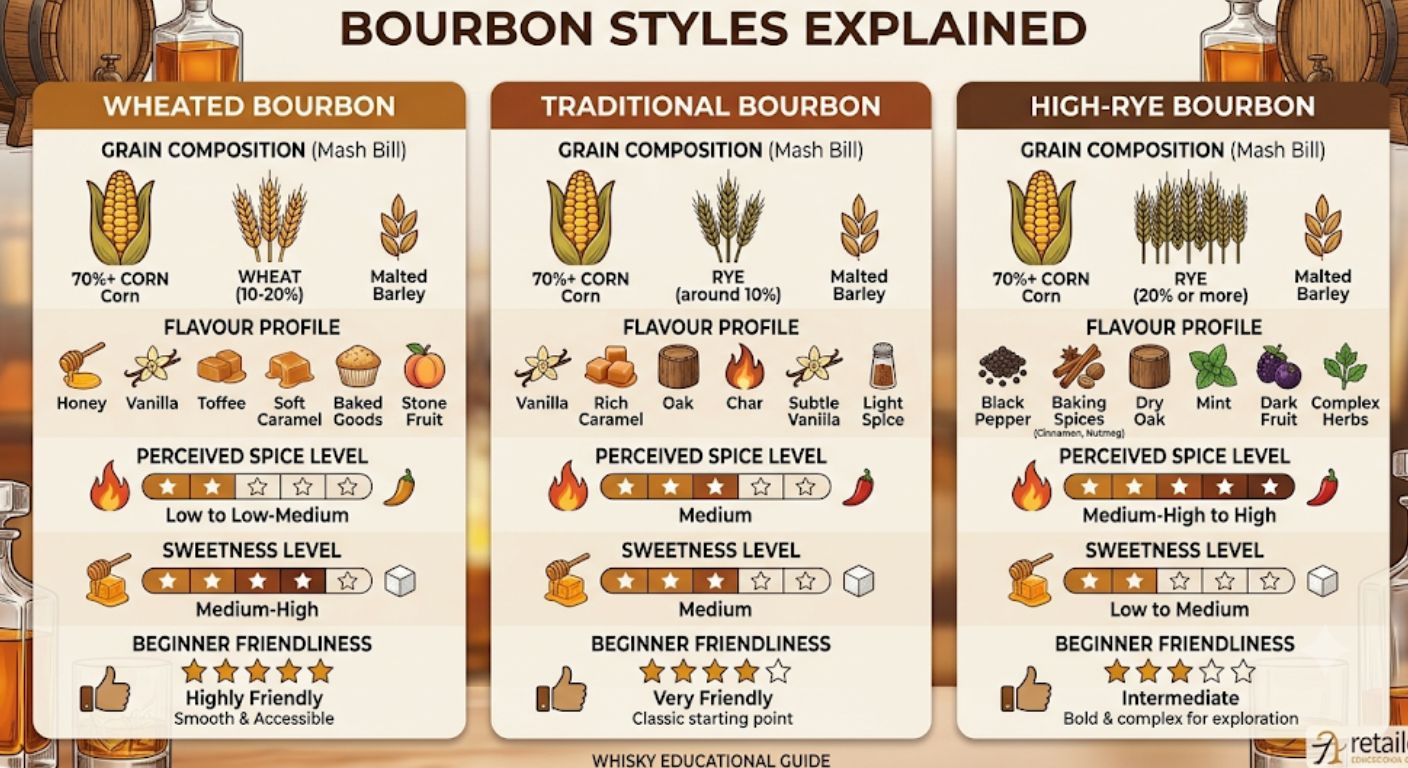
The mash bill is the grain recipe. Bourbon must contain at least 51% corn, but the remaining grain mix changes the flavour. Most bourbons use corn, rye and malted barley. Some replace rye with wheat. Others increase the rye content for more spice.
For a first bottle, mash bill matters because it changes how the bourbon feels before you have built a flavour vocabulary.
Wheated bourbon
Wheated bourbon usually gives the softest first impression. It often shows vanilla, caramel, honey, soft bread, light oak and gentle sweetness. It is a strong choice if you want bourbon that feels rounded rather than spicy.
Traditional bourbon
Traditional bourbon keeps rye in the grain mix but not usually at a high level. This gives balance: sweetness from corn, structure from oak, and enough spice to stop the whiskey feeling flat. It is the most useful all-round starting point.
High-rye bourbon
High-rye bourbon is more peppery, herbal, dry and spicy. It can be excellent, but it is not always the easiest first glass. Choose it early only if you already like spice-led whiskey or plan to use the bottle in mixed drinks.
If you want to browse bourbon specifically rather than the wider American whiskey range, the Bourbon Whiskey category is the natural place to compare styles, ABV and producer details.
How Much Should A Beginner Spend On Bourbon?
A beginner should usually spend around £30–£60 on a first bottle of bourbon in the UK. Below that, quality can still be good, but choice narrows. Above that, you may start paying for age, scarcity, limited releases or collector demand before you understand what you like.
The first bottle should teach you something. It does not need to be rare, old or expensive. A reliable bourbon at 40–46% ABV will usually give a better starting point than a high-proof bottle bought because it has a strong reputation online.
Use this price logic:
- Under £30: suitable for mixing or casual discovery, but check ABV and producer carefully.
- £30–£60: the strongest beginner range for balance, credibility and value.
- £60–£100: useful once you know whether you prefer wheated, high-rye, older or richer oak styles.
- £100+: better treated as specialist territory, not a first step.
If budget is your main filter, avoid chasing limited bottles first. Look for clear labelling, sensible strength and a style that matches how you intend to drink it.
Should Beginners Start With Kentucky Bourbon?
Kentucky bourbon is a logical starting point because it gives a strong reference for the category, but bourbon does not legally have to come from Kentucky. It must be made in the United States. Kentucky remains important because of its production history, climate, distilling concentration and major producer base.
For beginners, Kentucky bourbon is useful because many benchmark bottles come from long-established producers. That makes it easier to compare traditional bourbon, wheated bourbon, higher rye recipes and age-stated releases without changing too many variables at once.
However, do not treat “Kentucky” as a guarantee of quality. A well-made bourbon from another US state can be more useful than a poorly chosen Kentucky bottle. Region helps with context; it does not replace ABV, mash bill and balance.
Beginner-Friendly Bourbon Producers To Understand
It helps to recognise producer names because bourbon labels can be confusing. Some brands are tied to major distilleries, while others are sourced, blended or released under different labels. For beginners, producer context reduces the chance of buying purely on packaging.
Evan Williams is useful for understanding accessible Kentucky bourbon with traditional flavour markers: corn sweetness, oak, vanilla and enough structure for both sipping and mixing. It is often a practical reference point for value-led bourbon.
Old Forester is another important name because it sits close to the classic Kentucky bourbon profile while offering expressions across different strengths and flavour weights. For beginners, it can show how ABV and oak change the same broad style.
Old Crow carries historical importance in American whiskey and helps explain how older bourbon names can still influence modern buying behaviour. It is worth understanding as part of bourbon history, even if the buying decision should still come back to bottle specifics.
How To Drink Bourbon For The First Time
There is no single correct way to drink bourbon for the first time. The best method is the one that lets you taste the whiskey clearly without making alcohol heat dominate. Start neat if you want the purest reference, but use water or ice if the strength gets in the way.
Step 1: Pour a small measure
Start with a small pour rather than a full glass. A smaller measure lets you adjust gradually with water or ice. It also makes comparison easier if you are tasting two styles side by side.
Step 2: Smell before sipping
Do not push your nose too far into the glass. Bourbon can carry strong alcohol vapour, especially above 45% ABV. Smell gently and look for broad markers first: vanilla, caramel, oak, spice, fruit or toasted sugar.
Step 3: Take a small first sip
The first sip often feels sharper than the second. Let the bourbon coat the palate briefly before swallowing. Do not judge the bottle from the first contact alone.
Step 4: Add water or ice if needed
A few drops of water can reduce alcohol heat and open up sweetness. A large ice cube will cool and dilute the bourbon more slowly than small ice cubes. Neither method is wrong.
Step 5: Compare the finish
After swallowing, notice whether the finish is sweet, spicy, dry, oaky or hot. This tells you more about your preference than the first aroma does.
If You Like Scotch, Which Bourbon Should You Start With?
Scotch drinkers often need a different route into bourbon because the oak rules are different. Scotch is usually matured in used casks. Bourbon must use new charred oak. That means bourbon can show stronger vanilla, caramel and wood sweetness at a younger age.
Use your Scotch preference as a guide:
- If you like soft Speyside single malt: start with wheated or lower-ABV traditional bourbon.
- If you like sherry-cask Scotch: consider richer, double-oaked or cask-finished bourbon later, not necessarily first.
- If you like Highland whisky: traditional bourbon around 43–46% ABV is usually a sensible bridge.
- If you like peat or cask strength: you may tolerate higher proof sooner, but still start with balance rather than heat.
Do not expect bourbon to copy Scotch. Treat it as a separate style with its own structure: corn sweetness, new oak, char, spice and American maturation conditions.
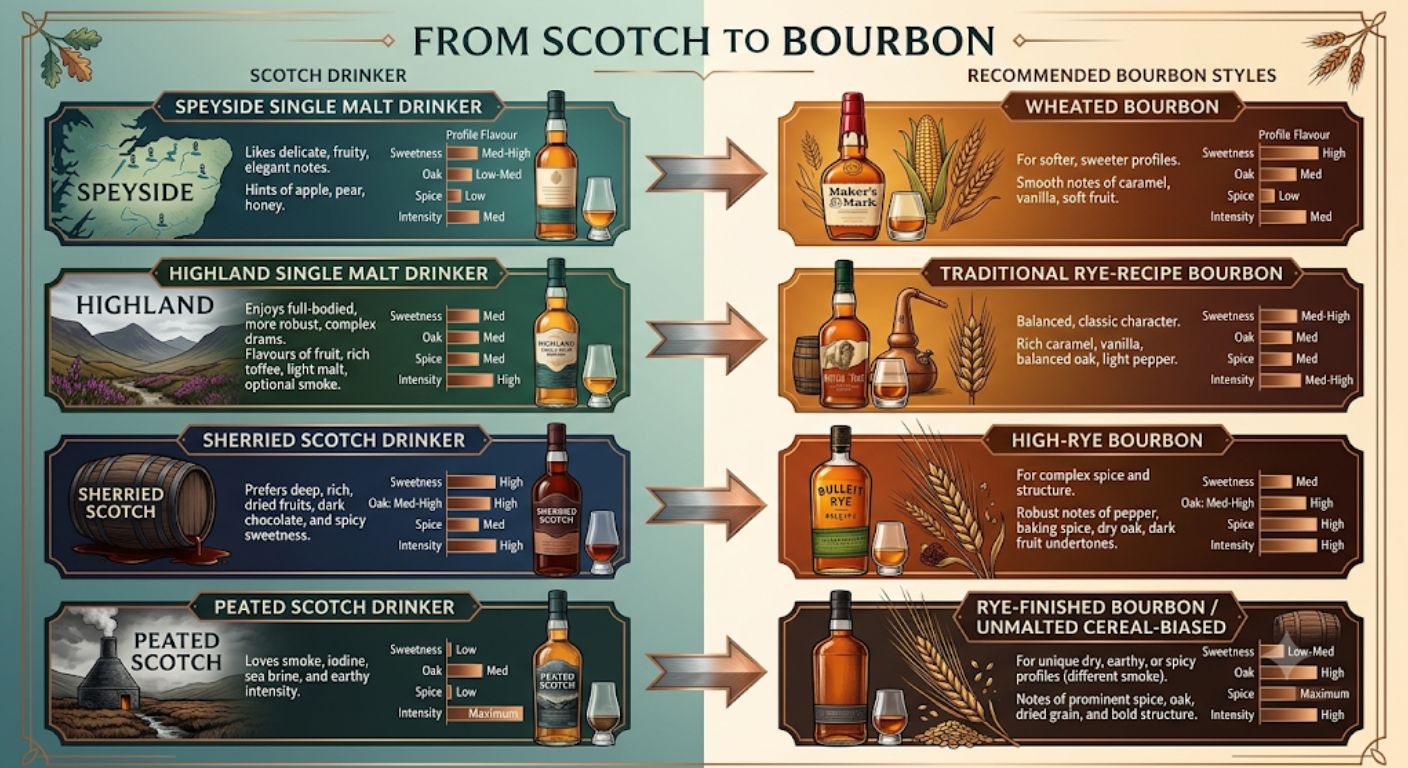
Decision Logic: Which Beginner Bourbon Style Should You Choose?
The simplest way to choose is to match the bourbon to the job you want it to do.
- If you want the softest first glass, choose wheated bourbon around 40–45% ABV.
- If you want one bottle for sipping and cocktails, choose traditional bourbon around 43–50% ABV.
- If you dislike sweetness, choose a bourbon with more rye influence, but avoid very high proof at first.
- If you want to drink it neat, stay closer to 40–46% ABV.
- If you want to use it in an Old Fashioned, choose something with enough strength and oak to hold its shape.
- If your budget is £30–£60, avoid chasing rare releases and focus on recognised producers, clear ABV and a style you can compare later.
- If you are buying as a gift for a beginner, avoid barrel proof unless the recipient already drinks higher-strength spirits.
The best first bourbon is not the most famous bottle. It is the one that gives you a clear read on the category without overwhelming your palate or budget.
Common Beginner Mistakes
Most poor first bourbon choices come from treating reputation as more important than fit. A bottle can be excellent and still be wrong for a beginner.
- Starting too strong: barrel proof bourbon can make alcohol heat the only thing you notice.
- Buying for hype: allocated bottles are not always better learning bottles.
- Ignoring mash bill: wheated, traditional and high-rye bourbon can feel very different.
- Assuming older means smoother: long oak exposure can add dryness, tannin and intensity.
- Using price as the main quality signal: £30–£60 often gives a stronger beginner experience than many expensive bottles.
- Judging from one sip: bourbon often opens up after a few minutes and a little dilution.
FAQ
What is the smoothest bourbon for beginners?
The smoothest bourbon for beginners is usually a wheated bourbon or a lower-strength traditional bourbon around 40–45% ABV. Look for soft vanilla, caramel, honey and gentle oak rather than high proof or heavy spice. “Smooth” should mean low burn and good balance, not lack of flavour.
Should I drink bourbon neat or on the rocks first?
Start neat if you want to understand the bourbon clearly, then add a few drops of water or one large ice cube if the alcohol feels too sharp. Ice is not a mistake. For beginners, controlled dilution often makes the whiskey easier to read.
Why does my first sip of bourbon taste like fire?
The first sip can taste hot because your palate is adjusting to alcohol strength, especially above 45% ABV. Take a smaller sip, let it coat the mouth, then wait before judging. Water or ice can reduce the heat and bring out sweetness.
Is wheated bourbon better than high-rye bourbon for beginners?
Wheated bourbon is usually easier for beginners because it tends to feel softer, sweeter and less peppery. High-rye bourbon gives more spice, dryness and structure. Choose wheated if you want approachability. Choose high rye if you already enjoy spice-led whiskey.
How much should I spend on my first bourbon?
Most UK beginners should spend around £30–£60 on a first bourbon. That range is high enough for credible quality but low enough to avoid paying for scarcity or collector demand. Spend more only once you know your preferred mash bill, ABV and oak style.
Is bourbon stronger than Scotch whisky?
Not always. Many bourbons are bottled at 40–46% ABV, similar to common Scotch whisky. Bourbon can feel stronger because new charred oak and rye spice create a more intense profile. Higher-proof bourbon is common, so always check the ABV before buying.
Does bourbon have to come from Kentucky?
No. Bourbon must be made in the United States, but it does not have to come from Kentucky. Kentucky is historically important and produces many benchmark bottles, but the legal definition is national. A bourbon from another US state can still be legitimate bourbon.
Is older bourbon better for beginners?
Older bourbon is not automatically better for beginners. More time in new oak can add depth, but it can also add dryness, tannin and stronger wood influence. A balanced younger bourbon may be easier to enjoy than an older bottle with heavy oak.
Summary: The Beginner Rules That Matter
Choosing the best bourbon for beginners is easier when you focus on structure rather than reputation.
- ABV: start around 40–46% for neat drinking.
- Mash bill: wheated is usually softest; traditional is most balanced; high rye is spicier.
- Price: £30–£60 is the practical UK starting range.
- Age: useful context, but not a guarantee of smoothness.
- Oak: new charred oak gives bourbon much of its vanilla, caramel and spice.
- Use: choose lower strength for neat sipping and stronger bourbon if cocktails are the main purpose.
Common mistakes are starting too high in ABV, buying for hype, ignoring mash bill and assuming expensive means easier to drink. A good first bourbon should be clear, balanced and informative. Once you understand whether you prefer soft wheat, classic rye balance or stronger oak influence, future bottles become much easier to choose.
For the next step, compare bottle details, producer names and strengths within the £50 to £100 Scotch selection if you are also weighing bourbon against Scotch at a similar budget.

Comments