
 Chat with us on WhatsApp


Best English Whisky: A Complete Buyer's Guide
Choosing the best English whisky is not about finding one famous bottle and treating it as the answer. The category is young, fast-moving, and shaped by small distilleries using different grains, cask types, fermentation styles, and bottling strengths. That makes it interesting, but it also makes buying harder.
This guide explains how to choose English whisky by style, cask type, ABV, age, distillery, and budget. It is designed for buyers who want to understand what they are paying for, not just follow a list. If you already know you want to browse bottles, the main English whisky selection is the natural place to compare current releases.
For this guide, English whisky means whisky distilled and matured in England, including single malt, grain whisky, blends, peated releases, sherry-cask styles, bourbon-cask styles, and limited independent or distillery-led bottlings.
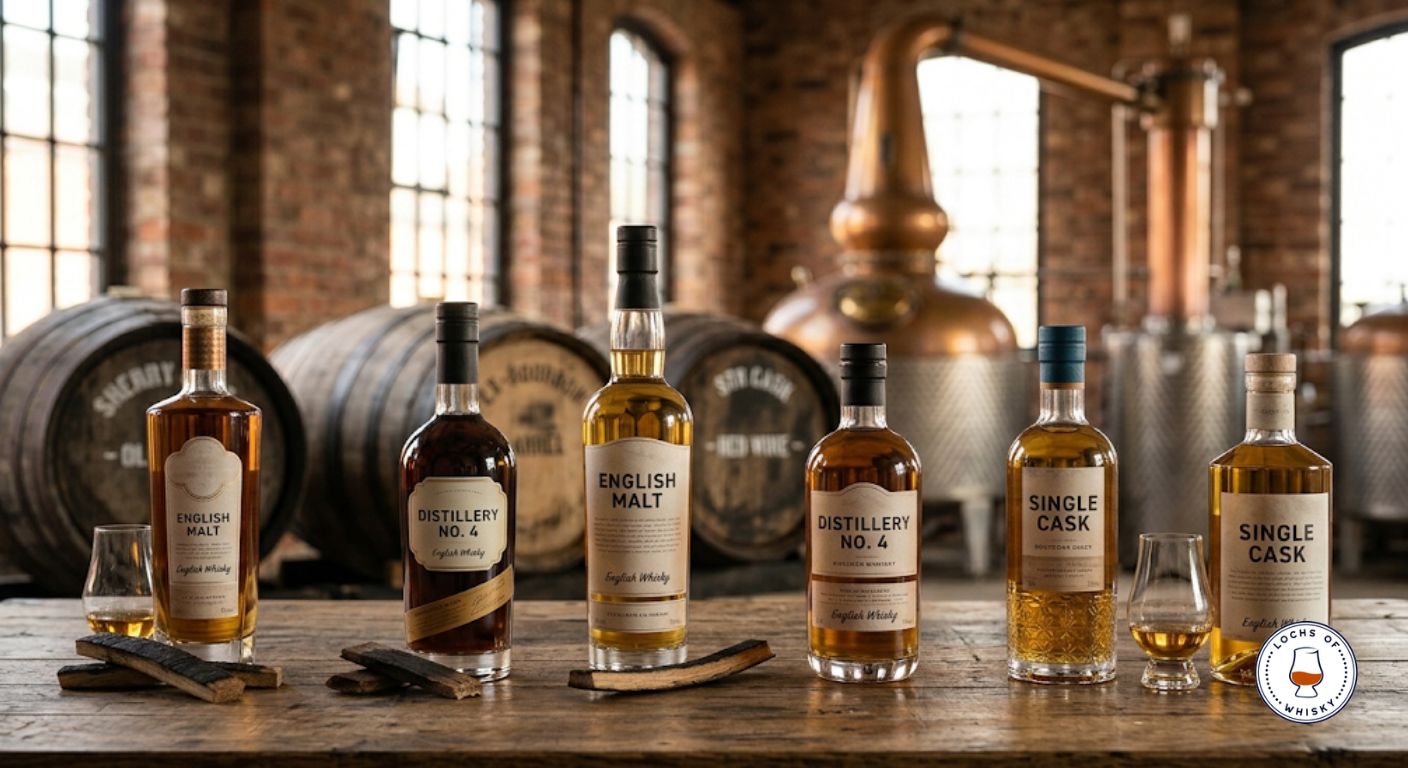
What Makes English Whisky Different?
English whisky is different because it is still being defined by active producers rather than centuries of fixed regional tradition. Scotland has deeply established categories, regions, and house styles. England has a younger distilling scene, where producers are building identity through local grain, long fermentation, small-batch production, varied cask policy, and direct experimentation.
The result is not one single English flavour profile. Some English single malts are soft, fruity, and bourbon-cask led. Others are dense, spicy, and sherry-driven. Some distilleries use peated malt. Others work with rye, heritage barley, STR wine casks, virgin oak, or unusual small-batch methods.
This is why the question “what is the best English whisky?” needs a structured answer. The right bottle depends on what you enjoy:
- For fruit and vanilla: look for ex-bourbon cask maturation.
- For dried fruit and spice: choose sherry cask or PX influence.
- For strength and intensity: check cask-strength releases above 50% ABV.
- For an easy first bottle: stay around 40–46% ABV.
- For collector interest: look at single casks, early distillery releases, and limited editions.
English whisky also sits within the wider world whisky category, alongside Japanese, Taiwanese, Indian, Welsh, Australian, and European whisky. That matters because buyers often compare English whisky against Scotch, but the better comparison is often with other modern world whisky producers: younger distilleries, active cask management, smaller batches, and more experimental release structures.
Is English Whisky As Good As Scotch?
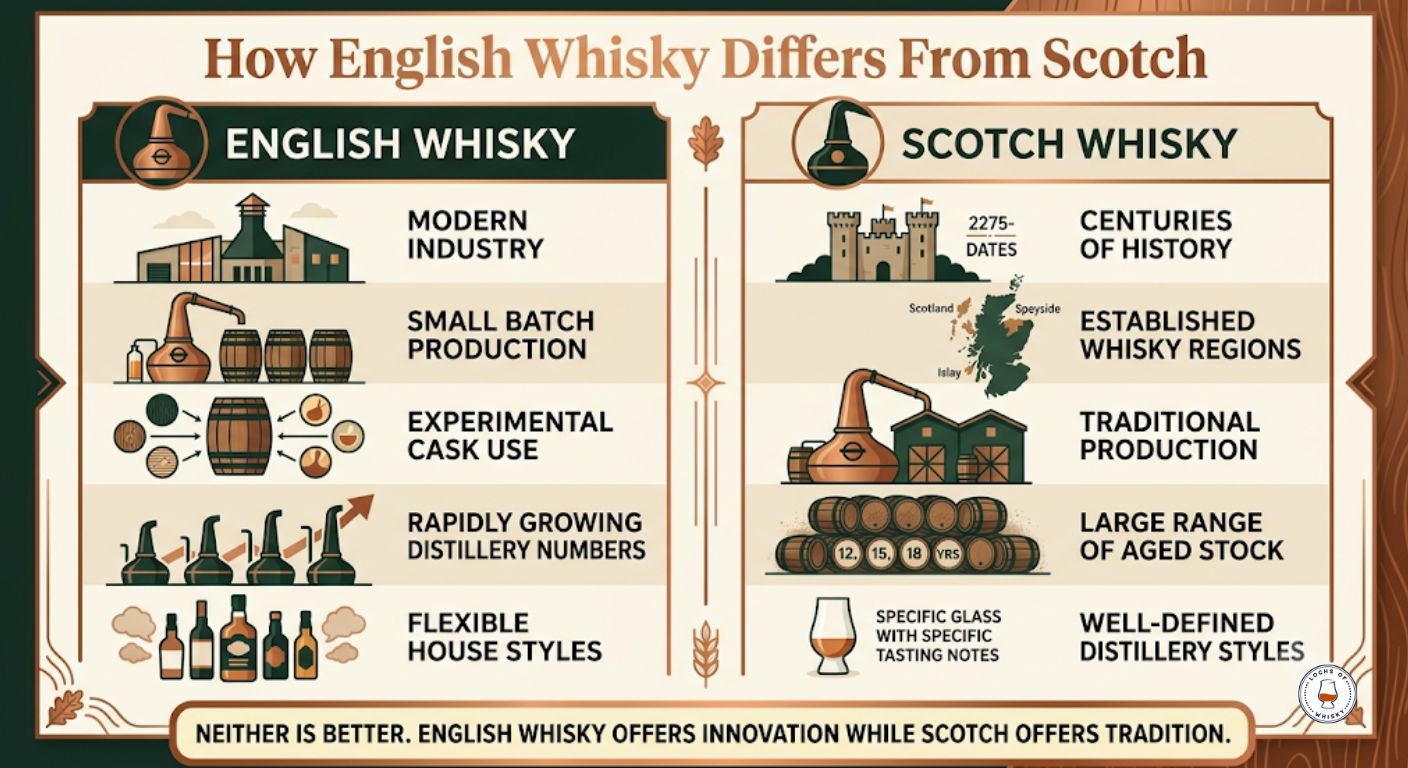
English whisky can be as good as Scotch, but it should not be judged by copying Scotch expectations. Scotch has greater depth, age, regional history, and mature stock. English whisky has less heritage but more flexibility. The strongest English bottlings now compete seriously on quality, especially in cask selection, distillery character, and award recognition.
The practical difference is maturity of category. Scotch offers a wider range of older stock, established distillery identities, and long-running age-statement releases. English whisky offers newer releases, smaller batches, and more variation between producers.
Bottom line: Scotch is still broader and more historically established; English whisky is smaller, younger, and increasingly credible at the quality end.
Major awards have helped shift the category from curiosity to serious buying consideration. Recent recognition at the World Whiskies Awards has given English producers stronger international proof points, particularly for single malt and small-batch releases. Awards are not a buying strategy on their own, but they are useful evidence that English whisky is no longer a novelty category.
For a narrower bottle-led view of current releases, use the supporting guide to Best English Whiskies To Try In 2025. This pillar explains how to choose; the supporting guide is better for bottle-by-bottle comparison.
English Single Malt, Grain Whisky, and Blends Explained
What is English single malt whisky?
English single malt whisky is malt whisky made at one English distillery using malted barley. Under the English whisky GI framework, malt English whisky must be batch distilled, with at least one distillation in a copper pot still, matured in wooden casks for at least three years, and bottled at a minimum of 40% ABV.
Single malt is the style most buyers associate with premium English whisky. It is usually the clearest expression of a distillery’s production choices: barley, fermentation, still shape, cask policy, and bottling strength.
Important bottle details to check:
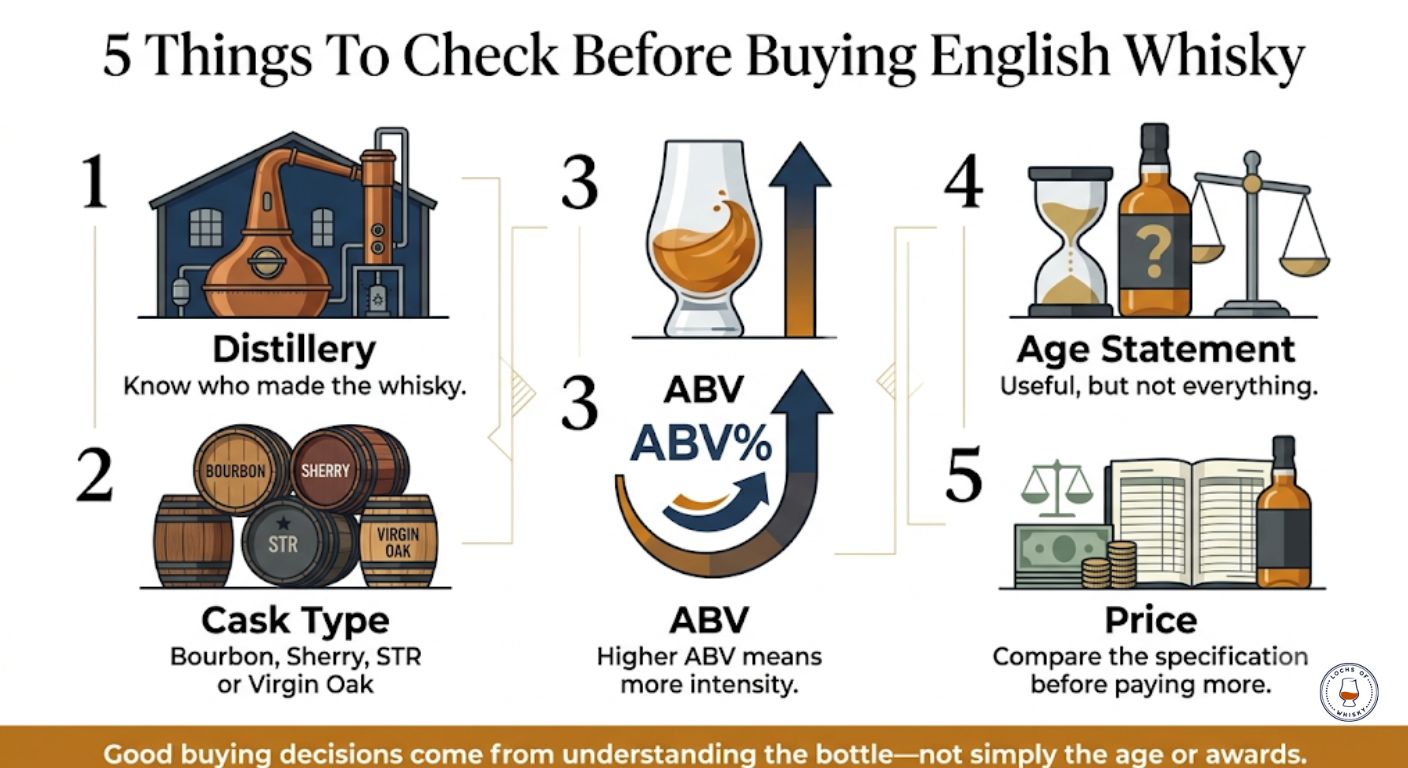
- Distillery: tells you who made the spirit.
- Age: useful, but not a quality guarantee.
- ABV: affects intensity, texture, and drinkability.
- Cask type: often the strongest clue to flavour.
- Batch or cask number: useful for limited releases.
What is the difference between single malt and blended whisky?
Single malt comes from one distillery and is made from malted barley. Blended whisky combines whisky from more than one source, and may include malt whisky, grain whisky, or both depending on the style. Single malt usually highlights distillery identity; blends focus more on balance and consistency.
In buying terms, single malt is usually the safer choice if you want to understand a specific English distillery. Blended English whisky can still be high quality, but it is less direct as a distillery-led discovery route.
Bottom line: choose single malt for distillery character; choose blends for balance, softness, or value.
The Rules For English Whisky
English whisky is moving towards a clearer protected identity through the English Whisky geographical indication process. The core requirements include English production, maturation in England, wood cask ageing, a minimum three-year maturation period, and a minimum bottling strength of 40% ABV. The UK Government’s published English Whisky product specification sets out the technical framework for the category.
For buyers, the rules matter because they protect basic expectations. A bottle labelled as English whisky should not be new make spirit, flavoured spirit, or an imported whisky simply bottled in England. It must meet the minimum whisky requirements.
However, rules do not tell you whether the bottle is good. They only confirm that it qualifies. Quality still depends on:
- the quality of the new make spirit;
- the cask type and cask activity;
- the length and conditions of maturation;
- the skill of blending or single-cask selection;
- whether the bottling strength suits the style.
One thing our customers often do not flag until after the bottle arrives is that cask-strength English whisky can hit very differently from the same distillery at 40–46% ABV, so the strength is worth checking before committing.
Which English Whisky Distilleries Should Buyers Know?
The English whisky map is now broad enough that distillery identity matters. You do not need to memorise every producer, but you should recognise the names that appear regularly in specialist retail, awards, and collector discussions.
Cotswolds Distillery
Cotswolds is one of the most visible modern English whisky producers. It is known for rich, fruit-led single malt, active cask use, and strong recognition beyond the English category. STR red wine casks are particularly associated with its house style.
Bimber
London’s Bimber has become one of the most followed English single malt producers among enthusiasts. Its appeal comes from small-batch production, strong release identity, and frequent limited bottlings. Bimber bottles often attract buyers who already understand single cask, cask strength, and release-series collecting.
St George’s / The English Distillery
St Georges, also known through The English Distillery, is central to the modern revival of English whisky. It helped re-establish English single malt production in the 21st century and remains important for buyers who want historical context as well as drinkable releases.
The Cheshire
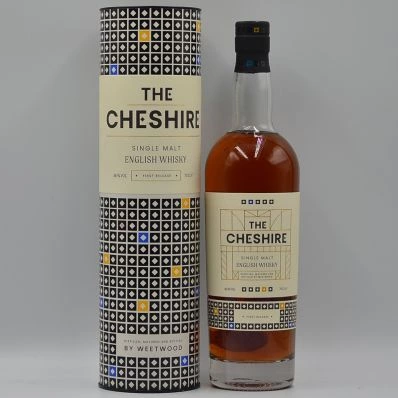
The Cheshire is part of the newer generation of English whisky producers building identity through local production and small-batch releases. For buyers, names like this matter because English whisky discovery is increasingly distillery-led, not just country-led.
Other names to recognise
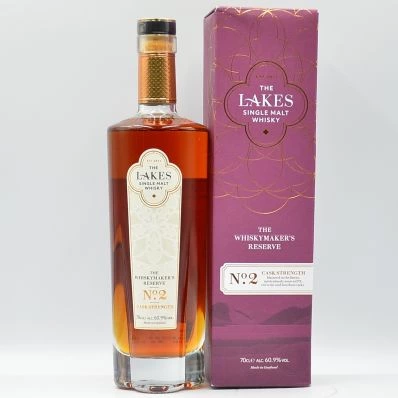
Other important English whisky producers include The Lakes, Spirit of Yorkshire, White Peak, Ad Gefrin, Copper Rivet, Dartmoor, Fielden, and Circumstance. This guide does not try to become a full A–Z list because that topic is better handled by the dedicated English distillery guide.
How Cask Type Changes English Whisky
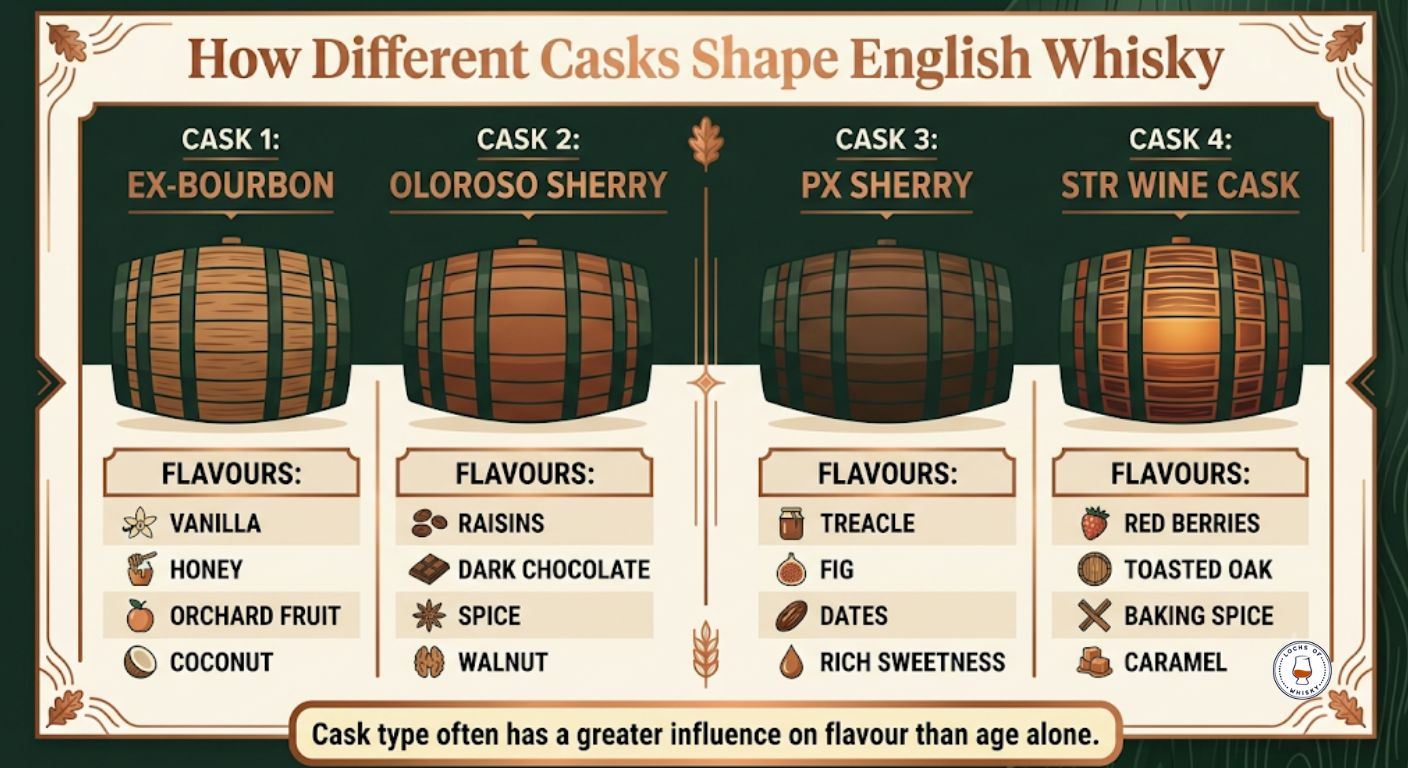
Cask type is often the most useful buying clue on an English whisky label. Many English distilleries are young compared with Scottish producers, so cask activity can shape the final whisky strongly. This is not a flaw. It is part of the category’s current character.
Ex-bourbon casks
Ex-bourbon casks usually bring vanilla, honey, coconut, light oak, orchard fruit, and a cleaner sweetness. They are often a good starting point for beginners because the profile is familiar and rarely too heavy.
Choose this if: you prefer lighter, sweeter, more approachable whisky.
Sherry casks
Sherry casks, especially Oloroso and Pedro Ximénez, bring dried fruit, dark sugar, walnut, spice, chocolate, and heavier texture. Full sherry maturation usually has more depth and cost than a short sherry finish.
Choose this if: you like richer whisky with dried fruit, spice, and weight.
STR casks
STR means shaved, toasted, and re-charred. These are usually ex-red wine casks that have been treated to refresh the oak and manage wine influence. STR maturation can create red fruit, spice, toasted oak, and a rounded sweetness. Cotswolds is one of the best-known English examples of this approach.
Choose this if: you want modern cask influence without moving fully into heavy sherry style.
Virgin oak
Virgin oak can add strong spice, vanilla, resin, and grip. It can work well in small doses, but too much can dominate young spirit.
Choose this if: you like bold oak, spice, and a more forceful finish.
Peated casks and peated malt
Peated English whisky is still a smaller part of the category, but it is increasingly important. Peat adds smoke, earth, ash, medicinal notes, or bonfire character depending on the malt and production method.
Choose this if: you already enjoy smoky Scotch or want a stronger flavour profile.
Does Age Matter In English Whisky?
Age matters, but it is not the main quality signal in English whisky. Because many English distilleries are young, a good three-to-six-year-old release from active casks can outperform an older whisky from tired wood. Cask quality, spirit quality, and balance matter more than the age number alone.
Use age as a context clue:
- 3–5 years: often lively, cask-forward, and youthful.
- 6–9 years: usually more integrated, with better balance if the cask is good.
- 10+ years: less common in English whisky and often more expensive.
Age-statement English whisky can be desirable because older stock is limited, but do not assume older always means better. A younger single cask at 55% ABV may be more interesting than an older 40% release if the cask and spirit are stronger.
How ABV Should Guide Your Choice
ABV is one of the easiest ways to avoid buying the wrong English whisky. It tells you how intense the bottle is likely to feel, even before you know the tasting notes.
- 40–43% ABV: softer, easier drinking, usually beginner-friendly.
- 46% ABV: a strong middle ground, often with good texture and clarity.
- 48–50% ABV: more body and flavour concentration.
- 50%+ ABV: cask strength or near cask strength; powerful, often best with water.
If you are buying a gift, 40–46% is usually safer unless the recipient already enjoys high-strength whisky. If you are buying for yourself and already drink single malt, 46–50% often gives the best balance between flavour and control. If you collect limited releases or enjoy adding water, cask strength can be the most rewarding.
Best English Whisky By Buyer Type
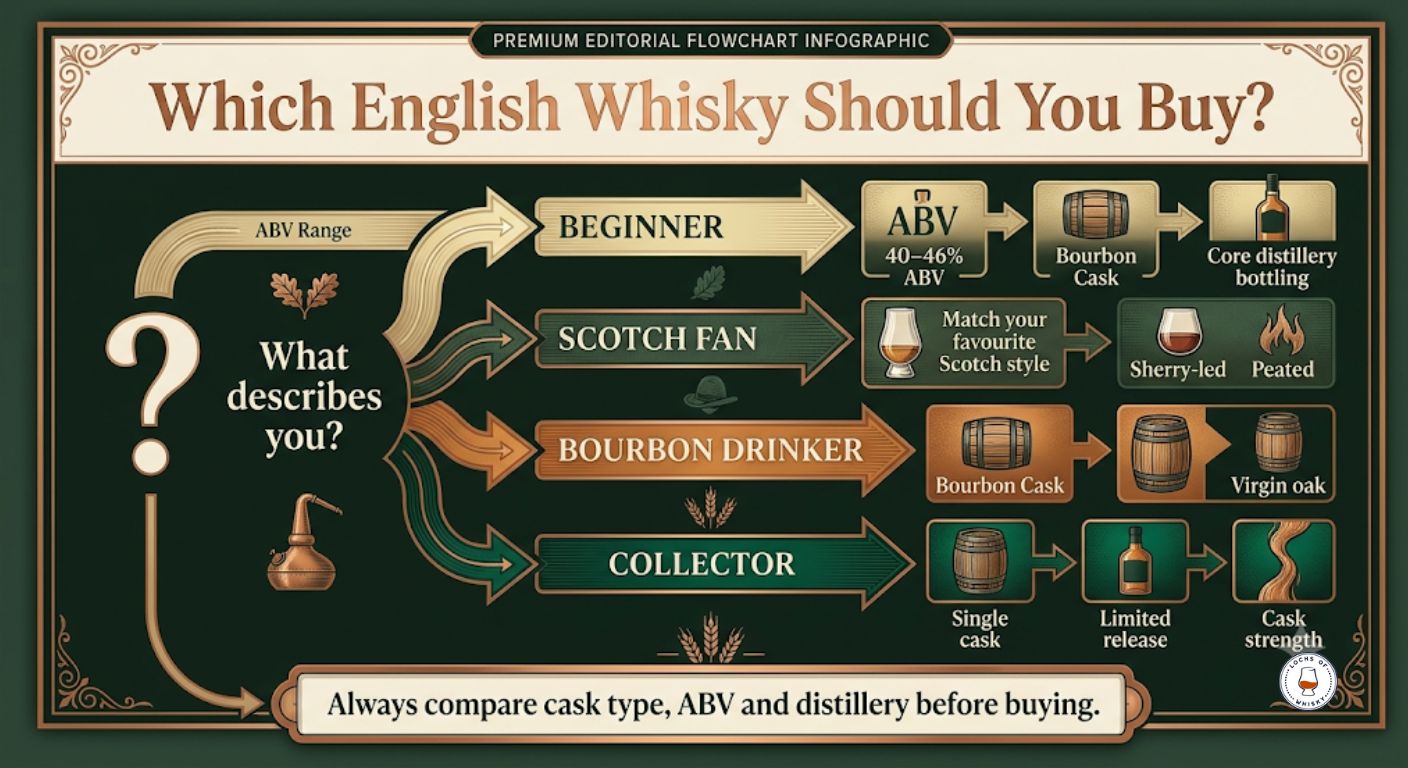
The best English whisky to buy depends on the buyer. Use preference, budget, and drinking experience before looking at awards or limited-edition language.
If you are new to English whisky
Start with a single malt around 40–46% ABV from a recognised distillery. Look for ex-bourbon, STR, or balanced sherry influence rather than a very high-strength single cask. This gives you a clearer sense of English whisky without overwhelming the first pour.
If you like Scotch single malt
Match by style rather than country. If you like Speyside Scotch, look for fruit-led bourbon or STR casks. If you like sherried Highland or Speyside whisky, choose English whisky with Oloroso or PX influence. If you like Islay, look for peated English releases rather than assuming all English whisky is light.
If you like bourbon
Look for English whisky matured in ex-bourbon casks or virgin oak. These bottles are more likely to show vanilla, caramel, honey, and oak spice. Avoid heavily peated or very dry sherry-cask releases as a first step unless you already enjoy Scotch.
If you are buying a gift
Choose recognisable distillery names, moderate ABV, and clear packaging. A 46% English single malt from a respected producer is usually safer than a specialist single cask at 58%. For gift buyers, clarity matters more than rarity.
If you are buying for a collector
Look for single casks, inaugural releases, distillery-exclusive bottlings, early batches, discontinued releases, or independent bottlings. Check cask number, bottle count, ABV, and whether the bottle has its original box or tube.
English Whisky Price Bands
English whisky often costs more than entry-level Scotch because many producers are small, stock is younger, and production lacks the same economies of scale. That does not make every bottle good value. It means you need to judge price against specification.
£30–£50
This is usually entry-level territory. Expect accessible single malts, blends, or smaller-format bottles. Avoid expecting old age statements or complex single-cask releases at this level.
£50–£80
This is often the strongest buying range for English whisky. You can find credible single malts, good cask influence, 46% ABV bottlings, and more distinctive distillery character.
£80–£150
This range is where limited releases, cask-strength bottlings, older English whisky, or more specialist distillery releases start to appear. Buy here only when the specification supports the price.
£150+
This is collector territory. The bottle should justify the price through age, rarity of release, distillery significance, cask detail, or historical importance. Do not pay this level for vague limited-edition wording alone.
How To Drink English Whisky For Beginners
Drink English whisky in a way that lets you understand the bottle first. Use a tulip-shaped glass if possible, pour a small measure, nose it gently, taste it neat, then add a few drops of water if the ABV is high or the whisky feels closed. Ice is optional but can mute detail.
A simple tasting process works best:
- Pour 20–25ml into a tulip-shaped glass.
- Let it sit for five minutes.
- Smell gently rather than deeply inhaling.
- Taste neat first.
- Add water gradually if the whisky is above 48% ABV.
- Note whether the dominant influence is spirit, cask, peat, or alcohol strength.
There are no fixed rules for enjoyment, but there is a sensible order. Taste neat first so you understand the bottle. Adjust with water afterwards.
Common Buying Mistakes
- Buying only by award wins: awards are useful, but your flavour preference still matters.
- Ignoring ABV: a 58% cask-strength bottle is not the same experience as a 46% core release.
- Assuming older is better: cask quality often matters more than age in English whisky.
- Confusing sherry finish with full sherry maturation: they are not the same and usually do not cost the same.
- Buying vague limited editions: check bottle count, cask type, batch number, and distillery context.
- Expecting Scotch regional rules: English whisky does not yet work like Speyside, Islay, Highland, and Lowland Scotch.
FAQ
What is the best English whisky to buy?
The best English whisky to buy is the one that matches your preferred style. For beginners, choose a 40–46% English single malt from a recognised distillery with clear cask information. For richer flavour, look for sherry casks. For lighter sweetness, choose ex-bourbon or STR cask maturation.
What are the best English whisky brands in the UK?
The strongest English whisky names include Cotswolds, Bimber, The English Distillery, The Lakes, Spirit of Yorkshire, White Peak, Ad Gefrin, Copper Rivet, and The Cheshire. “Best” depends on whether you want accessible drinking, single-cask releases, award recognition, or collector interest.
Is English whisky good for beginners?
Yes, English whisky can be good for beginners if you choose carefully. Start with single malt around 40–46% ABV and avoid very high-strength single casks at first. Bourbon-cask, STR, and balanced sherry-cask releases are usually easier starting points than heavy peat or cask-strength bottlings.
What does STR mean in whisky maturation?
STR means shaved, toasted, and re-charred. It usually refers to ex-red wine casks that have been treated to refresh the oak and control the wine influence. In English whisky, STR casks can add red fruit, spice, toasted oak, and rounded sweetness without becoming as heavy as full sherry maturation.
Is English single malt the same as Scotch single malt?
No. Both are whisky styles, but Scotch single malt must follow Scotch whisky regulations and be produced in Scotland. English single malt is produced in England under the English whisky framework. The flavour difference depends on distillery, cask, grain, maturation, and ABV rather than nationality alone.
Why is English whisky expensive?
English whisky can be expensive because many producers are small, stock is limited, and older whisky is less common. Small-batch production, active cask use, and limited releases increase cost. A higher price is only justified when the bottle has strong cask detail, distillery credibility, age, or release significance.
Should I choose English whisky by distillery or cask type?
Use both. Distillery tells you who made the spirit and gives context. Cask type tells you more about likely flavour. If you are new, start with cask type. If you already know producers you like, buy by distillery and then compare casks, batches, and ABV.
What ABV is best for English whisky?
For most buyers, 46% ABV is the best middle ground. It gives more texture than 40–43% without the intensity of cask strength. Beginners may prefer 40–46%. Enthusiasts often enjoy 48–55%. Cask-strength releases above 55% are best for drinkers comfortable adding water.
-
 Game of Thrones Whisky Johnnie Walker A Song Of FireSpecial Price £139.98 Regular Price £144.99 Inc VATSaving £5.01
 -
-
-
-
-
-
-
-
-
 Jack Daniel's - Master Distiller Batch 2 Jess Motlow Limited Edition Bourbon Whiskey£164.99 Inc VATOut of stock
 -
Structured Summary
- ABV: 40–46% is safer for beginners; 50%+ is for experienced drinkers or collectors.
- Age: useful context, but not a guarantee of quality.
- Cask type: ex-bourbon is lighter; sherry is richer; STR is modern, fruity, and spicy.
- Distillery: matters more as the category matures.
- Price: £50–£80 is often the strongest range for serious drinking bottles.
Common mistakes include buying only by awards, ignoring ABV, assuming older is always better, and paying collector prices for vague limited-edition wording. The best shortcut is simple: choose by drinking style first, then check distillery, cask, ABV, age, and price.
For a broader view of available bottles, current releases, and different English distillery styles, browse the full English whisky category at Lochs of Whisky.

Related Products
-
-
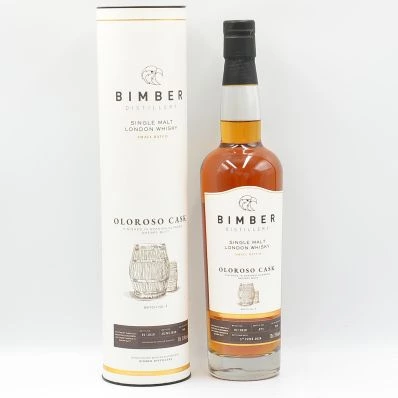 Bimber Oloroso Finish Small Batch #1 Single Malt WhiskySpecial Price £109.99 Regular Price £149.99 Inc VATSaving £40
 -
-
Comments