
 Chat with us on WhatsApp

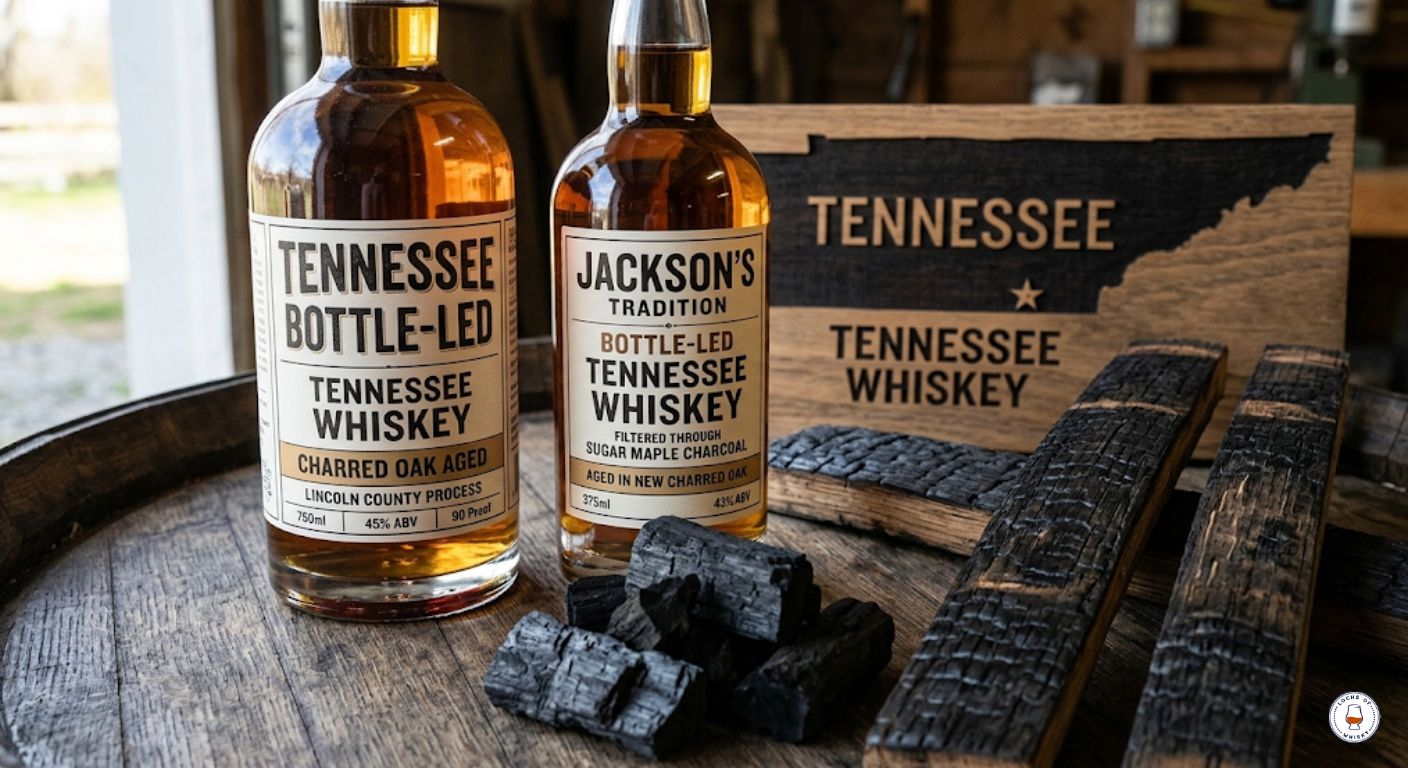
Best Tennessee Whiskey: Moving Away From Jack Daniel's
Tennessee whiskey is often reduced to one name, but the category is broader than Jack Daniel's. For UK buyers, the main issue is not finding Tennessee whiskey; it is understanding which bottles offer genuine character, fair value, and enough distinction from standard bourbon to justify the choice.
This guide explains what Tennessee whiskey is, how it differs from bourbon, why the Lincoln County Process matters, and how to judge Tennessee whiskey brands by mash bill, ABV, age, cask type and price. It is written for buyers who already know Jack Daniel's but want a clearer route into the wider category.
If you are comparing Tennessee releases with wider US styles, start with the broader American Whiskey category before narrowing down by distillery, proof or maturation style.
What Is Tennessee Whiskey?
Tennessee whiskey is American whiskey made in Tennessee, usually from a corn-led mash bill, matured in new charred oak, and filtered through sugar maple charcoal before ageing. That charcoal filtration step is known as the Lincoln County Process.
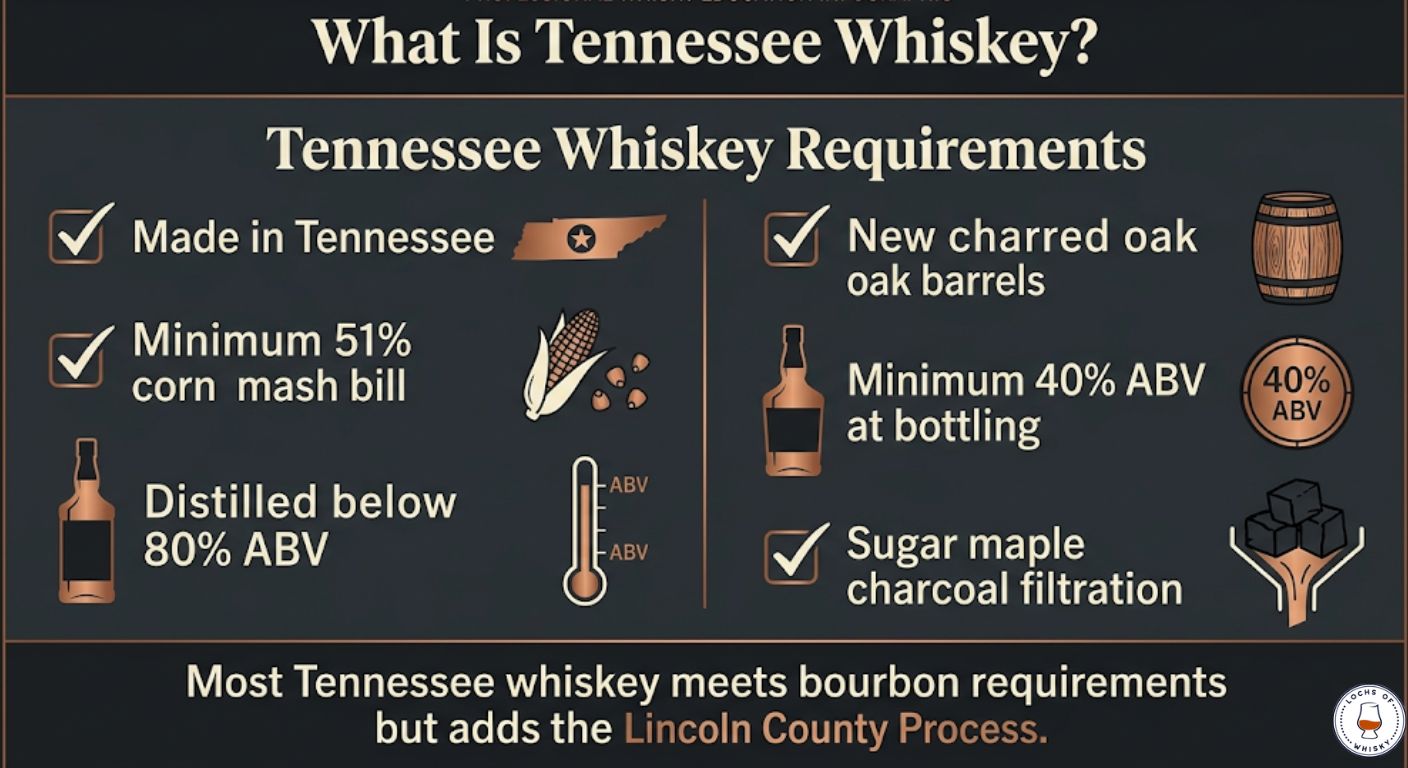
Most Tennessee whiskey follows rules very close to bourbon. It must usually be:
- Made in Tennessee
- Produced from at least 51% corn
- Distilled below 80% ABV
- Entered into new charred oak barrels at no more than 62.5% ABV
- Bottled at a minimum of 40% ABV
- Filtered through sugar maple charcoal before maturation
The US Alcohol and Tobacco Tax and Trade Bureau explains the core bourbon standard around 51% corn, distillation strength, and new charred oak maturation in its official distilled spirits guidance: TTB bourbon whisky classification guidance.
The extra Tennessee identity comes from place and process. It is not simply bourbon with a different label. The charcoal mellowing step gives many Tennessee whiskeys a softer entry, rounded sweetness, and less obvious grain sharpness than some comparable bourbons.
Bourbon vs Tennessee Whiskey
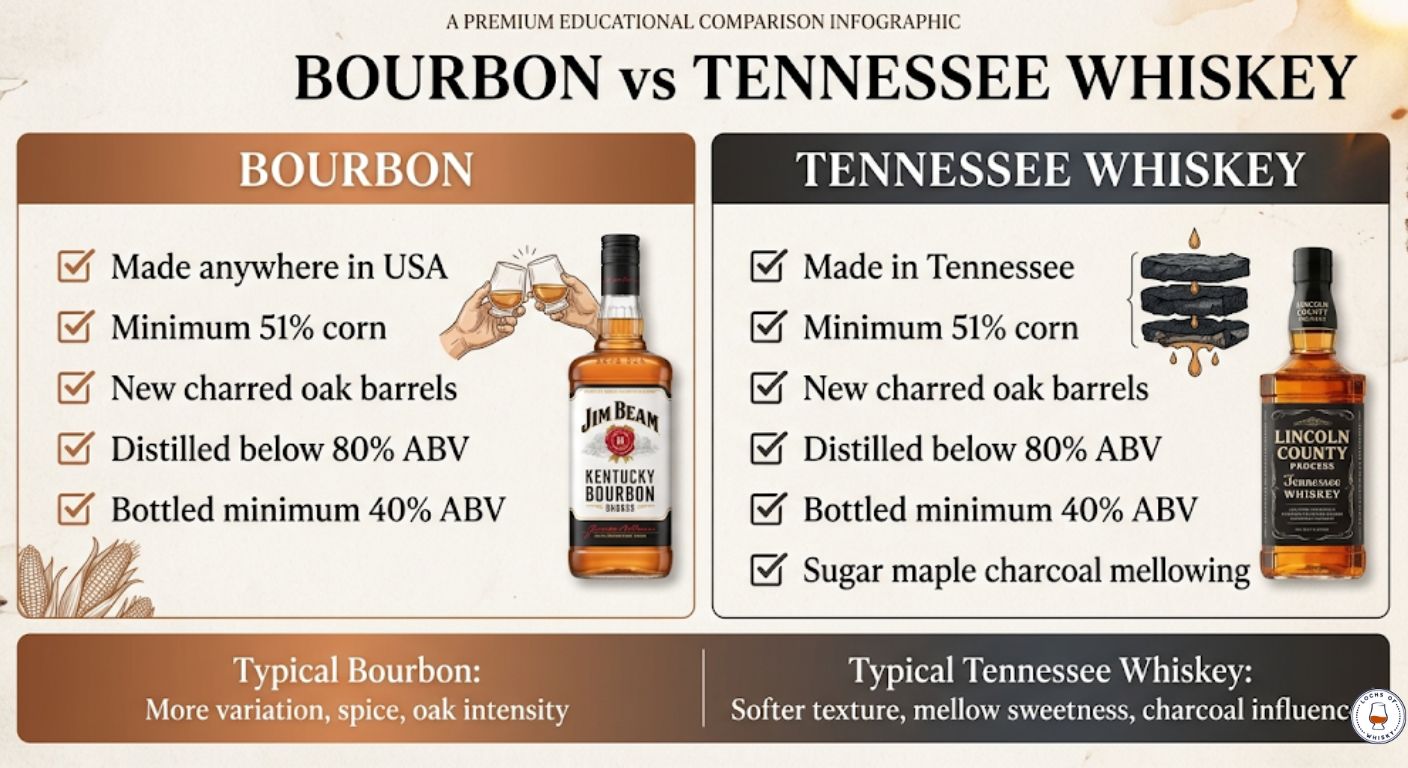
The key difference between bourbon and Tennessee whiskey is the Lincoln County Process. Bourbon can be made anywhere in the United States if it meets the legal production rules. Tennessee whiskey must be made in Tennessee and is normally charcoal mellowed before barrel ageing.
This means many Tennessee whiskeys are technically bourbon-like in structure, but they are not positioned in exactly the same way. Bourbon is defined nationally. Tennessee whiskey is defined by state identity and production tradition.
For buyers, the difference matters most in flavour and value. Bourbon often gives a wider range of styles, from high-rye spice to wheated softness and barrel-proof intensity. Tennessee whiskey tends to sit in a narrower lane: corn sweetness, oak, caramel, banana, toasted grain, charcoal-softened texture and accessible ABV.
If you want broader US whiskey comparison points, especially Kentucky-led bottles, the Bourbon Whiskey category is the natural place to compare Tennessee releases against classic bourbon profiles.
The Lincoln County Process Explained
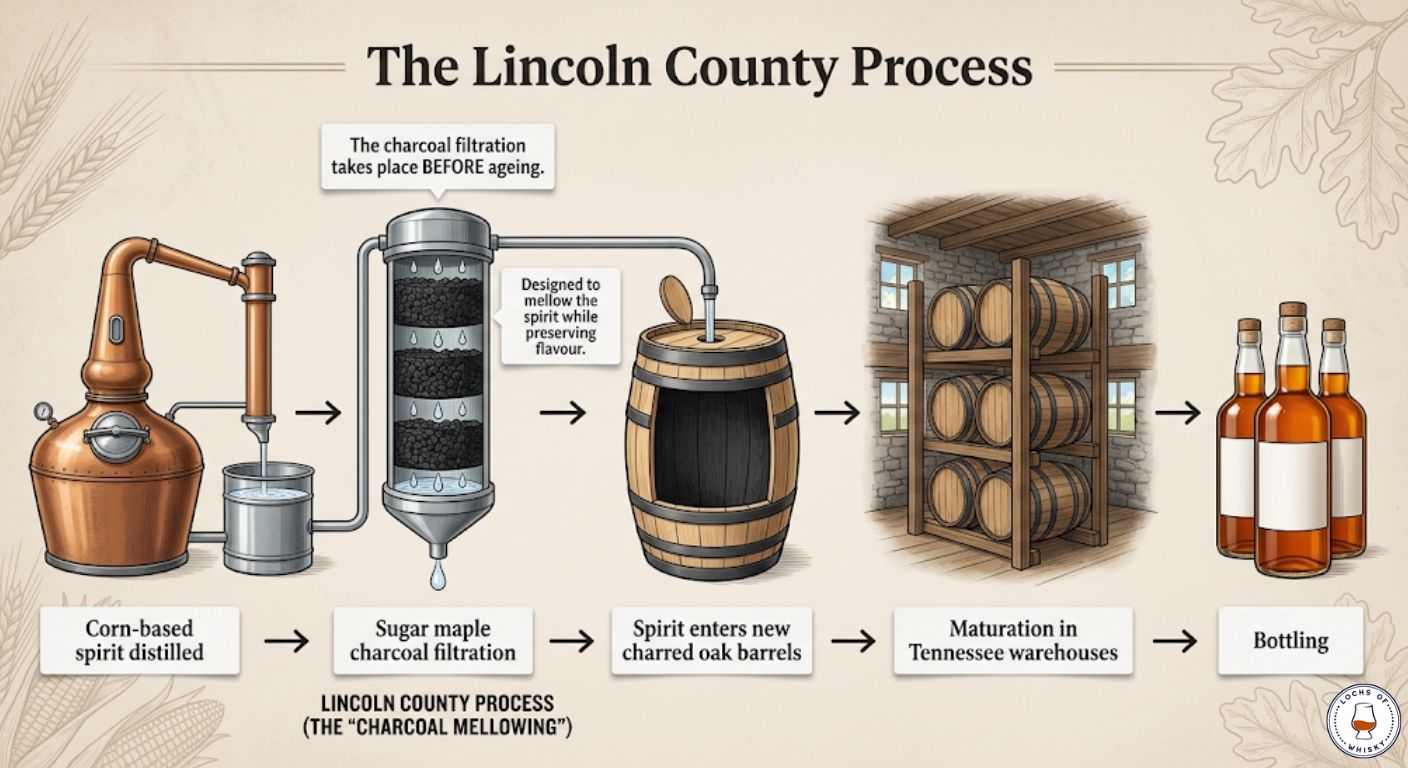
The Lincoln County Process filters new make spirit through sugar maple charcoal before it goes into barrel. The spirit is already distilled, but not yet matured. The charcoal helps soften heavier edges before oak ageing begins.
This is why Tennessee whiskey is often described as mellow. The process does not make the whiskey flavourless when handled well. It can reduce roughness while leaving the corn sweetness, oak structure and distillery character intact.
The process can vary by producer. Some use deep charcoal vats. Some adjust contact time. Some emphasise the process heavily, while others focus more on barrel selection, age statement or proof. The label will rarely tell the full story, so ABV, age and producer style still matter.
Moving Away From Jack Daniel's
Jack Daniel's Old No. 7 is the reference point for most people because it is widely available, familiar and bottled at 40% ABV. It gives the classic Tennessee profile: sweet corn, light oak, banana, vanilla and a soft finish.
The problem is not that Jack Daniel's is a poor benchmark. The problem is that it can make the whole category feel narrower than it is. Once you move into single barrel, bottled-in-bond or higher proof Tennessee whiskey, the category becomes more serious.
The Jack Daniel's distillery guide gives useful context on why the brand dominates the category, but buyers looking for more depth should compare it against producers such as Nearest Green and Leipers Fork.
Customers regularly tell us they want “something like Jack Daniel's, but better”; in practice, that usually means the same Tennessee sweetness with either higher ABV, clearer age, stronger oak influence or a more distinctive distillery character.
Best Tennessee Whiskey Brands To Know
The best Tennessee whiskey brands are not all trying to do the same job. Some are built around accessibility. Some lean into heritage. Others target enthusiasts who want single barrel strength, longer ageing or more transparency.
Jack Daniel's
Jack Daniel's remains the category anchor. Old No. 7 is the entry point, but the more useful buying comparisons come from Single Barrel, Bonded, Triple Mash and higher-proof releases. These show more structure than the standard bottle and make better sense for buyers who want recognisable Tennessee character without staying at entry level.
Nearest Green
Nearest Green is one of the most important modern Tennessee whiskey names. It is tied to the legacy of Nathan “Nearest” Green, widely recognised for his role in Jack Daniel's early distilling history. The Nearest Green guide is a useful reference point for buyers interested in Tennessee whiskey heritage beyond the largest producer.
Leipers Fork
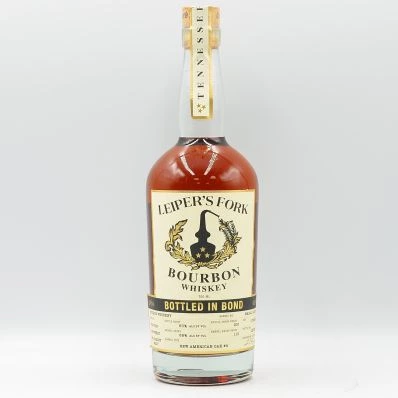
Leipers Fork is a smaller Tennessee producer with more craft-led positioning. For buyers, the appeal is not scale. It is the chance to explore Tennessee whiskey with more visible production identity and less reliance on mass-market familiarity. See the Leipers Fork guide for distillery context.
How To Choose Tennessee Whiskey
Choosing Tennessee whiskey is easier if you ignore broad rankings and check five details: ABV, mash bill, age, cask type and price.
ABV
Standard Tennessee whiskey often sits at 40% ABV. That is accessible, but it can feel light. Bottled-in-bond releases at 50% ABV usually offer better structure. Single barrel and barrel-proof releases can move much higher, often giving more oak, spice and concentration.
Mash Bill
Most Tennessee whiskey is corn-led. A higher corn percentage usually means more sweetness. More rye generally brings spice and grip. Wheat can soften the profile. If the bottle does not disclose the mash bill, judge it more cautiously and use ABV, producer and age statement as stronger buying signals.
Age Statement
Age matters, but it is not everything. Tennessee's climate can mature whiskey assertively, so older does not always mean better. Around four to eight years can give good balance. Ten years and above may bring deeper oak, but only if the cask quality supports it.
Cask Type
New charred American oak is central to the style. Expect vanilla, caramel, toasted oak and spice. Finishes can add interest, but they should not hide weak base whiskey. For collectors and enthusiasts, original maturation detail is usually more useful than vague finishing language.
Price
In the UK, entry Tennessee whiskey often sits around £20–35. More serious bottles often fall around £40–75. Limited, older, single barrel or barrel-proof releases can move above £80. The useful question is not whether the bottle is expensive; it is whether the ABV, age, producer and maturation detail justify the price.
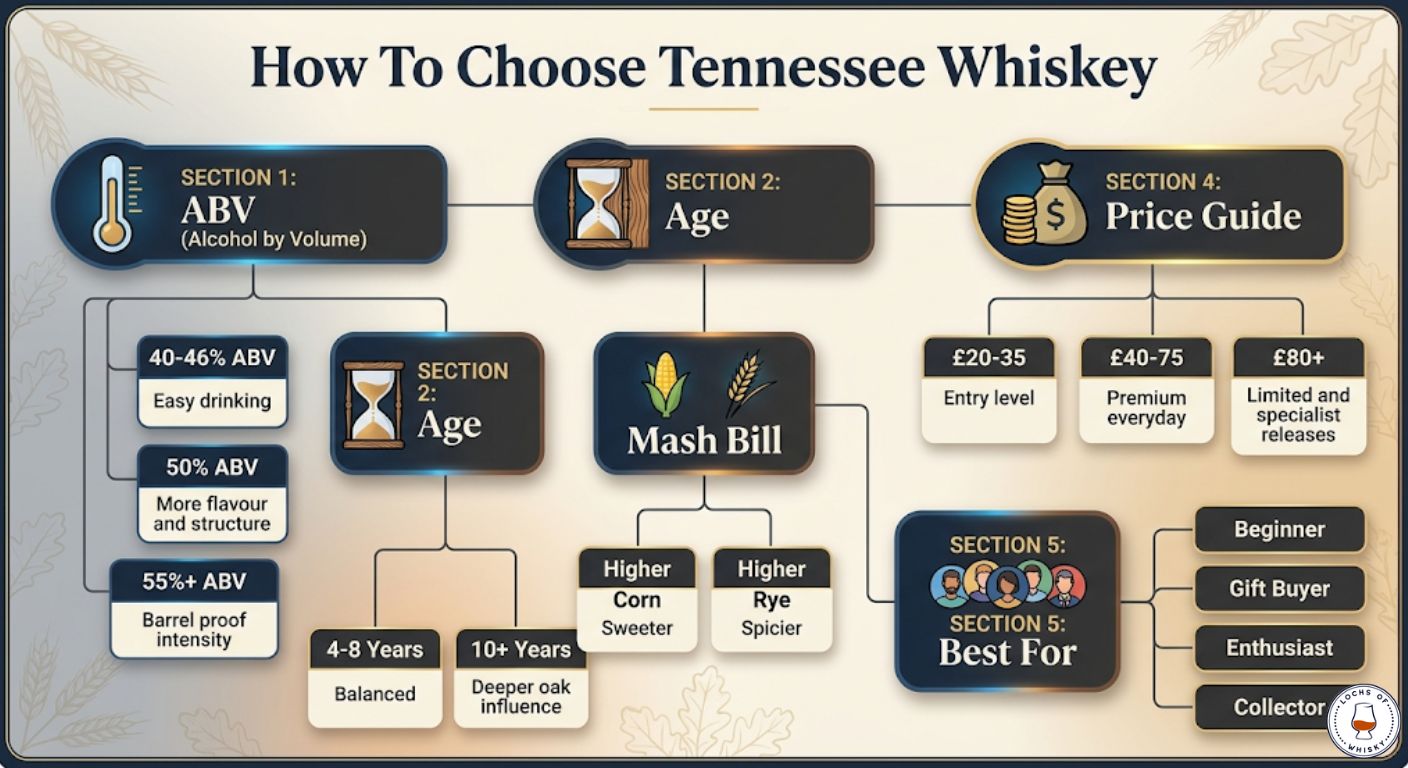
Decision Logic: Which Tennessee Whiskey Should You Choose?
- If you like Jack Daniel's but want more structure, choose a bottled-in-bond or single barrel Tennessee whiskey rather than another 40% ABV bottle.
- If you want soft sweetness, look for corn-led Tennessee whiskey around 40–46% ABV.
- If you want more oak and spice, choose 50% ABV or higher.
- If you are buying as a gift, avoid obscure barrel-proof bottles unless the recipient already drinks high-strength whiskey.
- If your budget is £30–60, prioritise ABV and producer credibility over packaging.
- If you want collector interest, look for single barrel, age-stated, limited or discontinued Tennessee releases.
- If you want maximum individuality, compare Tennessee single barrels with Single Barrel Bourbon to understand how barrel selection changes the drinking profile.
Top Rated Tennessee Whiskey: What Actually Matters?
Top rated Tennessee whiskey is not always the right bottle for every buyer. Awards, reviews and online rankings often reward intensity, age or novelty. A high-proof single barrel may score well but still be unsuitable for someone moving up from Jack Daniel's Old No. 7.
Use ratings as a secondary signal. The primary signals should be:
- Producer reputation
- ABV
- Age statement or batch transparency
- Barrel type
- UK price
- Availability
A £45 bottle at 50% ABV from a credible Tennessee producer can be a stronger buy than an expensive limited release with little information. Transparency matters more than noise.
Tennessee Whiskey Brands UK Buyers Should Approach Carefully
UK buyers should be careful with Tennessee whiskey that gives very little detail. A bottle may look premium but still offer no age statement, low ABV and vague production information.
Watch for these issues:
- Low ABV with premium pricing
- No age statement and no batch detail
- Heavy reliance on brand story instead of production facts
- Flavoured whiskey being confused with straight Tennessee whiskey
- Imported bottles priced far above their US market position
Flavoured Tennessee whiskey can be enjoyable, but it should not be judged against straight whiskey. Honey, apple, cinnamon or liqueur-style releases are different products with different use cases.
FAQ
Is Tennessee whiskey technically bourbon?
Many Tennessee whiskeys meet the broad production rules associated with bourbon: at least 51% corn, distillation below 80% ABV, new charred oak maturation and bottling at 40% ABV or higher. The distinction is that Tennessee whiskey is made in Tennessee and normally uses the Lincoln County Process before ageing.
Is Tennessee whiskey smoother than bourbon?
Generally, yes. Tennessee whiskey often tastes smoother because the new spirit is filtered through sugar maple charcoal before it enters the barrel. This can reduce harsh edges and create a softer texture. Smoothness does not automatically mean better quality; some bottles are mellow but lack depth.
What is the Lincoln County Process?
The Lincoln County Process is sugar maple charcoal filtration before barrel ageing. New make spirit passes through or rests with charcoal, which helps mellow the whiskey before maturation in new charred oak. It is the key production step that separates most Tennessee whiskey from standard bourbon.
Why did Jack Daniel's lower its proof?
Jack Daniel's Old No. 7 was reduced to 40% ABV in the early 2000s. Some drinkers felt the lower proof made it softer but less characterful. Buyers who want more intensity should look at Bonded, Single Barrel or higher-proof Jack Daniel's releases rather than the standard bottle.
Who was Nearest Green?
Nathan “Nearest” Green is recognised as a major figure in Tennessee whiskey history and is closely associated with the early development of Jack Daniel's distilling knowledge. Modern Nearest Green whiskey connects that history with a current Tennessee whiskey brand focused on heritage and production identity.
What is the best budget Tennessee whiskey?
For budget Tennessee whiskey, look for bottles around £25–45 with clear producer identity and at least 40% ABV. If you can stretch toward £45–60, bottled-in-bond or higher-proof releases usually offer better structure and more value than entry-level 40% ABV bottles.
What are higher proof alternatives to Jack Daniel's Old No. 7?
Look at Jack Daniel's Bonded, Jack Daniel's Single Barrel, barrel-proof Tennessee releases, or comparable bottled-in-bond whiskey from Tennessee producers. The main upgrade is ABV: moving from 40% to 50% ABV or higher usually brings more oak, spice, body and finish.
Structured Summary
Key Rules
- Tennessee whiskey is usually bourbon-like, but made in Tennessee and charcoal mellowed before ageing.
- The Lincoln County Process is the key production distinction.
- 40% ABV is accessible; 50% ABV usually gives better structure.
- New charred American oak drives vanilla, caramel, toasted oak and spice.
- Age helps, but cask quality and ABV matter just as much.
Common Mistakes
- Assuming all Tennessee whiskey tastes like standard Jack Daniel's.
- Paying premium prices for low-ABV bottles with limited detail.
- Confusing flavoured Tennessee whiskey with straight whiskey.
- Choosing by brand story instead of ABV, age, cask and producer.
Decision Shortcuts
- For easy drinking, choose 40–46% ABV.
- For more depth, choose bottled-in-bond or single barrel.
- For collectors, prioritise age-stated, discontinued, single barrel or limited releases.
- For value, compare UK price against ABV and production transparency.
Tennessee whiskey rewards careful selection. The category is narrow if you only judge it by standard Jack Daniel's, but far more interesting once you compare producer, proof, barrel selection and age. For wider US whiskey browsing, return to the American Whiskey category and compare Tennessee bottles against bourbon, rye and single barrel releases.

Comments