
 Chat with us on WhatsApp


Learning how to drink bourbon is mostly about matching the pour to the bottle. A 40% ABV easy-drinking bourbon does not need the same treatment as a barrel-proof whiskey at 60% ABV. A wheated bourbon behaves differently from a high-rye style. A cocktail needs structure, while a neat pour needs aroma and balance.
This guide explains when to drink bourbon neat, when to add water, when ice helps, and when a cocktail is the better choice. It also covers glassware, tasting technique, common mistakes, and practical buying logic for UK drinkers exploring American whiskey. For a wider view of the category, the American whiskey selection gives useful context across bourbon, rye, Tennessee whiskey and newer American styles.
What Bourbon Is Before You Decide How To Drink It
Bourbon is an American whiskey style with legal production rules. It must be made in the United States from at least 51% corn, distilled below maximum proof limits, matured in new charred oak, and bottled at no less than 40% ABV. The TTB standards of identity for whisky set out the formal US regulatory framework.
Those rules matter because they explain why bourbon tastes the way it does. Corn gives bourbon its core sweetness. New charred oak brings vanilla, caramel, toasted sugar, coconut, spice and tannin. Secondary grains then change the direction:
- Wheated bourbon: softer, rounder, often sweeter in texture.
- High-rye bourbon: spicier, drier, more peppery and assertive.
- Traditional bourbon mash bill: balanced between corn sweetness, rye spice and oak.
- Four-grain bourbon: more layered, depending on the producer and cask selection.
This is why there is no single “correct” way to drink bourbon. The right serve depends on proof, mash bill, oak intensity, age, and your own tolerance for alcohol heat.
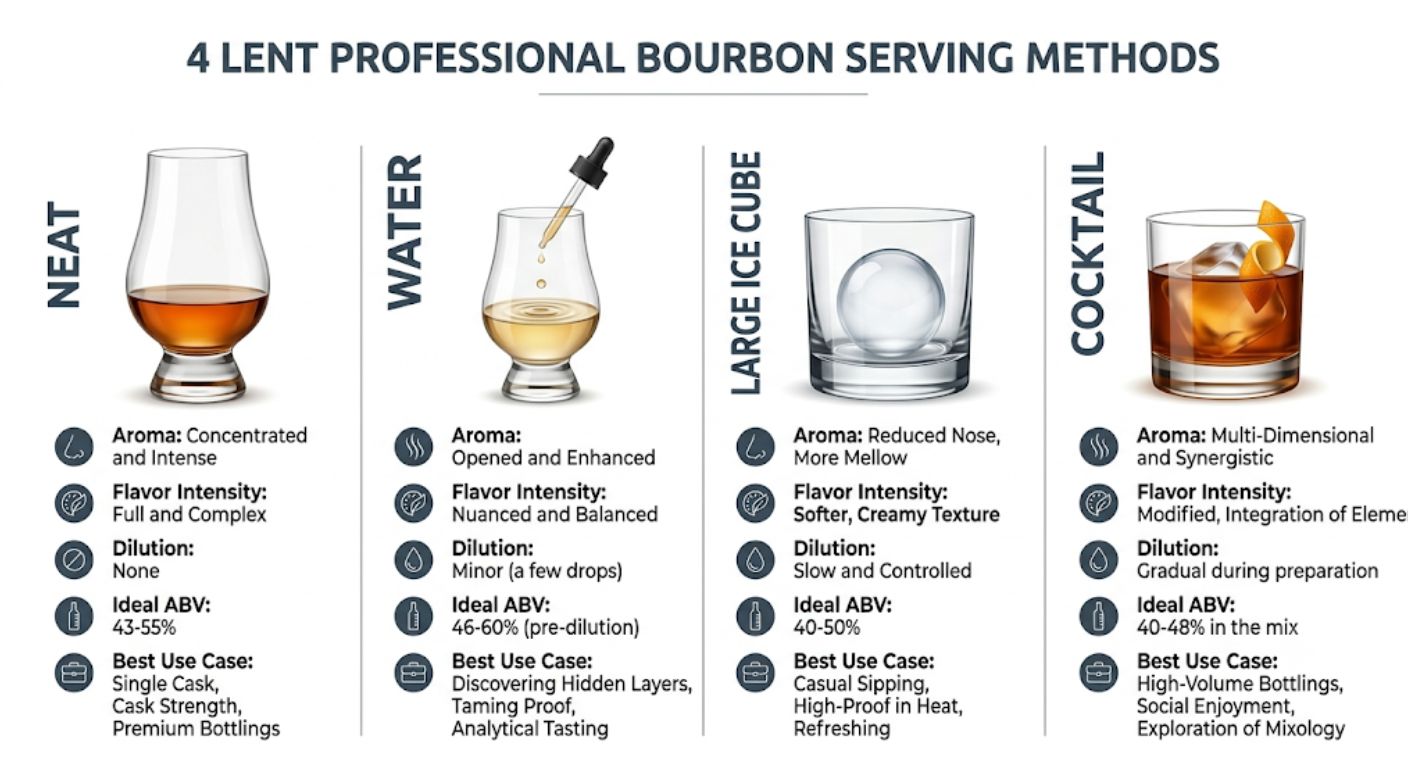
Neat: Best For Understanding The Bottle
Drinking bourbon neat means serving it at room temperature with nothing added. It is the clearest way to assess aroma, texture, sweetness, oak, spice and finish. Neat is best when you want to understand the whiskey itself rather than soften, chill or mix it.
Start with a small pour: 25ml is enough. Let it sit in the glass for a few minutes, especially if it is above 46% ABV. Do not bury your nose in the glass. Bourbon carries ethanol vapour, and aggressive nosing can make even a well-balanced whiskey feel harsh.
Use short, gentle sniffs from slightly above the rim. Then take a small sip and let it move across the tongue before swallowing. The first sip often shows heat more than flavour. The second sip is usually more useful.
Neat works especially well for:
- Lower-proof bourbon around 40–46% ABV.
- Older or more oak-driven bottles where dilution may flatten texture.
- Single barrel releases where you want to judge the cask character.
- Comparing different mash bills side by side.
Our customers often underestimate ABV when moving from standard bourbon to barrel-proof releases; a bottle at 58–62% ABV can feel like a different category, even when the flavour profile looks familiar on paper.
Water: Best For High-Proof Bourbon
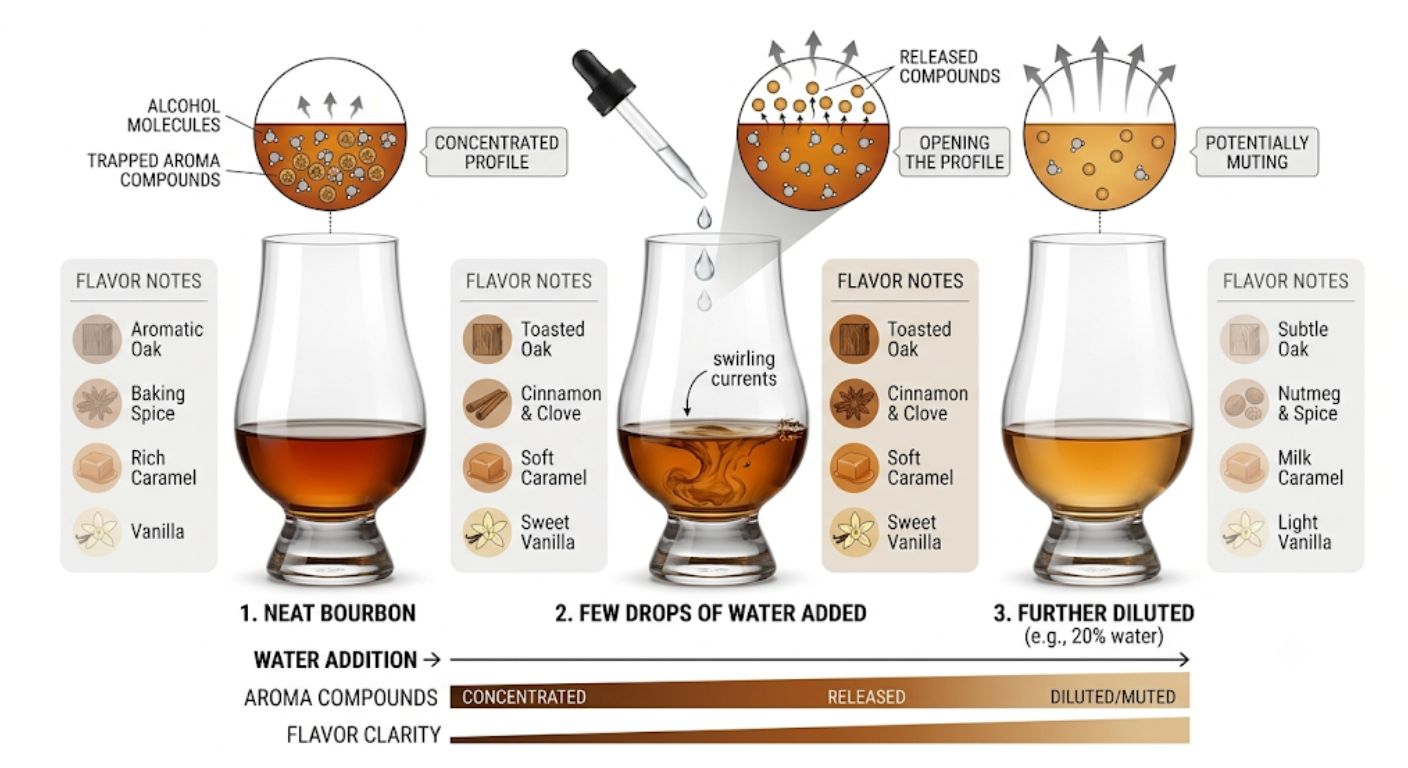
Adding water to bourbon does not ruin it when done carefully. A few drops can reduce ethanol heat and help aromas rise from the glass. This is most useful with stronger bourbon, especially cask-strength or barrel-proof bottles above 50% ABV.
Use room-temperature water, not chilled water. Add it slowly. A pipette is ideal, but a teaspoon also works if you are careful. The aim is not to make the bourbon weak. The aim is to find the point where alcohol heat falls back and flavour becomes clearer.
How much water should you add?
Start with two or three drops in a 25ml pour, then nose and taste again. If the bourbon still feels closed, sharp or hot, add another few drops. For very high-proof bourbon, you may need more, but stop before the texture becomes thin.
A useful method is to taste the same bourbon three ways:
- Neat: to understand the full-strength profile.
- With a few drops: to soften ethanol and lift aroma.
- With a little more water: to see where flavour starts to fade.
This teaches you more than following a fixed rule. A 45% ABV bourbon may need no water. A 60% ABV bourbon may open noticeably with dilution.
Ice: Best For Softer Drinking, Not Detailed Tasting
Ice chills bourbon and dilutes it as it melts. That can make alcohol heat more manageable, but it also suppresses aroma. Ice is best when you want an easier, slower drink rather than a detailed tasting pour.
The type of ice matters. Small freezer cubes melt quickly and can turn bourbon thin before you finish the glass. A large cube or sphere melts more slowly because it has less surface area relative to its volume. That gives you a steadier chill and slower dilution.
When should you drink bourbon on the rocks?
Drink bourbon on the rocks when the pour feels too hot neat, when you want a relaxed serve, or when the bottle has enough sweetness and oak to survive chilling. It works well with robust bourbon around 45–50% ABV, but delicate or low-proof whiskey can become muted quickly.
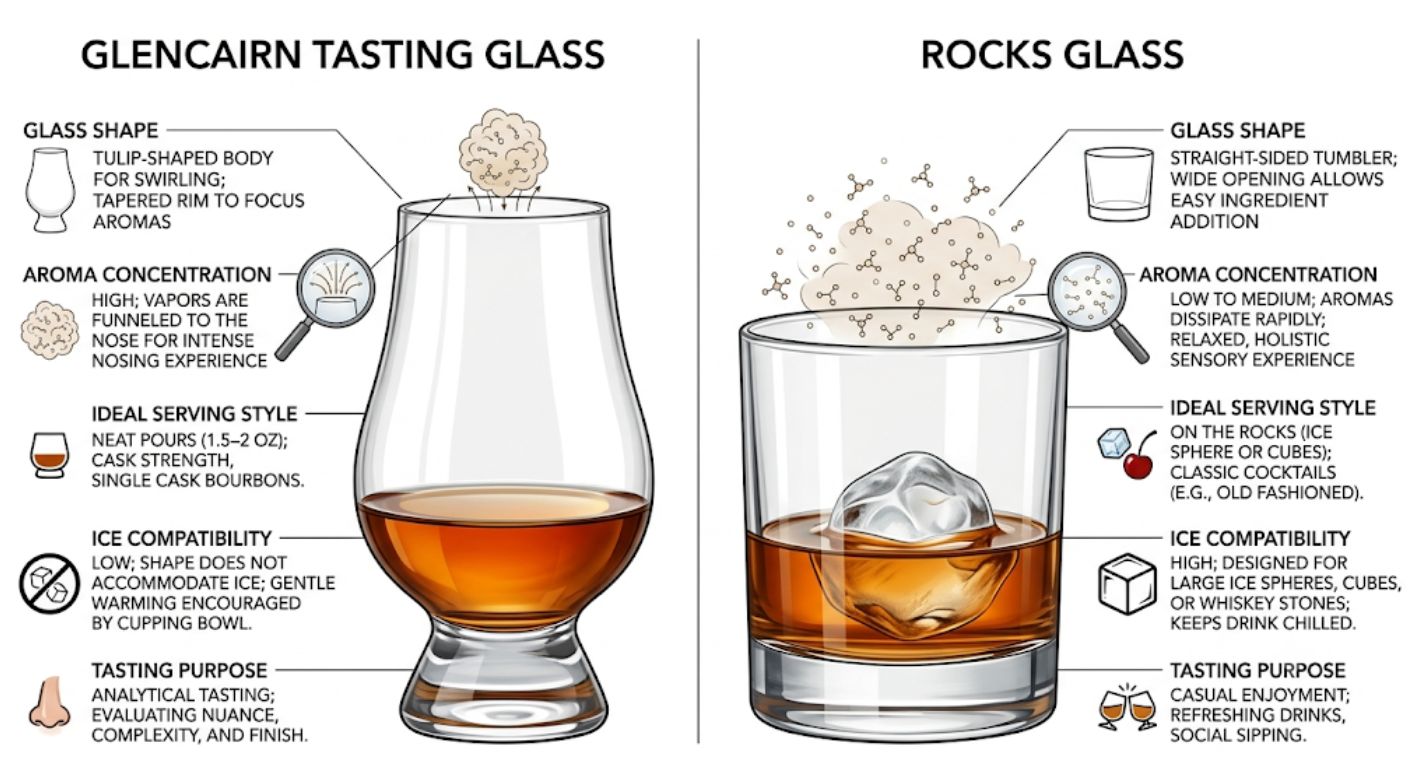
Use a rocks glass for ice. A Glencairn or tulip glass is better for nosing, but it is not designed for large ice. If the purpose is flavour analysis, use a nosing glass. If the purpose is a slow drink over ice, use a tumbler.
Glassware: Glencairn vs Rocks Glass
A Glencairn-style glass is best for tasting bourbon neat because the bowl holds aroma and the narrow rim concentrates it. A rocks glass is better for ice, cocktails and casual drinking because it has the width and weight needed for larger cubes and stirred serves.
| Glass | Best Use | Why It Works |
|---|---|---|
| Glencairn or tulip glass | Neat bourbon, tasting flights, comparing bottles | Concentrates aroma and makes it easier to assess nose and finish |
| Rocks glass | Bourbon over ice, Old Fashioned, casual sipping | Wide enough for large ice and comfortable for stirred drinks |
| Copita | Detailed nosing | Works well for aromatic spirits but can intensify alcohol vapour |
| Shot glass | Not recommended for tasting | Too narrow and short to assess aroma or texture properly |
The Kentucky Chew Tasting Method
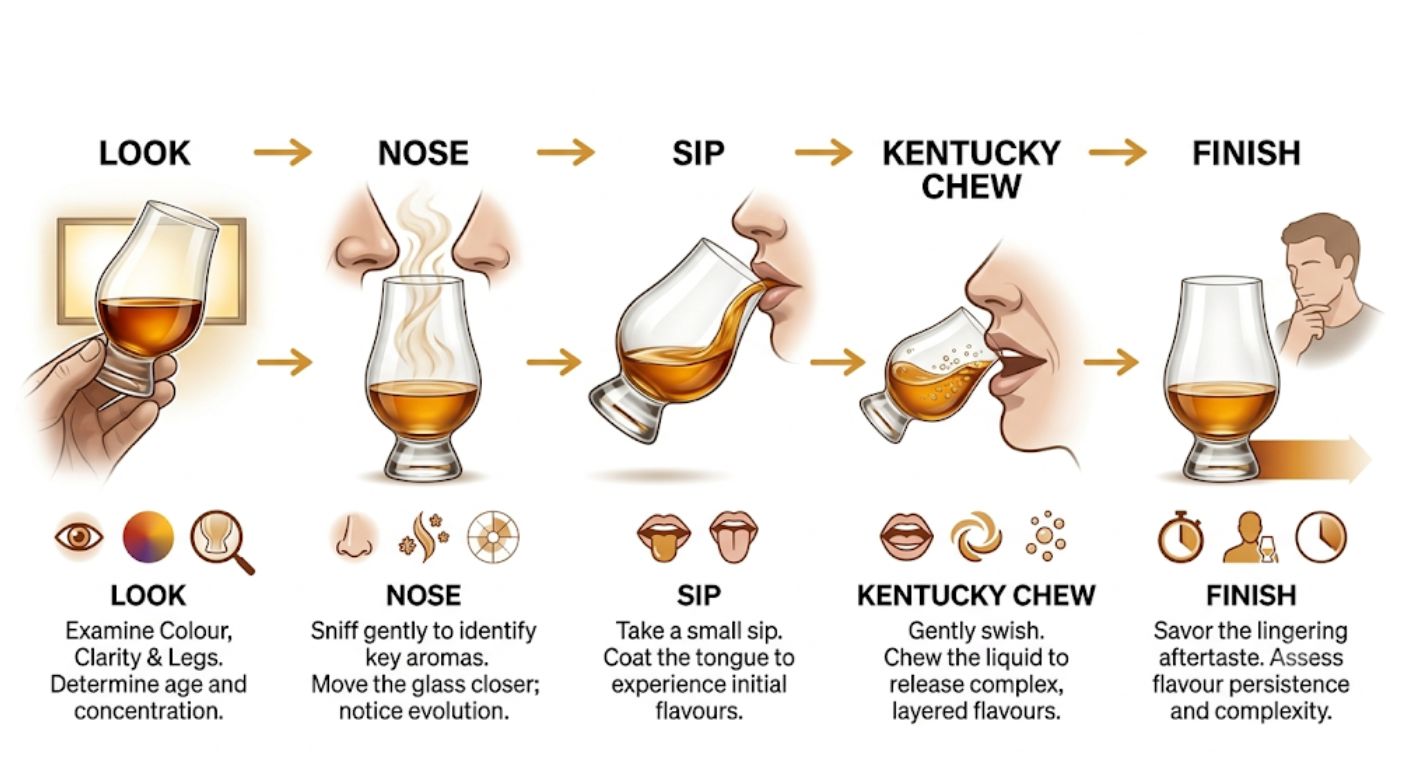
The Kentucky Chew is a simple bourbon tasting technique. Take a small sip, move it around the mouth, let it coat the tongue and cheeks, then swallow and assess the finish. It helps you notice texture, sweetness, spice and oak rather than judging only the first hit of alcohol.
- Take a small sip, not a mouthful.
- Hold it briefly on the tongue.
- Move it gently around the mouth.
- Breathe lightly through the nose if comfortable.
- Swallow and note the finish: sweet, spicy, dry, hot, oily or tannic.
This is useful with bourbon because new charred oak can make the finish feel sweet, drying or spicy depending on age, cask activity and proof.
Cocktails: Best When The Bourbon Has Structure
Bourbon works well in cocktails because it has sweetness, oak and body. The best cocktail bourbon is not necessarily the most expensive bottle. It needs enough proof and flavour to stand up to sugar, bitters, citrus, vermouth or ice.
For an Old Fashioned, choose a bourbon with enough oak and spice to avoid becoming flat. For a Whiskey Sour, choose something with body and sweetness. For a Mint Julep, a slightly higher-proof bourbon often works better because crushed ice dilutes quickly.
If you are choosing bourbon around food rather than cocktails, the same logic applies: match weight to weight. Rich bourbon can stand up to steak, BBQ and chocolate, while softer styles work better with cheese or lighter dishes.
Neat, Rocks, Water Or Cocktail: Decision Logic
| Situation | Best Serve | Reason |
|---|---|---|
| You want to understand the bottle | Neat | Shows aroma, texture, oak, spice and finish most clearly |
| The bourbon is above 50% ABV | Neat first, then water | Lets you assess full strength before reducing alcohol heat |
| The bourbon feels sharp or closed | A few drops of water | Can reduce ethanol edge and open aroma |
| You want a slower, softer drink | Large ice cube | Chills and dilutes gradually |
| The bourbon is delicate or low proof | Neat or very light water | Ice may mute aroma and thin the body |
| You are making cocktails | 45–50% ABV bourbon where possible | Higher flavour intensity holds up better when mixed |
How To Choose Bourbon By Drinking Style
If you prefer soft, sweet bourbon, look for wheated styles around 40–46% ABV. These tend to suit neat drinking and beginner-friendly serves. If you prefer spice and structure, look for high-rye bourbon or bottles closer to 45–50% ABV.
If you drink bourbon mostly in cocktails, avoid paying extra only for age or collectability. A bottle with good proof, oak and spice is often more useful than a delicate bottle with a higher price. If you drink neat, age, cask quality and balance matter more.
- £30–45: good for everyday neat pours, highballs and cocktails.
- £45–70: often the best range for stronger flavour, better balance and more interesting mash bills.
- £70–120: look for single barrel, higher proof, limited releases or craft distillery character.
- £120+: buy for specific distillery, release, age, proof or collector interest — not because price alone guarantees better drinking.
For drinkers moving between Scotch and bourbon, it helps to compare flavour structure rather than category labels. A sherry-cask Scotch drinker may want richness and dried fruit, while a Speyside drinker may prefer softer vanilla-led bourbon. If you are comparing premium Scotch against American whiskey, the Best Scotch 50 to 100 range gives a useful price benchmark for what £50–£100 can buy in another whisky category.
Distillery Style Matters
Producer identity matters because mash bill, fermentation, still type, barrel entry proof, warehouse location and blending approach all affect how a bourbon or American whiskey drinks.
Classic Kentucky producers tend to give a clear reference point for bourbon structure. For example, Buffalo Trace is often associated with approachable bourbon profiles built around caramel, vanilla, oak and gentle spice. Texas producers can show a bolder climate influence, with faster oak extraction and more concentrated flavours; Balcones is a useful American whiskey reference point for that bigger style. Smaller US producers such as Yellow Rose can also help drinkers understand how American whiskey varies outside the standard Kentucky frame.
Common Mistakes When Drinking Bourbon
- Using too much ice: small cubes dilute quickly and can flatten the whiskey.
- Nosing too aggressively: bourbon can carry strong ethanol vapour, especially above 50% ABV.
- Assuming neat is always best: some high-proof bourbon improves with water.
- Using expensive bottles automatically in cocktails: structure matters more than price.
- Ignoring ABV: proof changes texture, heat, dilution and cocktail performance.
- Confusing smoothness with quality: some excellent bourbon is assertive, spicy or oak-heavy by design.
FAQ
What is the best way to drink bourbon?
The best way is to taste it neat first, then decide. If it feels balanced, keep it neat. If it feels hot or closed, add a few drops of water. If you want an easier drink, use one large ice cube. For cocktails, choose bourbon with enough proof and flavour to hold its shape.
Should bourbon be drunk neat or with ice?
Drink bourbon neat when you want aroma, texture and finish. Use ice when you want a softer, colder serve. Ice lowers alcohol heat but also mutes aroma and gradually dilutes the whiskey. A large cube is better than several small cubes because it melts more slowly.
Does adding water to bourbon ruin it?
No, not when added carefully. A few drops of water can reduce alcohol heat and help aromas become clearer, especially in bourbon above 50% ABV. Too much water can make the whiskey thin, so add slowly and taste after each small adjustment.
What is the difference between bourbon neat and straight up?
Neat means bourbon served at room temperature with nothing added. Straight up, or “up”, usually means the drink has been chilled with ice and then strained into a glass. For bourbon, neat is best for tasting; straight up is more common in cocktail service.
What glass should you use for bourbon?
Use a Glencairn or tulip-shaped glass for neat tasting because it concentrates aroma. Use a rocks glass for bourbon with ice or cocktails because it has room for a large cube and is easier to handle. Avoid shot glasses for tasting because they hide aroma and texture.
Are whiskey stones better than ice for bourbon?
Whiskey stones chill bourbon gently without dilution, but they do not cool as effectively as ice. Ice chills faster and changes the drink as it melts. Stones are useful if you only want a slight chill. Ice is better if you want both cooling and controlled dilution.
How do you make clear ice for bourbon?
Use directional freezing. Fill a small insulated cooler with water and freeze it with the lid off. The top freezes first, pushing air bubbles and impurities downward. Cut away the cloudy lower section and use the clear upper ice for large cubes or blocks.
Is bourbon good in cocktails?
Yes. Bourbon works well in cocktails because corn sweetness, charred oak, vanilla and spice give it structure. For stirred drinks, use bourbon with enough oak and proof. For citrus cocktails, use bourbon with body and sweetness. Very delicate or expensive bottles are usually better kept for neat drinking.
-
-
-
-
-

-
-
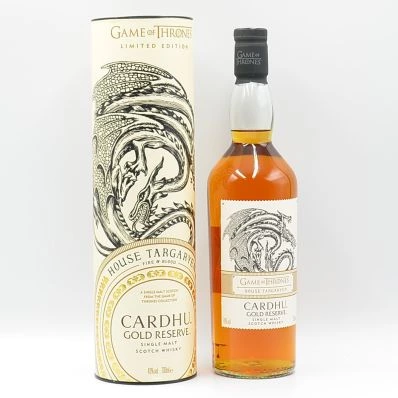
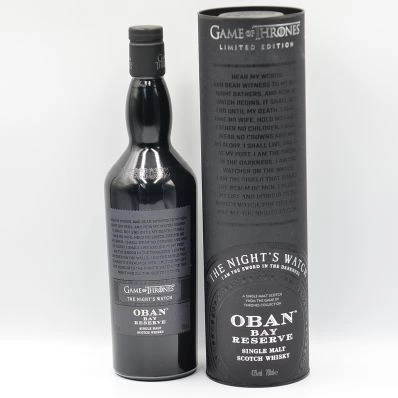 Game of Thrones Whisky Oban Bay Reserve The Night's WatchSpecial Price £72.98 Regular Price £84.99 Inc VATSaving £12.01
 -
-

Structured Summary
- Start neat: always taste the bottle first before adding water or ice.
- Check ABV: 40–46% ABV often drinks well neat; 50%+ may benefit from water.
- Use water carefully: add drops, not splashes.
- Use large ice: one large cube gives slower dilution than small freezer cubes.
- Choose glassware by purpose: Glencairn for tasting, rocks glass for ice and cocktails.
- Match bourbon to serve: wheated for soft sipping, high-rye for spice, higher proof for cocktails.
- Do not judge by price alone: mash bill, ABV, age, cask quality and producer style matter more.
The simplest rule is: taste first, adjust second. Bourbon should be served in the way that shows the bottle at its best. For broader exploration by style, proof and producer, browse the American whiskey category.

Comments