
 Chat with us on WhatsApp


Is Whisky A Good Investment?
Whisky can be a good investment, but only when bought with clear rules around provenance, condition, scarcity, storage, and exit route. It is not a guaranteed-return asset, and it should not be treated like a quick-flip product. The strongest cases usually involve collectible bottles from respected distilleries, limited releases with verified provenance, or maturing casks with proper ownership paperwork.
This guide explains how whisky investment works, where the risks sit, and how to judge whether a bottle or cask has genuine long-term interest. It also separates bottle collecting from cask ownership, because they behave very differently. If you are looking at bottles rather than casks, the safest starting point is usually established, authenticated stock in the whisky investment bottles category rather than speculative private offers.
What Makes Whisky Investable?
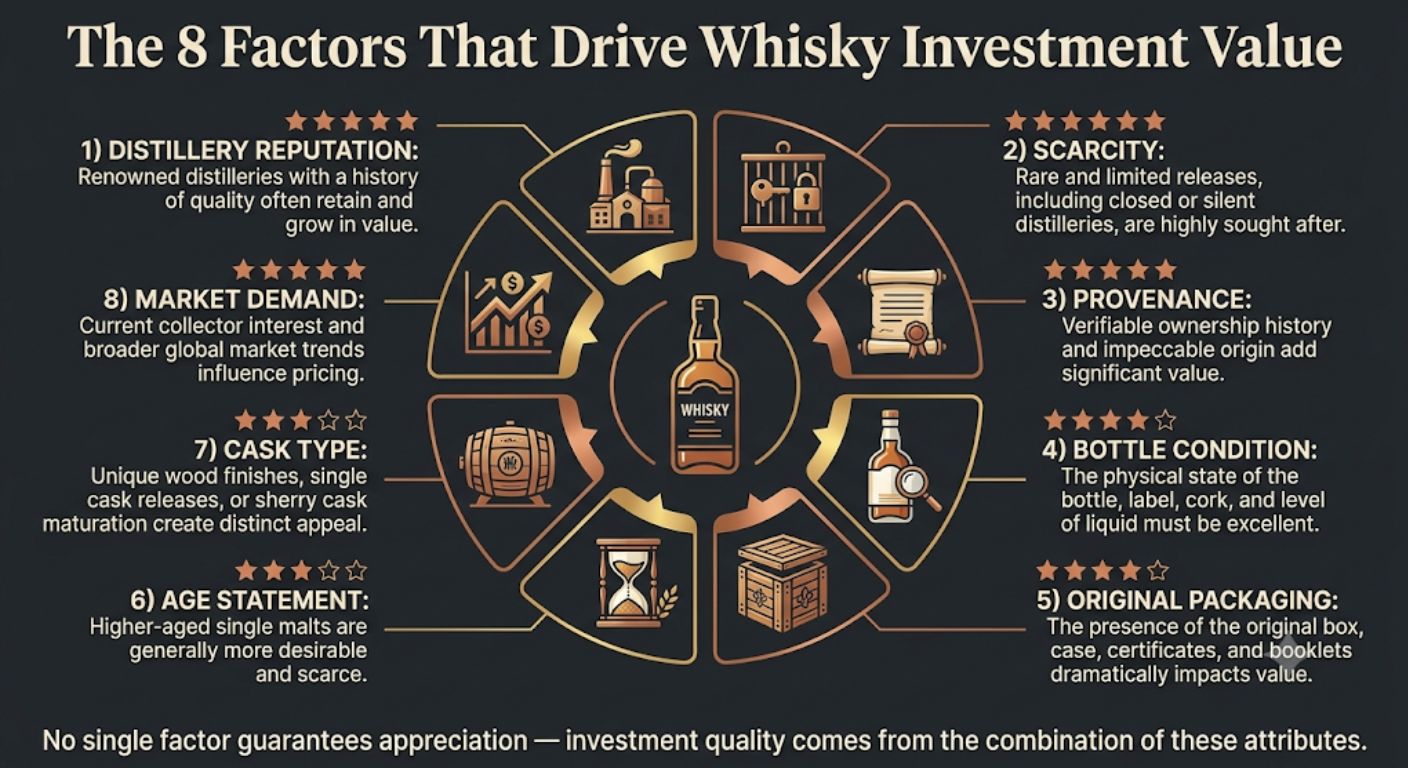
Whisky becomes investable when demand is likely to exceed available supply over time. That usually depends on the distillery, age statement, release size, bottle condition, original packaging, cask type, ABV, and documented provenance.
The strongest bottles usually share several traits:
- Recognised distillery reputation
- Limited or discontinued release
- Good bottle condition, fill level, label, and packaging
- Clear age statement or vintage
- Verified provenance
- Collector demand beyond short-term hype
Distillery reputation matters because collectors tend to trust names with long auction history and deep global demand. Macallan is the clearest example of a blue-chip whisky name, while Springbank has strong collector interest because of its production character, limited availability, and Campbeltown identity.
That does not mean every bottle from a famous distillery is a good investment. Standard modern releases, damaged bottles, poor fill levels, missing boxes, and overpaid auction lots can all underperform.
Bottle Investment vs Cask Investment
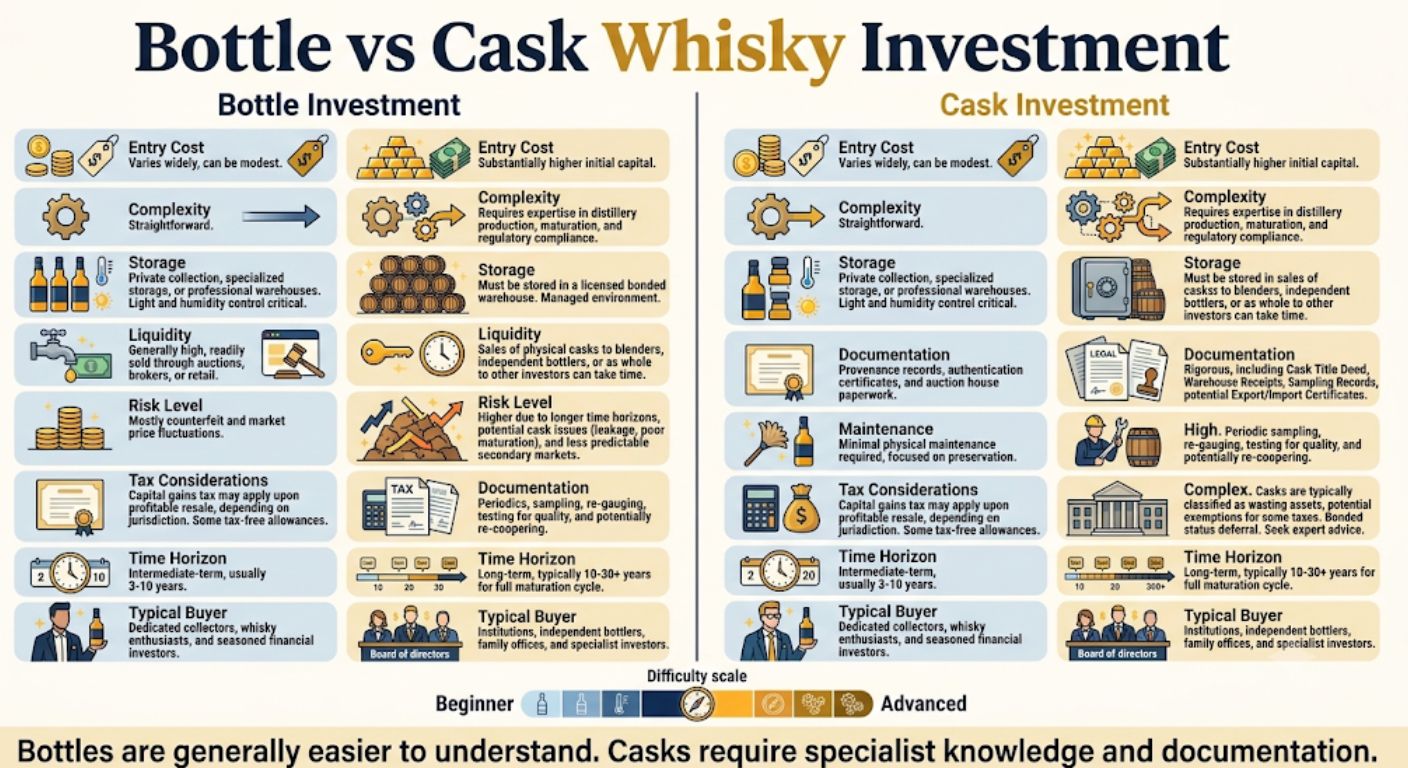
Bottles and casks are different assets. Bottles rely mainly on scarcity, condition, collector demand, and brand reputation. Casks rely on maturation, warehouse records, ownership verification, spirit quality, ABV, and the eventual exit route.
Bottle investment is usually easier to understand. You buy a finished, sealed product. You can inspect the label, closure, fill level, box, capsule, and release details. You can also compare recent market prices more easily.
Cask investment is more complex. A cask continues to mature, but it also loses volume through evaporation. ABV can fall over time, and if it drops below 40%, the liquid can no longer legally be sold as whisky. Storage, sampling, insurance, re-gauging, bottling, duty, VAT, and brokerage fees all affect the real outcome.
Why Some Whisky Bottles Rise In Value
Bottle values usually rise when collector demand grows while supply becomes harder to find. This is why discontinued releases, older age statements, closed distillery bottlings, limited editions, and historically important series can attract stronger interest.
The main drivers are:
- Distillery authority: long-standing reputation, collector recognition, and consistent demand.
- Scarcity: limited production, discontinued bottlings, or low surviving supply.
- Age and vintage: older age statements and dated releases can matter, but only when supported by demand.
- Condition: clean labels, strong fill levels, intact capsules, and original packaging protect value.
- Release context: anniversary bottlings, old-style labels, single casks, and notable independent bottlings can carry additional interest.
Age alone is not enough. Customers regularly ask us whether age statement really matters. After 12 years, the differences become more about cask quality than time in the barrel — we have seen 10-year-olds outclass 18-year-olds from less-active casks.
Blue-Chip Distilleries And Collector Demand
Blue-chip whisky distilleries are names with long-standing collector demand, strong resale recognition, and a track record of interest across different markets. They are not risk-free, but they are usually easier to understand than obscure bottles with little price history.
Collectors often focus on distilleries with clear identity. Macallan is closely associated with sherry-cask prestige and global auction demand. Springbank is valued for traditional production, limited supply, and Campbeltown character. Ardbeg attracts interest through Islay peat, cult status, and distinctive releases.
American whiskey can also have collector demand, especially high-age bourbon, allocated releases, and discontinued bottles. If your focus is premium American whiskey rather than Scotch, the best bourbon over £250 category is the more relevant commercial route.
What Makes A Whisky Bottle Risky?
A risky whisky bottle is one where the price depends more on hype than evidence. Poor provenance, weak condition, overproduction, damaged packaging, unclear authenticity, or a thin resale market can all reduce long-term appeal.
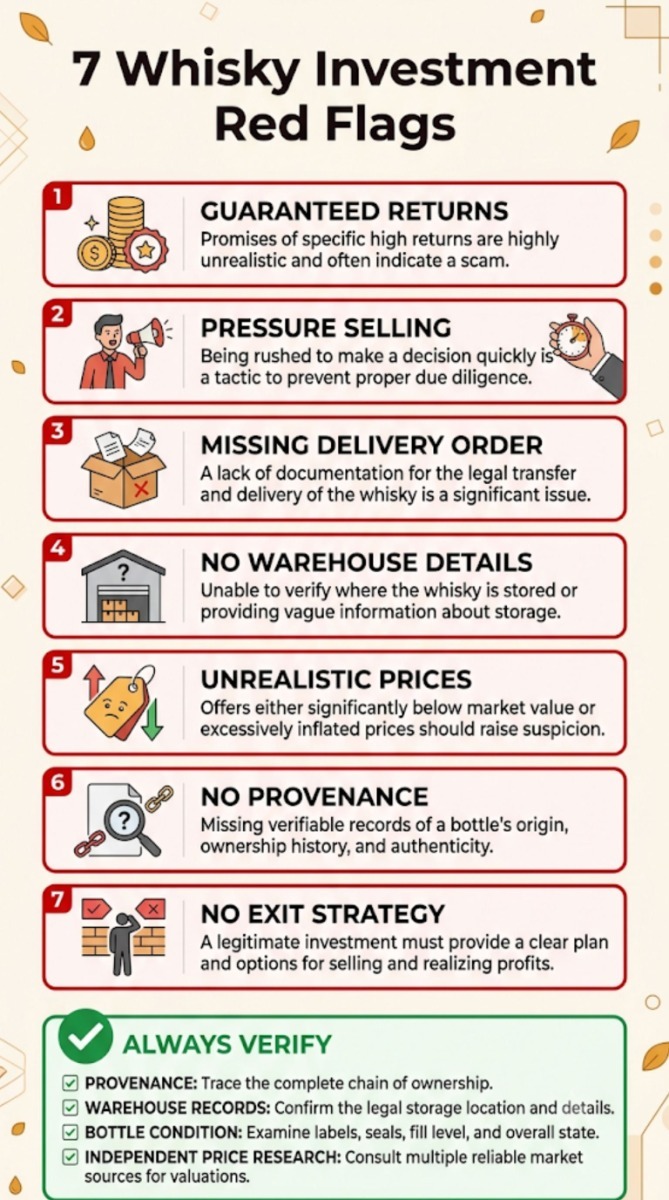
Watch carefully for:
- Missing original box or tube on a bottle where packaging matters
- Low fill level, leakage, capsule damage, or staining
- Unclear bottle history
- Unusually cheap private offers
- Modern limited editions with large release numbers
- Prices based only on asking prices, not completed sales
Counterfeit risk is also real, especially with older, high-value bottles. Labels, capsules, glass moulds, tax strips, fill levels, and provenance should all be considered together. If anything feels inconsistent, do not rely on the seller’s confidence alone.
How Whisky Cask Investment Works
A whisky cask is spirit maturing in oak. Its potential value can change as the liquid ages, but the result depends on distillery, cask type, fill strength, current ABV, volume, warehouse status, and buyer demand at the point of sale.
Casks are commonly stored in HMRC-approved excise warehouses. HMRC guidance explains the UK requirements for excise goods held in duty suspension through Excise Notice 196.
Before buying a cask, you need to understand:
- Who owns the cask now
- Where it is stored
- Whether the warehouse recognises the ownership transfer
- The original litre of alcohol figure
- The current bulk litres and ABV
- The cask type, fill history, and regauge date
- The planned exit route
The price of a cask is not just the headline purchase price. Storage, insurance, samples, regauging, transfer fees, bottling, duty, VAT, and selling costs can reduce the final return.
Ownership, Delivery Orders And Provenance
Ownership verification is one of the most important parts of whisky cask buying. A proper Delivery Order, warehouse record update, and independent confirmation from the warehouse are more important than a polished sales brochure.
A buyer should be able to confirm:
- The cask number
- The distillery or spirit source
- The cask type
- The fill date
- The warehouse location
- The seller’s right to transfer ownership
- Confirmation that the warehouse records have been updated
If the seller cannot provide warehouse-backed evidence, treat the offer as incomplete. A certificate from a broker is not the same as warehouse recognition of title.
Tax, Duty And VAT Considerations
UK tax treatment can make whisky appear attractive, but it should not be the only reason to buy. Casks are often discussed as wasting assets because spirit evaporates over time. Bottles may be treated differently depending on ownership, trading activity, gains, and collection value.
The key practical point is simple: whisky held in bond avoids immediate duty and VAT, but once it leaves bond for bottling or consumption, duty and VAT can become payable. This can materially change the economics of a cask exit.
Tax treatment depends on circumstances. Investors should not rely on marketing claims such as “tax-free whisky investment” without professional advice.
Exit Strategy: How Do You Actually Sell?
Whisky is illiquid. That means you may not be able to sell quickly at the price you want. A bottle may need auction, private sale, retail consignment, or a specialist buyer. A cask may need a broker, bottler, trade buyer, or private bottling plan.
Common bottle exits include:
- Specialist auction
- Private collector sale
- Retail consignment
- Direct sale to a specialist buyer
Common cask exits include:
- Selling the cask in bond
- Selling to an independent bottler
- Bottling under a private label
- Holding longer if ABV, quality, and demand support it
The exit route should be considered before purchase, not after years of storage.
Decision Logic: Should You Invest In Whisky?
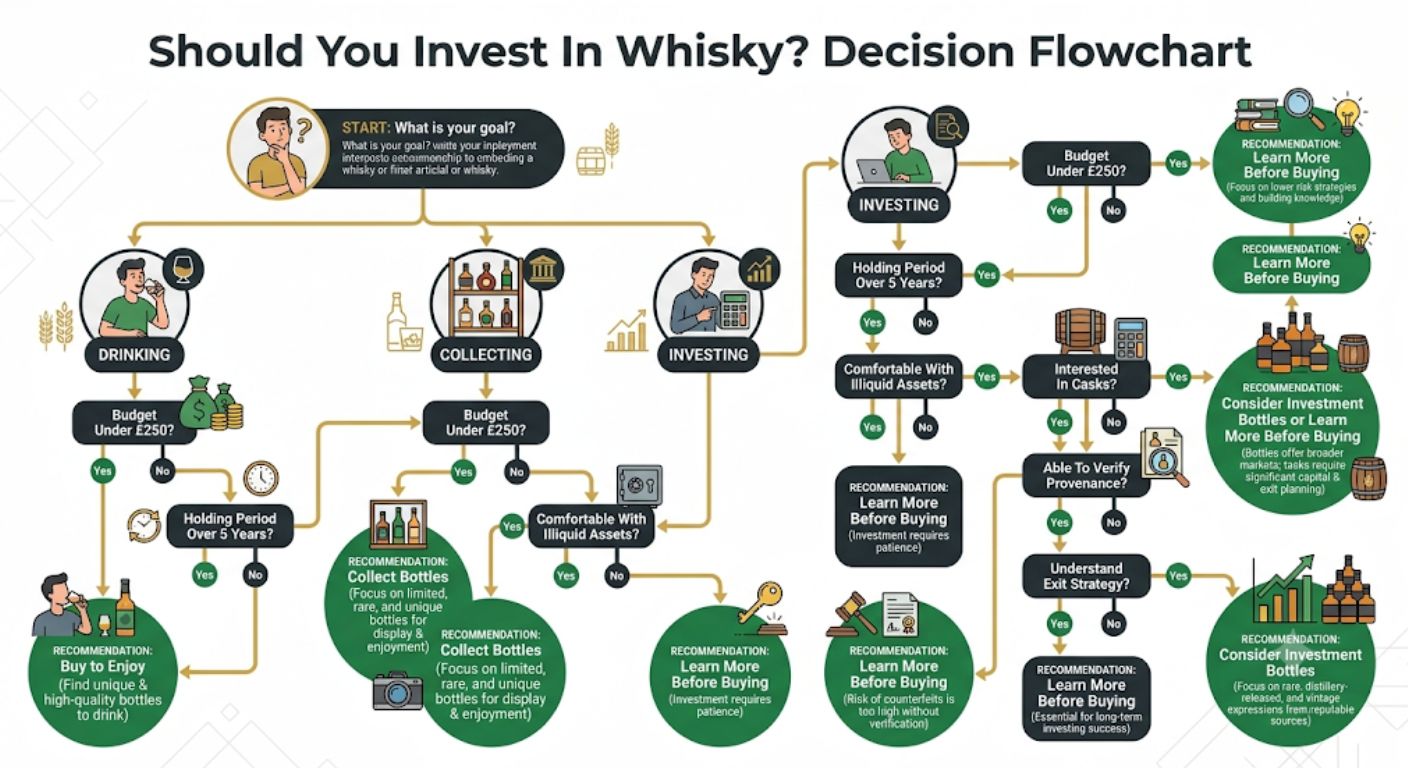
If you want a liquid asset you can sell quickly, whisky is usually not the right choice. If you want a tangible collector asset and can hold for years, it may make sense as a small part of a wider portfolio.
- If you are new to whisky investment, start with bottles, not casks.
- If your budget is under £250, focus on learning and collecting rather than expecting meaningful investment performance.
- If your budget is £250–£1,000, look for recognised distilleries, limited releases, strong condition, and clear provenance.
- If you are considering a cask, do not proceed without warehouse confirmation and a clear exit plan.
- If the seller promises guaranteed returns, walk away.
- If you cannot verify authenticity, do not buy.
For most buyers, the better route is to buy bottles they understand, from sources they trust, at prices that make sense against current market evidence.
Common Whisky Investment Mistakes
- Buying only because a bottle says “limited edition”
- Confusing high retail price with investment quality
- Ignoring condition and fill level
- Buying casks without warehouse confirmation
- Forgetting duty, VAT, storage, and selling costs
- Following hype around one distillery without checking price history
- Assuming age statement always equals value
The safest rule is to buy only what you can explain. If you cannot clearly say why a bottle should remain desirable, who might want it later, and how you would sell it, the investment case is weak.
FAQ
Is whisky a good investment?
Whisky can be a good investment when the bottle or cask has verified provenance, genuine scarcity, strong condition, recognised demand, and a realistic exit route. It is not guaranteed. Most buyers should treat whisky as a long-term collector asset, not a short-term financial product.
Is it better to invest in whisky bottles or casks?
Bottles are usually better for beginners because they are easier to inspect, store, compare, and sell. Casks can offer maturation potential, but they require stronger due diligence around ownership, warehouse records, ABV, storage costs, tax, and exit strategy.
How long should I hold whisky?
Most investment-grade whisky should be viewed as a multi-year hold. Bottles often need time for scarcity and collector demand to develop. Casks may need longer, but holding too long can create risks around evaporation, falling ABV, and over-maturation.
Are whisky casks regulated in the UK?
Whisky casks are not regulated like FCA-authorised investments. They are physical goods, and storage in duty suspension is governed by HMRC rules. Buyers still need to verify ownership, warehouse status, seller credibility, and the legal transfer of title.
What paperwork should I expect with a whisky cask?
You should expect cask identification details, warehouse confirmation, seller ownership evidence, regauge details where available, and a Delivery Order or recognised transfer process. A broker certificate alone is not enough if the warehouse does not recognise you as the owner.
What are the biggest whisky investment scam red flags?
Major red flags include guaranteed returns, pressure selling, missing warehouse details, no Delivery Order, vague provenance, unrealistic pricing, and refusal to let you confirm details independently. If a seller discourages checks, treat that as a serious warning sign.
Does age statement matter for whisky investment?
Age statement matters, but it is not enough on its own. A 25-year-old bottle from a weak or overproduced release may be less desirable than a younger bottle from a respected distillery, strong cask, or important series. Condition and demand still matter.
Can American whiskey be investable?
Yes, some American whiskey can be collectable, especially older bourbon, allocated releases, discontinued bottles, and limited editions with strong demand. The same rules apply: provenance, condition, scarcity, producer reputation, and realistic resale demand matter more than hype.
Summary: The Practical Rules
- Buy bottles with clear provenance, strong condition, and recognised collector demand.
- Do not treat “limited edition” as proof of future value.
- For bottles, check fill level, label, capsule, box, age, ABV, release details, and authenticity.
- For casks, verify warehouse records, ownership transfer, ABV, volume, cask type, and exit route.
- Never rely on guaranteed-return claims.
- Remember that whisky is illiquid; selling can take time.
- Use tax advantages carefully, and do not let tax claims replace due diligence.
The strongest whisky investment decisions are usually conservative: recognised names, verifiable provenance, sensible price, good condition, and a clear reason someone else may want the bottle later. For bottle-led collecting, the natural next step is to browse verified old, rare, and investment-focused bottles rather than speculative private offers.

Related Products
-
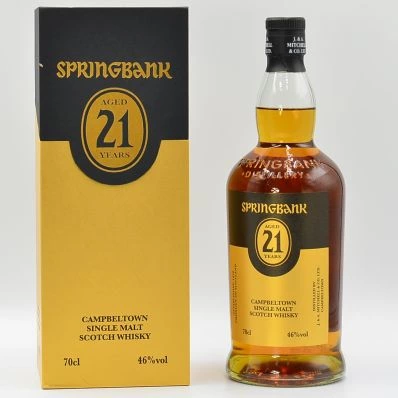 Springbank 21 Year Old Single Malt 2023 ReleaseSpecial Price £639.98 Regular Price £749.99 Inc VATSaving £110.01
 -

-
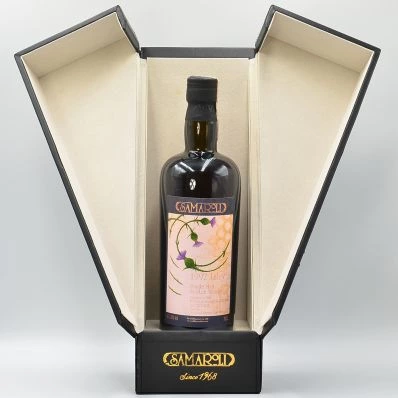 Bowmore Single Malt Islay Whisky 1997 Samaroli Sherry CaskSpecial Price £899.98 Regular Price £999.99 Inc VATSaving £100.01
 -
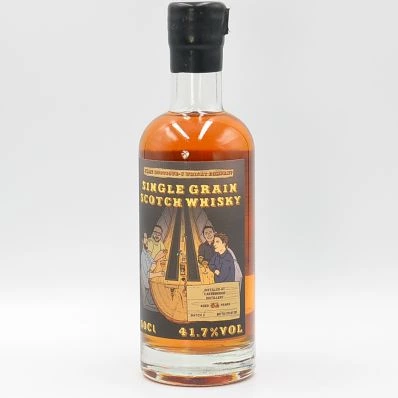 Carsebridge 52 Year Old Single Grain Whisky 1964 Batch 2 TBWCSpecial Price £329.98 Regular Price £449.99 Inc VATSaving £120.01

Comments