
 Chat with us on WhatsApp

Scotch Whisky Export Statistics: Where the World Drinks Scottish Whisky
India now imports more Scotch whisky than any country on earth. Yet the United States remains the industry's most valuable market. That contradiction explains almost everything happening in Scotch whisky exports today. The largest markets are not always the most valuable. The countries buying the most bottles are not always the countries spending the most money. That gap is where the real story sits.
The headline pattern is clear: Scotch is still one of Scotland’s most important global exports, but the market is becoming more uneven. Some countries import huge volumes at lower average values. Others buy less whisky, but spend more per bottle. Tariffs, local drinking habits, premiumisation, and the strength of single malt all shape where Scotch whisky actually goes.
This article looks at the export markets behind Scotch whisky demand, separating value from volume and showing why the global picture is more fragmented than most people assume.
For readers comparing export trends with what is available to drink or collect, the broader Scotch Whisky category remains the clearest starting point.
The Export Gap That Matters
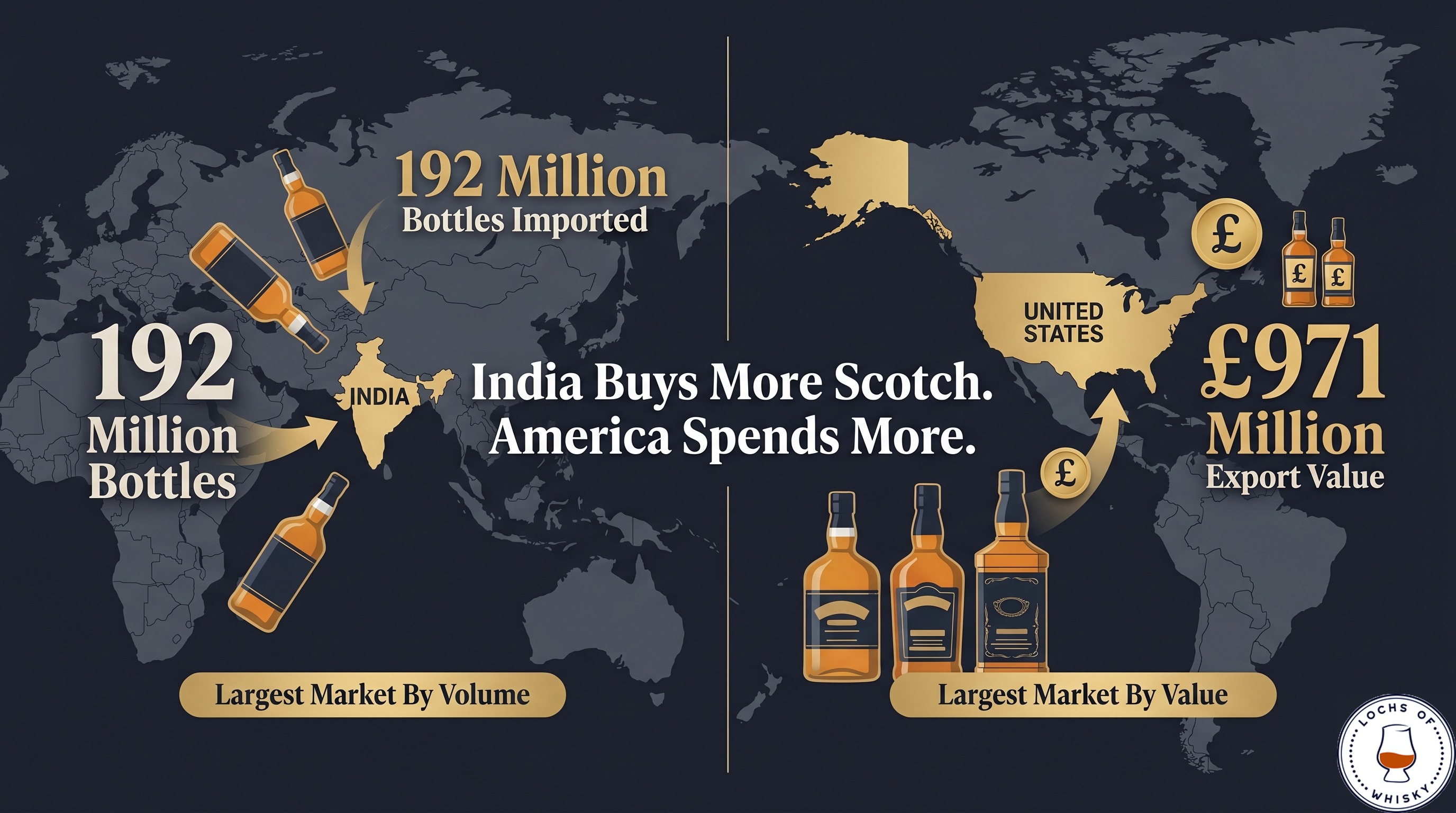
India imported more Scotch whisky than any other country in 2024, with 192 million bottles shipped there. Yet the United States remained the most valuable export market, generating £971 million in Scotch whisky export value.
This gap between bottle volume and export value is the clearest sign that Scotch whisky demand is no longer moving in one simple global pattern.
At A Glance
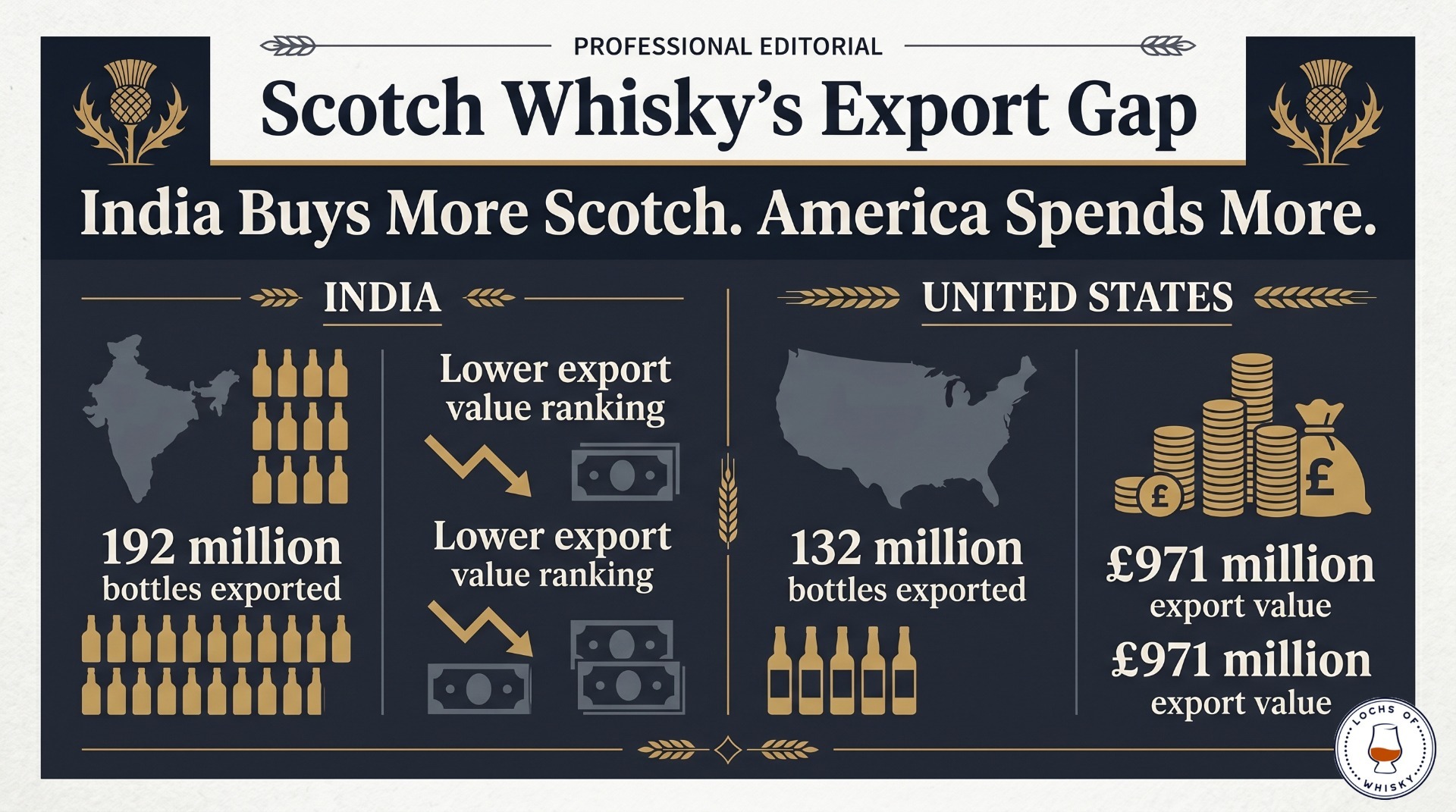
- Largest market by value: United States (£971m)
- Largest market by volume: India (192m bottles)
- Total Scotch exports: £5.4bn
- Total bottles exported: 1.4bn
- Fastest-growing major market: India (+14.6%)
Key Findings
India Overtook Every Other Nation to Become the World's Largest Scotch Market by Volume
India imported 192 million bottles of Scotch whisky in 2024, making it the largest export market by volume and reinforcing the country's growing importance to the global whisky industry.
The United States Remains Scotch Whisky's Most Valuable Export Market
While India imported the most bottles, the United States remained the industry's most valuable market, purchasing £971 million worth of Scotch whisky during 2024.
Scotch Whisky Exports Reached £5.4 Billion in 2024
Despite challenging global trading conditions, Scotch whisky remained one of the UK's most valuable food and drink exports, generating £5.4 billion in export revenue.
The World Imported 1.4 Billion Bottles of Scotch in a Single Year
Equivalent to almost 3.8 million bottles every day, Scotch whisky continues to rank among the world's most widely exported premium spirits.
India Recorded Double-Digit Growth as Global Demand Shifted East
Scotch exports to India grew by 14.6% year-on-year, making it the fastest-growing major export market and highlighting the continued shift in whisky demand towards Asia.
France Recorded the Sharpest Decline Among Major Markets
Export value to France fell by 11.6% year-on-year, making it the largest decline among Scotland's major export destinations.
More Whisky Left Scotland, But Generated Less Revenue
Export volumes increased by 3.9% in 2024, yet total export value fell by 3.7%, highlighting a growing gap between the amount of Scotch being sold and the revenue it generates.
Scotch Export Prices Fell Even as More Bottles Were Sold
The average export value per bottle fell from approximately £4.15 in 2023 to £3.86 in 2024, indicating that export volume grew faster than export value during the year.
More Bottles, Less Money
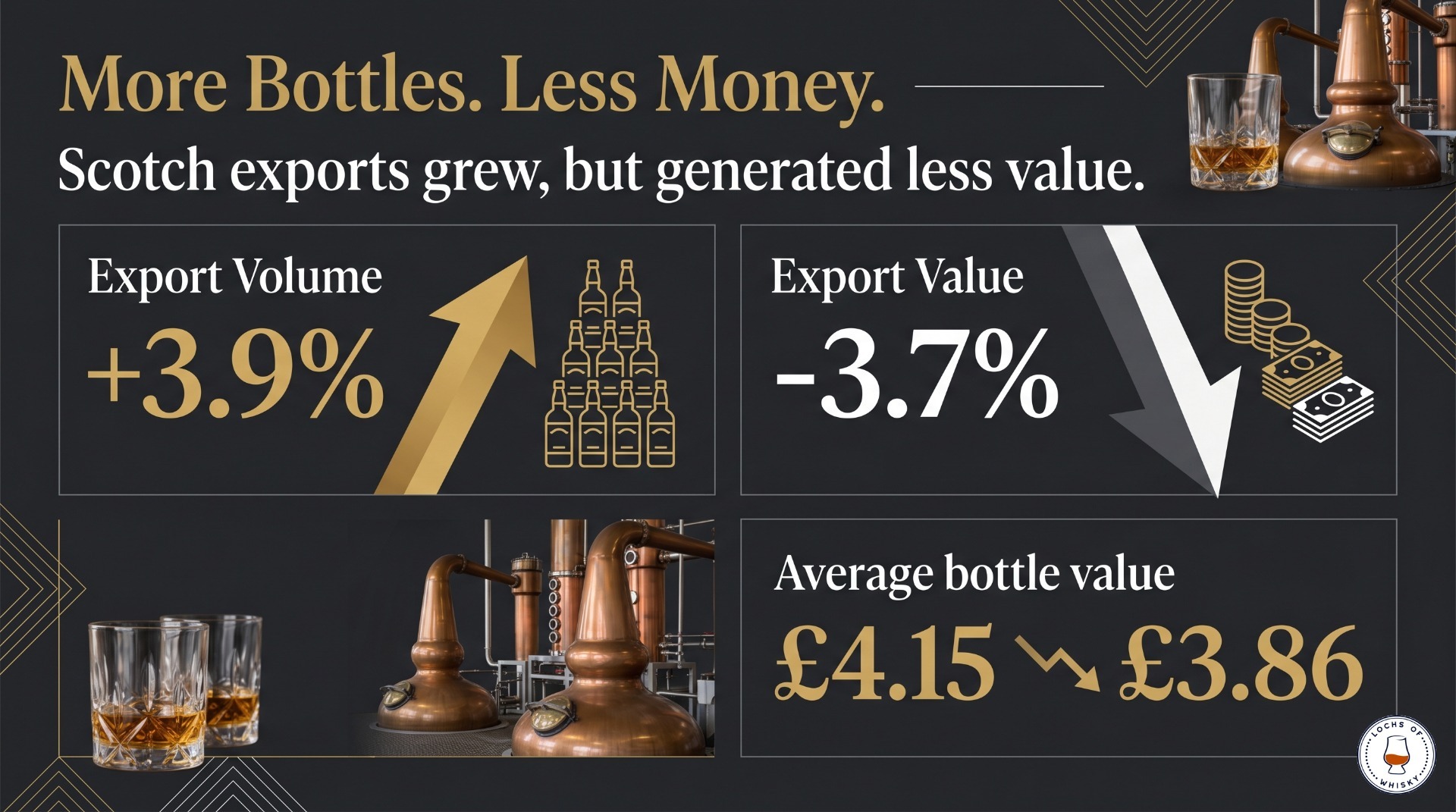
Scotch whisky export volume increased by 3.9% in 2024, but total export value fell by 3.7%.
The average export value per bottle also dropped from approximately £4.15 to £3.86.
This means more Scotch whisky was shipped around the world, yet each bottle generated less export value on average. It is one of the clearest signs that growth is becoming increasingly uneven across global whisky markets.
Blended Scotch Still Dominates Global Whisky Sales
Blended Scotch accounted for almost 60% of all Scotch whisky exports, generating approximately £3.2 billion in export value worldwide.
Single Malt Accounts for Just One-Third of Export Value
Single malt Scotch generated approximately £1.7 billion in export revenue during 2024, significantly below the value generated by blended Scotch despite its strong enthusiast following.
India now buys more Scotch than any other country, yet the United States still spends far more on it. That gap may reveal more about the future direction of the Scotch whisky industry than the £5.4 billion export figure itself.
The Most Important Finding
The most important finding is the gap between value and volume.
A market can import millions of bottles and still sit behind another country in export value. That usually means one of three things:
- The market buys more blended Scotch than single malt
- Import tariffs or local taxes keep pricing distorted
- Consumer demand is concentrated around accessible bottles rather than premium releases
This matters because whisky exports are often discussed as one simple number. They should not be. A bottle sent to a high-value premium market does not mean the same thing commercially as a bottle sent to a high-volume lower-value market.
That distinction also explains why the premium side of Scotch can remain strong even when total export volume softens. A smaller number of high-value bottles can carry more commercial weight than a larger number of lower-priced shipments.
-
-
-
 Game Of Thrones Whisky Dalwhinnie Winter's Frost House StarkSpecial Price £104.98 Regular Price £134.99 Inc VATSaving £30.01Out of stock
 -
-
-
-
-
-

-
 Game of Thrones Whisky Johnnie Walker A Song Of FireSpecial Price £139.98 Regular Price £144.99 Inc VATSaving £5.01
 -
What Lochs of Whisky Customers Actually Buy
Export data tells us where Scotch whisky moves around the world. It does not always show how enthusiasts actually choose bottles.
To compare global trade data with real buying behaviour, we asked 279 Lochs of Whisky customers about the bottles they buy, the styles they prefer, and the factors that influence their purchasing decisions.

Nearly Half Of Enthusiasts Buy By Distillery First
While export reports usually focus on countries, many whisky enthusiasts think in terms of distilleries. In our customer data, distillery identity was the strongest purchasing driver, with 48% of respondents saying it was the first thing they considered when choosing a bottle.
| Buying Factor | % of Respondents |
|---|---|
| Distillery | 48% |
| Price | 21% |
| Region | 14% |
| Age Statement | 10% |
| Bottler | 5% |
| Other | 2% |
Customer survey conducted by Lochs of Whisky in 2026 using responses from 279 whisky buyers. Percentages rounded to the nearest whole number.
This suggests that many experienced drinkers do not simply browse by category. They search for producers they already trust, distilleries they want to explore, or names they recognise from previous bottles.
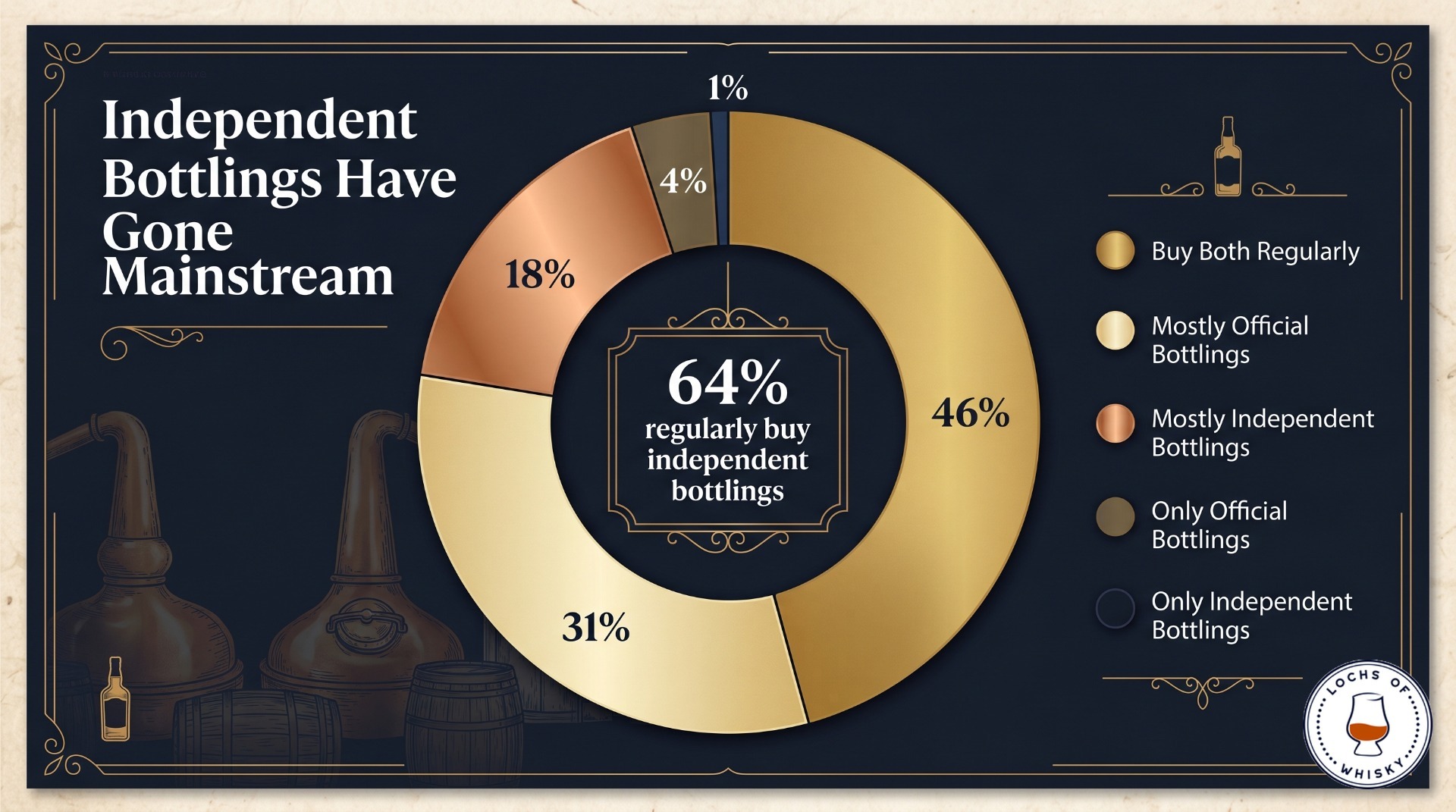
Independent Bottlings Are Now Mainstream Among Enthusiasts
Independent bottlers were once viewed as a niche part of the whisky market. Our customer data suggests that many enthusiasts now actively buy independent releases alongside official bottlings.
| Preference | % of Respondents |
|---|---|
| Buy Both Regularly | 46% |
| Mostly Official Bottlings | 31% |
| Mostly Independent Bottlings | 18% |
| Only Official Bottlings | 4% |
| Only Independent Bottlings | 1% |
Together, 64% of respondents regularly buy independent bottlings either as part of their normal purchasing or as their main preference. This supports the idea that whisky buyers are increasingly interested in cask variation, natural presentation, single-cask releases, and alternative views of familiar distilleries.
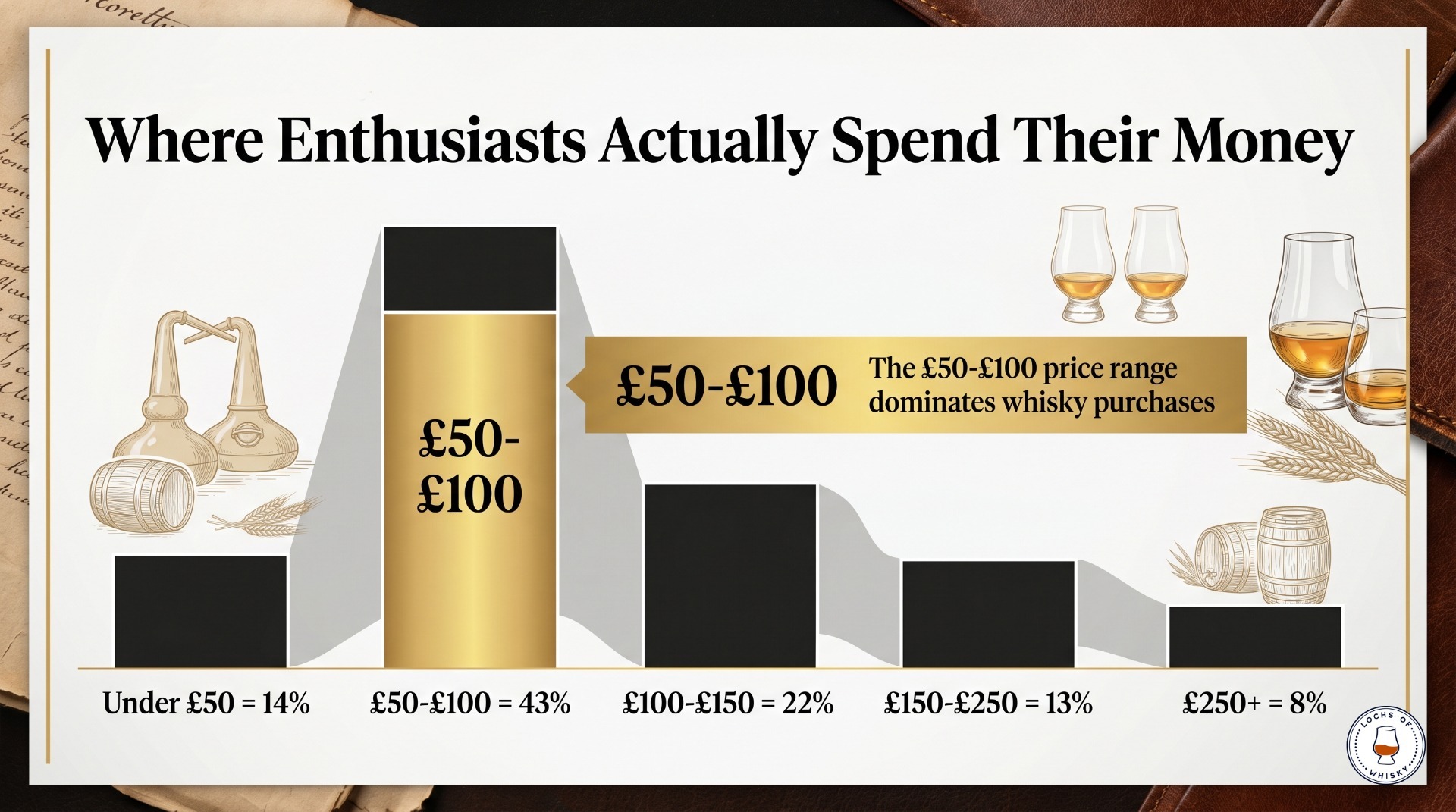
The £50–£100 Price Band Is The Sweet Spot
Customer spending behaviour also shows that premium whisky buying is not only happening at the luxury end of the market. While auction prices and high-value bottles often attract attention, most enthusiast purchases remain concentrated in a more accessible price range.
| Typical Spend Per Bottle | % of Respondents |
|---|---|
| Under £50 | 14% |
| £50–£100 | 43% |
| £100–£150 | 22% |
| £150–£250 | 13% |
| £250+ | 8% |
The £50–£100 range was the most common spending bracket, selected by 43% of respondents. A further 22% said they typically spend between £100 and £150 per bottle.
Together, this means 65% of Lochs of Whisky customers usually spend between £50 and £150 on a bottle of whisky. That suggests the strongest enthusiast demand is not necessarily at the very top of the market, but in the range where quality, distillery interest, independent bottlings and drinkability overlap.
Export Data Does Not Always Show What Drinkers Actually Buy
Export data measures movement across borders. It does not always tell us what a customer bought from a shelf, bar, or online retailer.
Several factors can blur the picture:
- Distributor stock building
- Re-exports through trade hubs
- Bulk whisky movements
- Currency effects
- Delayed retail sell-through
- Hospitality versus home consumption
- Blended whisky used in local mixing culture
What Happens Next
The next phase of Scotch whisky exports will likely be shaped by three forces.
First, tariffs and trade agreements will matter more than brand marketing. If major barriers reduce in large markets, Scotch could gain access to drinkers who already know the category but currently face high prices.
Second, premiumisation will remain uneven. Some markets will continue to trade up into single malt, independent bottlings, higher ABV releases, and age-statement bottles. Other markets will stay volume-led and blend-led.
Third, availability will become more strategic. Distilleries and bottlers will need to decide where limited stock goes, especially for older liquid and small-batch releases.
Distilleries such as Braes show how names can become more interesting to enthusiasts when bottles are less common, production context is less familiar, or independent bottlings bring the distillery into view.
Top Scotch Whisky Export Markets By Value
| Rank | Country | Export Value | Year-on-Year Change | Notes |
|---|---|---|---|---|
| 1 | United States | £971 million | -0.7% | Remains Scotch whisky's largest export market by value. |
| 2 | France | £419 million | -11.6% | Strong volume market despite significant value decline. |
| 3 | Singapore | £310 million | -17.9% | Major Asian trading hub and premium whisky market. |
The value ranking shows where Scotch whisky earns the most money, not simply where the most bottles are shipped. These markets are usually shaped by premium buying, strong retail networks, established whisky culture, and higher average bottle prices.
The United States has often been the benchmark for high-value Scotch exports because it combines scale with premium demand. In that type of market, single malt, age-statement releases, limited editions, and higher-end blends carry more weight.
This is also where regional identity matters. A drinker buying a premium Scotch is more likely to recognise the difference between Speyside Whisky, Islay, Highland, Lowland, Island, and Campbeltown styles.
“Export value is where premium demand shows up. Volume shows where Scotch is being consumed. They are related, but they are not the same measure.”
Top Scotch Whisky Export Markets By Volume
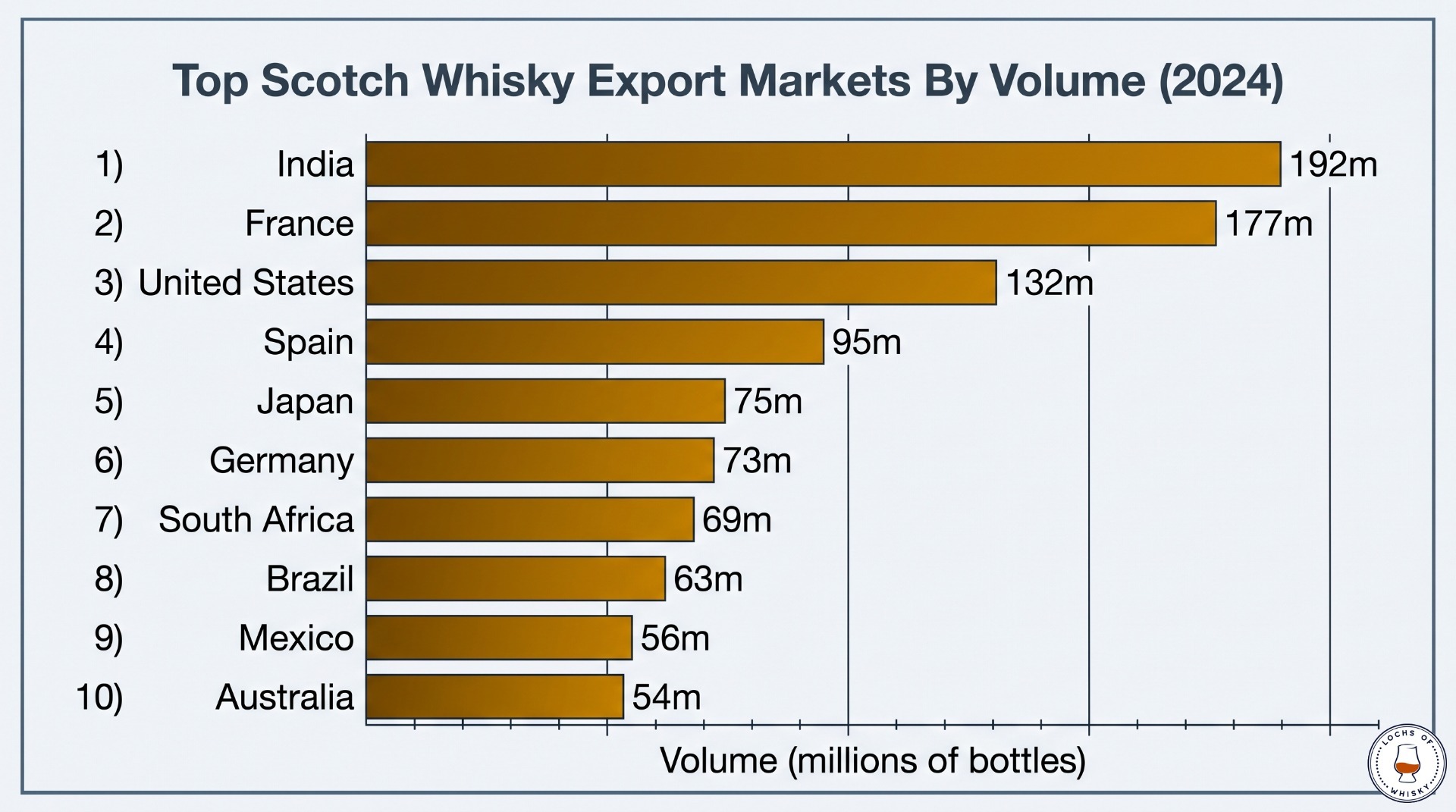
| Rank | Country | Export Volume | Year-on-Year Change | Value Rank |
|---|---|---|---|---|
| 1 | India | 192 million | +14% | 5 |
| 2 | France | 177 million | -6% | 2 |
| 3 | United States | 132 million | +2% | 1 |
| 4 | Spain | 95 million | +1% | 9 |
| 5 | Japan | 75 million | +7% | 8 |
| 6 | Germany | 73 million | -3% | 7 |
| 7 | South Africa | 69 million | +4% | 14 |
| 8 | Brazil | 63 million | +5% | 18 |
| 9 | Mexico | 56 million | +3% | 15 |
| 10 | Australia | 54 million | -1% | 12 |
The volume ranking gives a different view of the market. It shows where Scotch whisky is physically consumed at scale.
High-volume markets often favour blended Scotch, accessible price points, and mixed-drink occasions. This does not make them less important. It simply means they behave differently from markets driven by single malt and premium retail.
India is the key example. It can lead by volume while sitting lower by value because imported Scotch faces high tariffs and competes with a large domestic whisky market.
Why Value And Volume Tell Different Stories
Value and volume separate two kinds of demand.
Volume shows habit. Value shows willingness to pay.
A country with strong volume demand may be drinking Scotch regularly, but at a lower average price. A country with strong value demand may be buying fewer bottles, but buying more expensive bottles.
This split is especially important when looking at:
- Blended Scotch versus single malt
- Entry-level bottles versus premium bottles
- Mature markets versus emerging markets
- Tariff-heavy countries versus lower-barrier countries
- Retail drinking versus hospitality-led consumption
For more detail on that specific shift, see our Premium Whisky Market Statistics analysis.
The Countries Nobody Expected
Some of the most interesting Scotch whisky export stories come from markets that rarely dominate general whisky discussion.
While the United States, India and France attract most of the attention, several smaller or less-discussed markets recorded strong movement during 2024. These countries may not yet sit at the top of the export rankings, but they show where Scotch whisky demand is widening beyond its traditional strongholds.
Turkey Showed Strong Growth
Turkey recorded export growth of more than 36% in 2024, making it one of the more notable growth markets for Scotch whisky. This matters because Turkey is not usually discussed alongside the largest whisky importers, yet its growth suggests increasing demand for imported premium spirits.
Emerging Markets Are Becoming More Important
Growth is no longer concentrated only in Western Europe or North America. Scotch whisky demand is increasingly shaped by markets across Asia, Eastern Europe, the Middle East and Latin America, where rising interest in premium spirits is creating new opportunities for Scotch producers.
Smaller Markets Can Still Shape Future Demand
A smaller country does not need to overtake the United States, India or France to become important. If it records consistent growth over several years, it can influence allocation, distribution strategy, and the way distilleries think about future export demand.
The Biggest Market Shift
The biggest market shift is the move from simple global expansion to market-by-market fragmentation.
Scotch whisky is no longer growing in one smooth global pattern. Different markets are pulling in different directions:
- Some are buying more volume at lower value
- Some are buying fewer bottles but spending more
- Some are sensitive to tariffs
- Some are driven by cocktail culture
- Some are focused on premium single malt
- Some remain dominated by blended Scotch
We see this most clearly when customers ask why a familiar bottle has become harder to find: the answer is often not local stock alone, but wider allocation pressure, export demand, and how much of a release has been directed into larger overseas markets.
Regional Identity Still Influences Premium Demand
As export markets become more premium-focused, regional identity becomes increasingly important. Drinkers buying higher-value bottles are often looking beyond Scotch whisky as a category and exploring specific regional styles.
- Speyside remains associated with fruit-forward and sherry-influenced single malts.
- Islay continues to attract enthusiasts seeking heavily peated whisky.
- The Highlands offer the widest stylistic diversity.
- Campbeltown maintains strong enthusiast recognition despite relatively low production volumes.
Blended Scotch Still Matters
Single malt gets much of the attention, but blended Scotch remains central to export volume.
This is important because many discussions about Scotch whisky overfocus on premium single malt. That gives a distorted view of the category. Globally, blended Scotch is still the engine of volume demand.
Brands such as Buchanan's show why. In many markets, blended Scotch is not just an entry point. It is the mainstream Scotch category.
Single Malt, Independent Bottlings And Premium Demand
Single malt has a different export role. It supports the premium image of Scotch and gives drinkers a direct connection to place, distillery, age, cask, and production character.
This is where distillery-led discovery matters. A bottle from Deanston, for example, is not just “Scotch whisky”. It carries a production story, a regional context, a distillery identity, and often a clear style expectation.
Independent bottlings add another layer. They can show a distillery in a different form from the official core range, especially through single casks, higher ABV releases, unusual maturation, and natural presentation.
What Tariffs Do To Scotch Whisky Exports
Tariffs can reshape export demand without changing consumer interest.
If a country applies a high import tariff, Scotch becomes more expensive before it even reaches the shelf. That can push consumers towards cheaper blends, local alternatives, or smaller bottle formats. It can also make premium single malt harder to scale.
For official industry context, the Scotch Whisky Association publishes regular export and market data through its Facts & Figures reporting.
Value Per Bottle Is The Metric To Watch
Total export value and total export volume are useful, but value per bottle is often more revealing.
The Average Bottle Exported To The United States Was Worth Around 3.5 Times More Than The Average Bottle Exported To India
This highlights the difference between the world's largest Scotch market by value and its largest market by volume.
This shows whether a country is buying:
- More premium single malt
- More blended Scotch
- More high-volume accessible bottles
- More older or luxury releases
- More bulk or lower-value whisky
Decision Logic For Readers
Use export data carefully.
If you want to understand global Scotch demand, look at export value first. It shows where the money is.
If you want to understand where Scotch is most widely consumed, look at export volume. It shows scale.
If you want to understand premium demand, compare value per bottle and single malt share.
If you want to understand future opportunity, watch tariff-heavy markets and smaller countries with multi-year growth.
If you are buying Scotch for drinking, do not follow export rankings blindly. A high-growth market does not tell you whether a bottle suits your taste. Region, ABV, cask type, age statement, and distillery style matter more.
Methodology
This analysis uses published Scotch whisky export data for 2024, including export value, bottle volume, year-on-year movement, and market rankings. Export value refers to the value of Scotch whisky leaving Scotland for international markets, while export volume refers to the number of 70cl bottle equivalents shipped.
Lochs of Whisky customer data is based on responses from our own customer research, looking at buying behaviour, preferred bottle types, typical spend, and the factors that influence whisky purchasing decisions.
Export data is useful for understanding global trade patterns, but it does not always show final consumer behaviour. Distributor stock, re-exports, bulk whisky movements, local taxes, tariffs, and delayed retail sell-through can all affect the final picture.
FAQ
Which country imports the most Scotch whisky?
The answer depends on whether you measure by value or volume. One country may import the highest number of bottles, while another spends the most overall. Scotch whisky export data should always separate value from volume before drawing conclusions.
Why is India a major Scotch whisky export market?
India is important because it combines huge whisky demand with strong Scotch recognition. However, high tariffs and local market structure mean much of the opportunity is still restricted. India can lead by volume while remaining lower by value because imported Scotch is expensive relative to domestic whisky.
Why can the United States be more valuable than larger volume markets?
The United States is a high-value market because it has strong premium demand, established whisky retail, and significant interest in single malt and higher-priced bottles. Even if another country imports more bottles, the US can generate more export value through higher average spending.
Do Scotch whisky exports show what people actually drink?
Not perfectly. Export data shows whisky moving across borders, not final retail consumption. Distributor stock, re-exports, bulk whisky, hospitality demand, and delayed sell-through can all affect the numbers.
Are single malts driving Scotch whisky export growth?
Single malts are central to premium demand, but blended Scotch still carries major export volume. Some countries are single malt-led at the premium end, while others remain dominated by blended Scotch and accessible price points.
How do tariffs affect Scotch whisky exports?
Tariffs raise the landed cost of Scotch before it reaches consumers. That can reduce demand, push buyers towards cheaper alternatives, or limit premium growth. In markets with high import duties, tariff reductions can materially change Scotch whisky’s competitiveness.
Final Summary
Scotch whisky exports show where the world buys Scottish whisky, but the headline numbers only tell part of the story.
India now leads by volume, while the United States remains the most valuable market. That difference matters because it shows how different whisky markets behave. Some countries buy Scotch at scale. Others buy fewer bottles but spend more per bottle.
For the whisky industry, the key question is not simply where Scotch is growing. It is where value is being created.
For drinkers and collectors, the lesson is different. Export rankings can show global demand, but they do not replace bottle-level judgement. Distillery, bottler, cask type, age, ABV, and condition still matter more when choosing what to drink, collect, or explore next.


Comments