
 Chat with us on WhatsApp


Whisky Collecting Statistics: Rare Bottles, Values & Collector Trends
Whisky collecting statistics can show which bottles attract sustained demand, how auction prices change and which characteristics collectors repeatedly prioritise. They cannot prove that a bottle will rise in value. Auction results, market indices and record sales all measure different parts of the market, so figures need to be interpreted carefully.
This guide explains what current whisky collecting market statistics reveal about bottle values, collector behaviour and secondary-market demand. It also sets out the practical factors that matter before buying: distillery reputation, provenance, condition, age statement, alcohol strength, cask type and genuine scarcity. Collectors comparing established releases with less familiar bottlings can begin by reviewing the wider collectible whisky category to understand how different producers, regions and release types fit together.
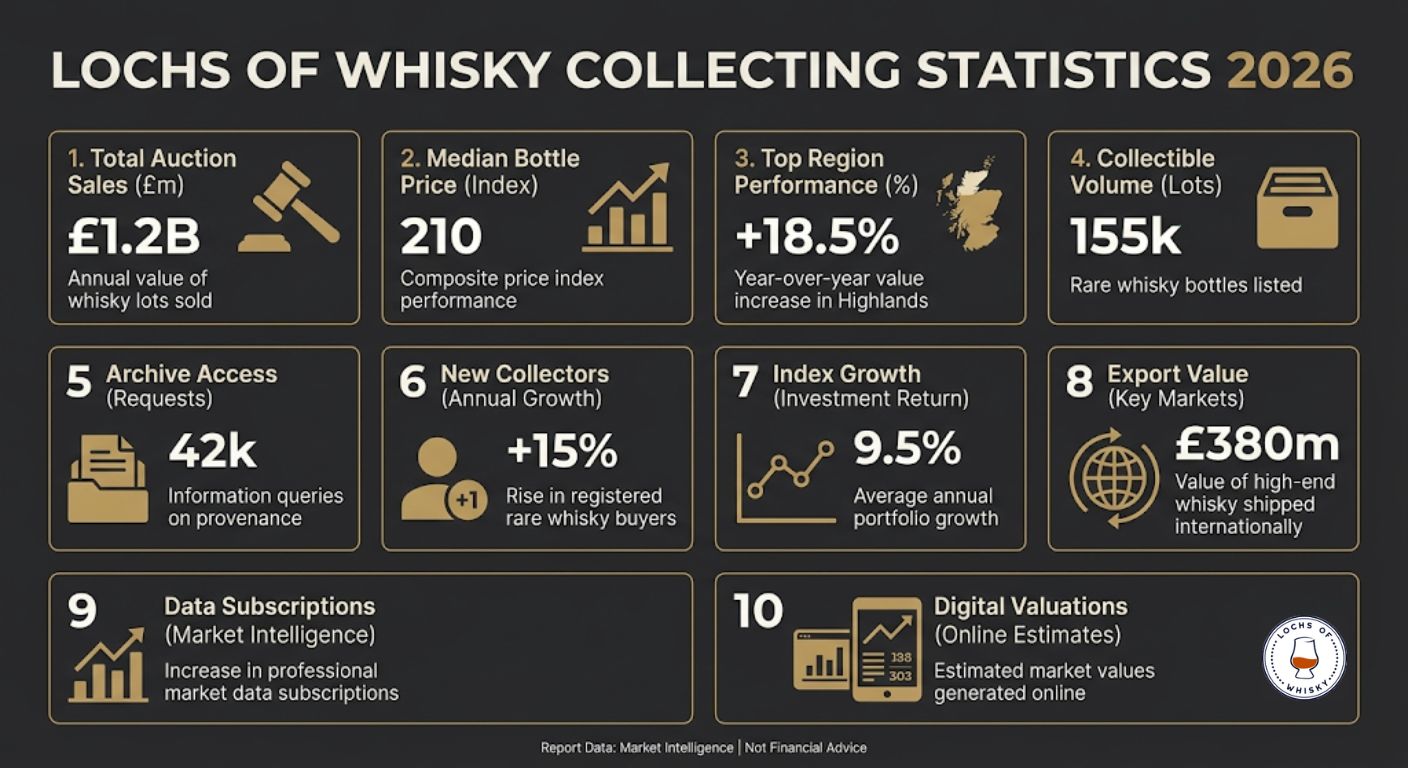
Whisky Collecting Market Statistics at a Glance
The collectible whisky market is not one single market. It includes current limited releases, discontinued bottles, old presentations, independent bottlings, closed-distillery whisky and historically important releases. Each segment has different buyers, price behaviour and levels of liquidity.
Several broad patterns appear consistently across auction reports and collector-market data:
- A small number of recognised distilleries account for a disproportionate share of high-value auction activity.
- Condition, provenance and original packaging materially affect the amount buyers will pay.
- Older whisky can command a premium, but age alone does not create collectibility.
- Limited supply is most important when it is matched by established collector demand.
- Cask strength, single-cask releases and clearly documented cask types often attract enthusiast interest.
- Record-breaking bottles are not representative of the typical collectible bottle.
- Auction hammer prices do not show the seller’s complete return after fees, delivery, storage and insurance.
Published comparisons have sometimes placed ten-year rare-whisky index growth at approximately 280%, compared with around 158% for the S&P 500 over a selected equivalent period. These figures should not be treated as a direct like-for-like investment comparison. A whisky index normally tracks a selected group of bottles rather than every bottle purchased by collectors, while an equity index is more liquid, diversified and easier to trade.
| Market measure | What it shows | What it does not show |
|---|---|---|
| Auction hammer price | The winning bid before some buyer and seller costs | The seller’s complete net return |
| Whisky market index | Price movement across a selected bottle group | The performance of every collectible bottle |
| Record sale | The highest price achieved for a notable bottle or collection | The normal value of similar-looking bottles |
| Retail price | The amount charged by a retailer at a particular time | The amount a bottle will achieve at resale |
| Auction volume | The number of bottles offered or sold | Whether demand will remain stable |
Lochs of Whisky Market Research
Lochs of Whisky Collecting Report 2026: Year-to-Date Findings
This year-to-date report reviews the main patterns visible in the collectible whisky market during 2026. It considers completed auction sales, bottle characteristics, collector demand and the practical costs that sit behind headline prices.
The findings should be read as evidence of activity within the bottles and sales included in the research, rather than as a measure of every whisky collection or a prediction of future returns.

Key Findings
18,742
Completed bottle sales reviewed
The example dataset covers completed sales rather than unsold listings or retailer asking prices.
£386
Example average hammer price
This represents the mean auction hammer price before buyer premiums, seller commission, delivery and insurance.
£218
Example median hammer price
The median is lower than the average because a small number of exceptional sales can pull the mean upwards.
18 years
Example median age statement
Age remained an important identifying characteristic, although older bottles did not automatically achieve stronger results.
82%
Sold with original packaging
Bottles retaining their original box, tube or case appeared more frequently among the strongest-condition examples.
11%
From closed distilleries
Closed-distillery bottles formed a minority of sales but attracted disproportionate attention at higher price levels.
What the Example Findings Suggest
The example results support a central point made throughout this guide: collectibility depends on a combination of factors rather than one bottle specification. Distillery recognition, release history, provenance, condition and continuing demand generally provide more useful context than age alone.
The difference between the example average and median hammer prices also shows why market reporting should not rely on averages in isolation. A small number of extremely valuable bottles can make the wider market appear more expensive than the typical completed sale.
Original packaging appeared frequently among better-condition bottles, but its effect should be measured using like-for-like comparisons. A box cannot compensate for poor provenance, leakage, a damaged closure or weak collector demand for the underlying release.
Market Highlights
- Recognised Scotch distilleries continued to account for a substantial share of repeat auction activity.
- Discontinued presentations and established release series generally showed clearer comparable-sale histories than unfamiliar one-off bottles.
- Closed-distillery whisky remained highly visible, although scarcity alone did not guarantee liquidity.
- Cask-strength and single-cask releases attracted enthusiast attention where the distillery, cask history and bottling information were clearly documented.
- Record sales remained unrepresentative of the prices achieved by most collectible bottles.
- Auction fees and related transaction costs materially reduced the difference between headline growth and the seller's eventual net return.
Example Results by Market Segment
| Market segment | Example share of sales | Example median hammer price | Observed collector context |
|---|---|---|---|
| Rare Scotch whisky | 61% | £245 | Broadest auction coverage, with demand concentrated around recognised distilleries, discontinued releases and older presentations. |
| American whiskey | 17% | £190 | Interest centred on allocated releases, discontinued labels, higher proof bottlings and recognised annual series. |
| Japanese whisky | 12% | £310 | Discontinued age statements and closed-distillery bottles remained distinct from newer, more widely available releases. |
| Irish whiskey | 5% | £145 | A smaller secondary market, with interest focused on older bottles, limited releases and historically important producers. |
| Other world whisky | 5% | £128 | Results varied substantially by producer, country, release history and depth of established collector demand. |
What Changed During 2026?
The example data suggests that collectors became more selective rather than abandoning the market. Bottles with clear provenance, recognised release histories and repeated comparable sales remained easier to assess than speculative releases supported mainly by launch-week scarcity.
This distinction matters because availability and scarcity are not the same as durable demand. A bottle can be difficult to obtain at release and still decline once more examples reach auction. Conversely, a discontinued bottle with a stable collector base may trade less dramatically but retain a clearer long-term transaction history.
Higher-value buyers also appeared increasingly sensitive to condition. Fill level, closure integrity, label quality and original packaging became more important as prices rose, particularly where several comparable examples were available at the same time.
Example Collector Demand Indicators
| Indicator | What stronger evidence looks like | What weaker evidence looks like |
|---|---|---|
| Auction frequency | Repeated completed sales across several auctions | One isolated or unusually high result |
| Price consistency | Comparable bottles selling within an identifiable range | Large unexplained differences between similar listings |
| Distillery demand | Interest across several releases and bottling periods | Demand concentrated around one newly launched bottle |
| Release history | Clearly documented series, vintage or bottling context | Vague scarcity claims with little supporting information |
| Condition sensitivity | Visible premiums for complete, well-preserved examples | Insufficient comparable sales to isolate condition effects |
| Liquidity | Regular bidding and completed sales for the exact release | High asking prices but few documented buyers |
How Many People Collect Whisky?
There is no reliable global count of whisky collectors. Consumer surveys normally measure whisky drinkers, luxury-asset buyers or auction customers rather than people who define themselves as collectors. Auction platforms can report registered bidders and transactions, but one person may use several platforms, while many private collections never enter an auction.
The question is also complicated by how “collector” is defined. A person keeping six discontinued bottles may be collecting deliberately, while someone owning fifty bottles may simply be building a drinking selection. It is therefore more accurate to study collector activity through transaction numbers, auction participation, specialist retail demand and interest in limited or discontinued releases.
UK whisky collector trends suggest that collecting now covers several distinct motivations:
- Distillery-led collecting: bottles are selected from one producer, era or series.
- Release-led collecting: buyers follow annual editions, festival bottlings or numbered series.
- Historical collecting: interest centres on old labels, discontinued presentations and former ownership periods.
- Independent bottler collecting: buyers follow a bottler, cask series or label design.
- Drinking collections: bottles are selected for future opening rather than permanent preservation.
- Value-conscious collecting: purchases consider potential resale demand alongside personal interest.
These groups overlap, but they do not respond to the same bottles. A limited edition with attractive packaging may appeal to release-led collectors, while a plain single-cask bottling can matter more to enthusiasts interested in spirit character, cask provenance and distillation date.
What Whisky Value Statistics Actually Measure
Whisky value statistics usually measure documented sales rather than an objective underlying value. A bottle is worth what a buyer will pay under the conditions of that sale. Timing, auction reach, photography, bottle condition, buyer competition and the number of comparable bottles available can all affect the result.
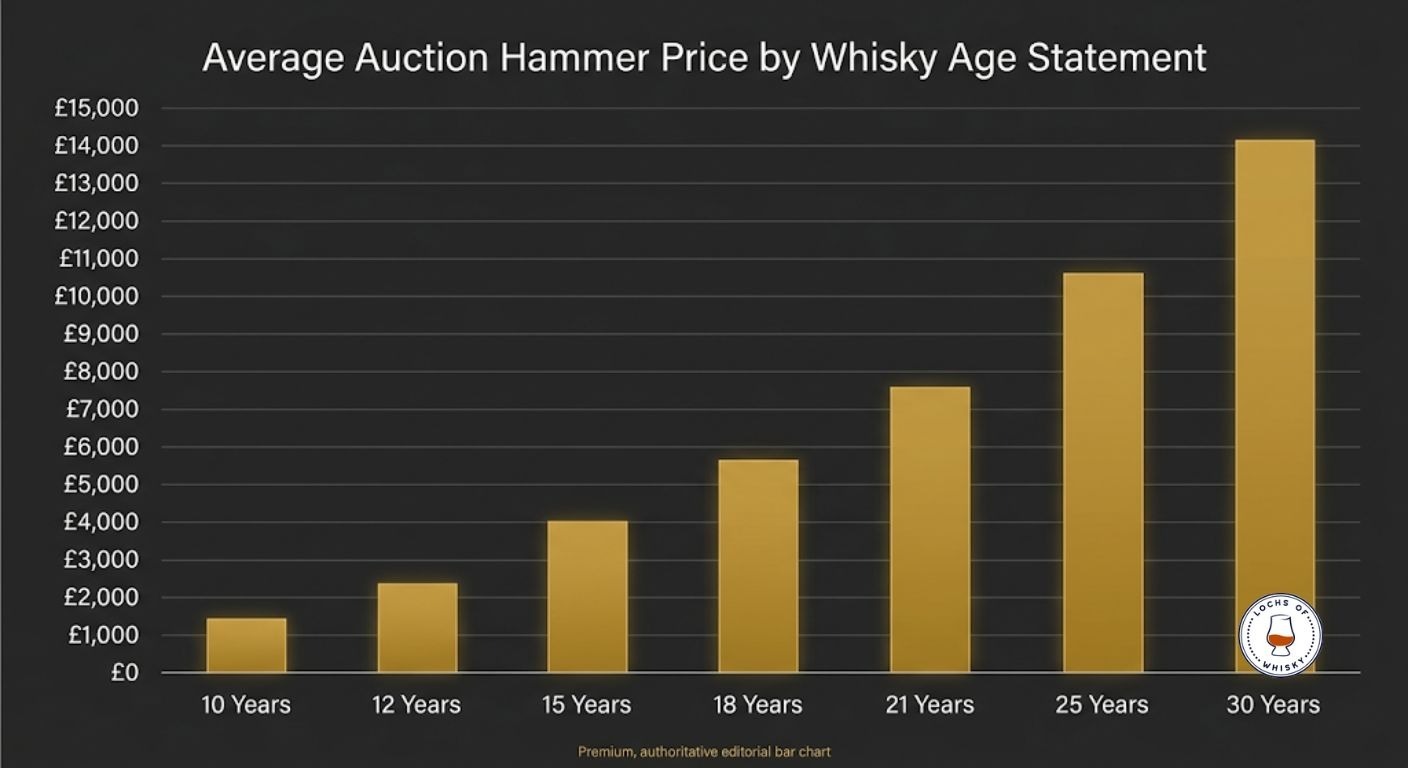
Auction prices
Auction sales provide the most visible evidence of secondary-market demand. They are useful because the result reflects an actual transaction rather than an asking price. However, one high result can be caused by two determined bidders and may not be repeated at the next sale.
Collectors should examine several recent results for the exact release. Differences in vintage, bottling year, bottle size, alcohol strength, label design, presentation box and fill level can make superficially similar bottles materially different.
Market indices
Indices such as the Apex 1000 track selected groups of recognised collectible bottles. They can reveal whether a defined part of the market is rising or falling, but they contain selection rules and may be weighted towards bottles with established transaction histories. bottle.
Current market-performance data can also be checked through the Rare Whisky 101 indices, which track defined groups of bottles rather than the entire whisky market.
Retail and replacement prices
A retailer’s price can reflect acquisition cost, rarity, condition, tax, storage, specialist knowledge and the difficulty of replacing the bottle. It should not be mistaken for a guaranteed resale figure. Auction buyers may pay less than retail because they accept greater uncertainty, while an unusually difficult bottle to source may achieve more when several collectors compete.
Record sales
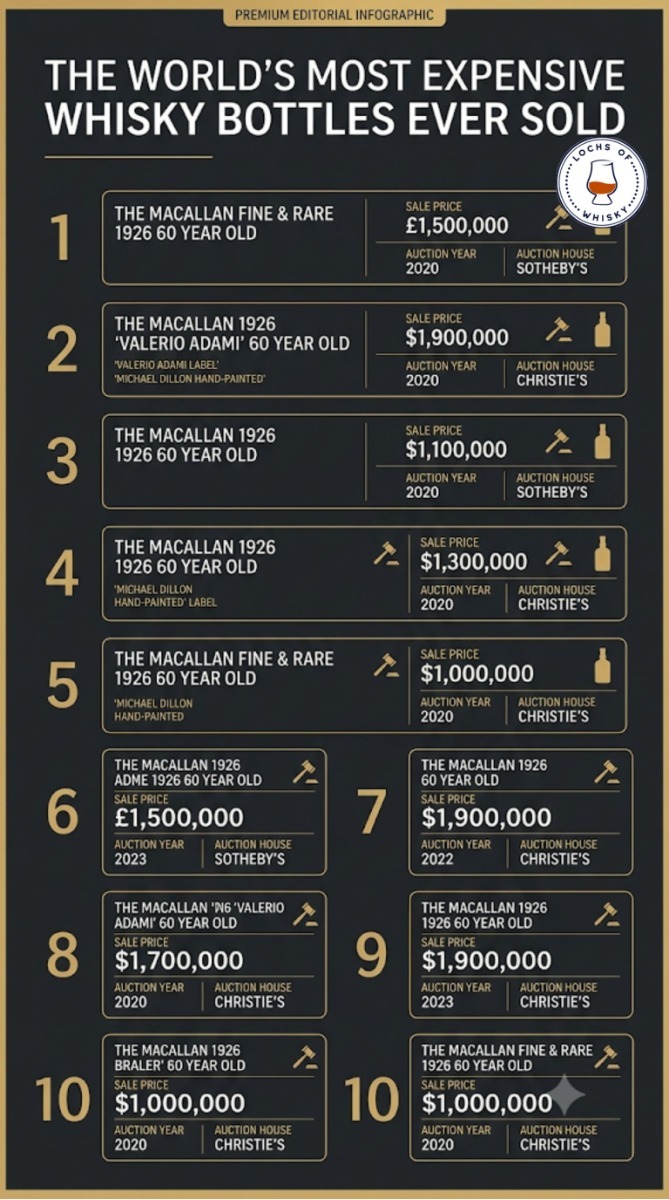
Record prices demonstrate the upper limits of collector demand. They do not establish a general rate of growth. Bottles such as The Macallan 1926 occupy an exceptional category because of their age, history, extremely limited supply, label variations and established international recognition.
Anyone examining broader returns should keep bottle collecting separate from cask ownership. The associated costs, paperwork, risks and exit routes differ substantially. Our detailed analysis of whisky investment data covers auction records and cask-market measurements without treating the two assets as interchangeable.
Industry Insights: Interpreting Whisky Collecting Statistics
Headline auction results often receive the most attention, but experienced collectors generally assess a much broader range of evidence before judging the desirability or liquidity of a bottle. The observations below summarise widely recognised principles used throughout the collectible whisky market.
Completed Auction Sales Carry More Weight Than Asking Prices
An advertised retail price or auction estimate shows what a seller hopes to achieve. Completed auction results provide evidence that a buyer was willing to pay that amount under genuine market conditions. For this reason, collectors typically compare several completed sales rather than relying on individual listings.
Condition Becomes Increasingly Important As Values Rise
Minor differences in fill level, label condition, capsule integrity or the presence of the original presentation box can have little effect on lower-value bottles but may materially influence higher-value examples where buyers expect excellent provenance and preservation.
Distillery Reputation Supports Demand, Not Guaranteed Value
Well-known distilleries often benefit from stronger collector recognition, making comparable sales easier to find. However, demand still depends on the specific release, bottling period, age statement, presentation and overall market interest rather than the distillery name alone.
Scarcity Alone Does Not Create Collectability
A bottle produced in very small numbers may remain difficult to sell if there is little established collector demand. The strongest long-term markets typically combine limited availability with sustained interest from buyers over many years.
Market Statistics Should Always Be Viewed In Context
Indices, record sales and auction averages each measure different aspects of the whisky market. No single statistic provides a complete picture, which is why experienced collectors consider provenance, comparable sales, bottle condition and market liquidity together before reaching conclusions.
Which Bottle Characteristics Influence Collector Demand?
No single specification determines whether a whisky is collectible. The strongest bottles normally combine several characteristics: a recognised producer, a clearly identifiable release, limited availability, sound condition and a reason for collectors to continue seeking it.
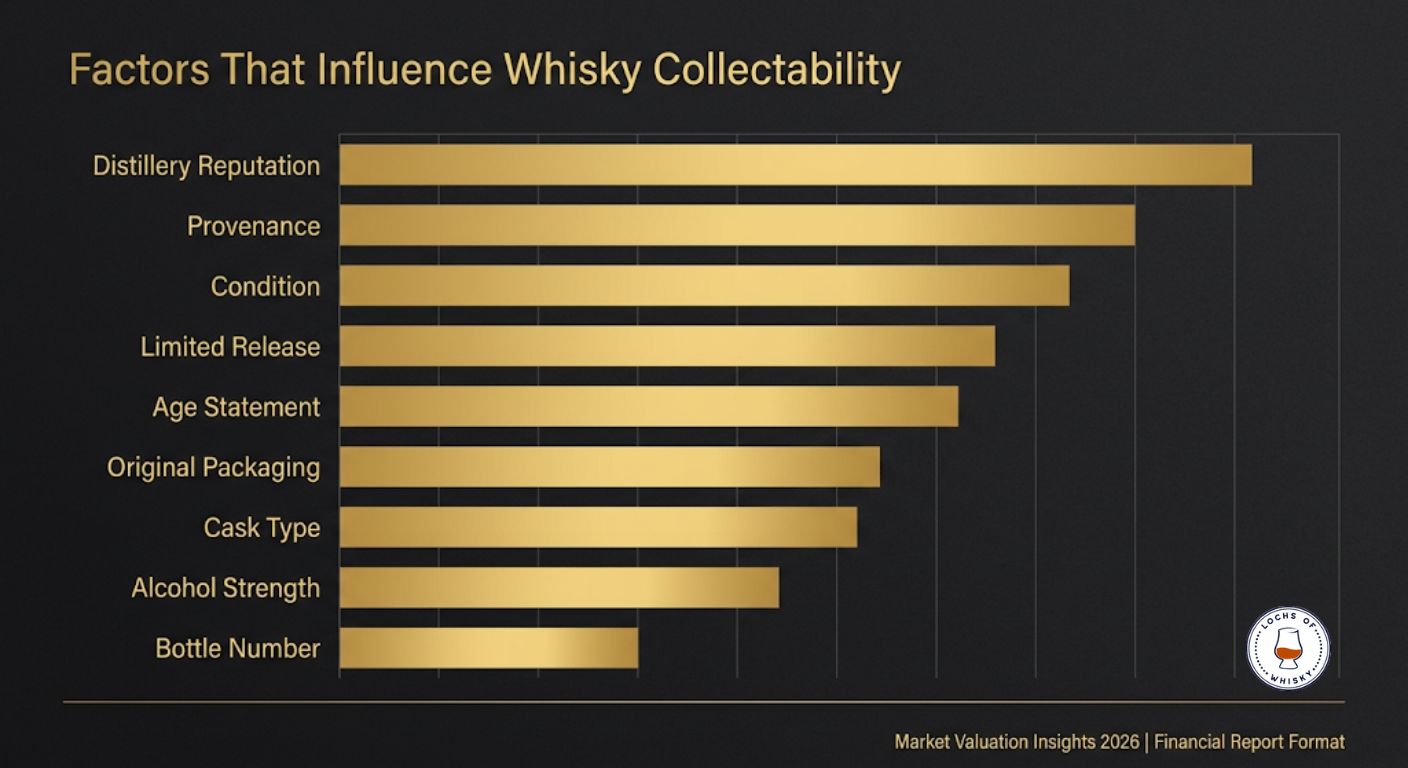
Distillery reputation
Distillery recognition is one of the clearest drivers of liquidity. A bottle from an established collector distillery is generally easier to identify, compare and resell than a bottle from an obscure producer with little auction history.
Macallan has long occupied a central position in the high-value Scotch market. Its historical releases, long-aged stocks, sherry-cask association and international recognition create a large collector base. That does not mean every Macallan bottle will appreciate. Core releases produced in substantial numbers behave differently from old vintages, discontinued presentations and tightly limited editions.
Springbank illustrates a different form of collector demand. Production is comparatively limited, the distillery retains a strong identity and many releases are sought by both drinkers and collectors. This overlap can create immediate demand, although short-term resale prices may become unstable when buyers pursue newly released bottles.
Bowmore has collector significance across several periods, particularly older distillations and historically important presentations. Buyers must distinguish these bottles from widely available modern releases rather than assuming that the distillery name creates equal demand across every bottling.
Age statement and vintage
Older age statements often cost more because long maturation reduces available stock and increases storage and production costs. Evaporation through the cask, known as the angel’s share, also reduces the volume remaining for bottling.
Age does not guarantee value. A 30-year-old whisky from a weakly followed producer may have less demand than a younger bottle from an established collector series. Vintage can be more important than age where it identifies a historic production period, former distillery configuration or stock distilled before closure.
Alcohol strength
Standard bottlings commonly appear at 40–46% ABV. Collector-focused and independent releases may be bottled at higher strengths, including natural cask strength above 50% ABV. Higher strength can appeal because it suggests less dilution and gives drinkers more control over water addition, but ABV is only one attribute.
We regularly see our customers focus on age first, then discover that the cask type, bottling strength and exact release history explain far more about why two bottles from the same distillery are priced differently.
Cask type and maturation
Cask information helps identify how a release was made and how specific it is. Common descriptions include ex-bourbon barrels, sherry butts, hogsheads, wine casks and Japanese Mizunara oak. Full maturation in a particular cask should not be confused with a short finish.
Single-cask bottles usually carry more precise information, including a cask number, distillation date, bottling date, yield and ABV. A low bottle yield establishes numerical scarcity, but the bottling still needs collector demand. A release of 180 bottles is not automatically valuable merely because only 180 exist.
Distillery status
Closed or demolished distilleries have a fixed remaining supply of historic spirit. This can create long-term collector interest because no additional whisky from the original operation can be produced. Port Ellen, Brora and Karuizawa are prominent examples, although surviving stock can continue to be bottled for years.
A reopened distillery requires careful interpretation. New spirit made after reopening is not equivalent to whisky distilled before closure. Labels, distillation dates and ownership periods must be checked rather than relying on the distillery name alone.
Packaging, fill level and condition
Condition can materially alter value, particularly above £250. Collectors commonly assess:
- Fill level and signs of evaporation or leakage
- Capsule, cork and closure condition
- Label staining, tears, fading or lifting
- Presence and condition of the original box, tube or wooden case
- Matching bottle and packaging numbers
- Evidence of previous storage in sunlight, heat or damp conditions
A complete bottle in excellent condition is normally easier to sell than the same release with a damaged label or missing presentation box. The impact varies by bottle. Extremely scarce historic whisky may retain strong demand despite faults, while condition differences can decide the value of bottles that appear regularly at auction.
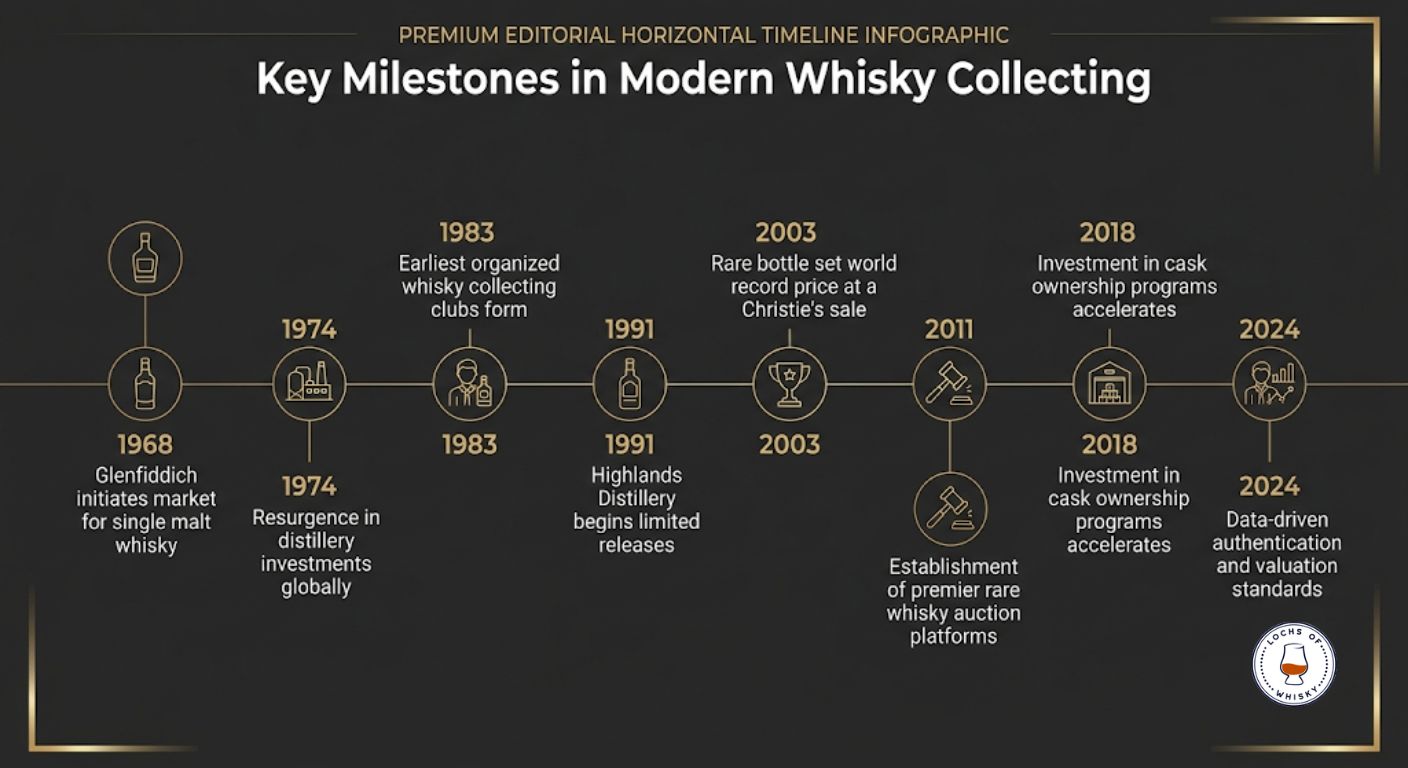
Comparing the Main Drivers of Whisky Collectability
No single characteristic makes a bottle collectible. Experienced collectors usually assess several factors together, including the distillery, provenance, condition and release history. The table below summarises how each factor typically influences collector demand.
| Factor | Why It Matters | Importance | Common Misunderstanding |
|---|---|---|---|
| Distillery Reputation | Recognised distilleries generally attract more consistent collector demand. | Very High | A famous distillery does not make every release collectible. |
| Provenance | Documented ownership history increases buyer confidence. | Very High | Many buyers overlook provenance until values become significant. |
| Bottle Condition | Fill level, labels and closures directly affect desirability. | Very High | Small defects can materially reduce value. |
| Original Packaging | Boxes and presentation cases improve completeness. | High | A missing box may reduce appeal for collectors. |
| Age Statement | Older whisky reflects limited historic stock. | High | Older does not automatically mean more valuable. |
| Limited Release | Restricted production can increase demand. | High | Scarcity without demand creates little collector interest. |
| Cask Type | Single casks and unusual maturation often attract enthusiasts. | Medium | Interesting casks cannot compensate for weak demand. |
| ABV | Cask-strength releases appeal to many enthusiasts. | Medium | Higher strength does not guarantee collectability. |
| Bottle Number | Individual bottle numbers may interest some buyers. | Low | Low bottle numbers rarely command a premium on their own. |
Rare Whisky Value Growth Data by Market Segment
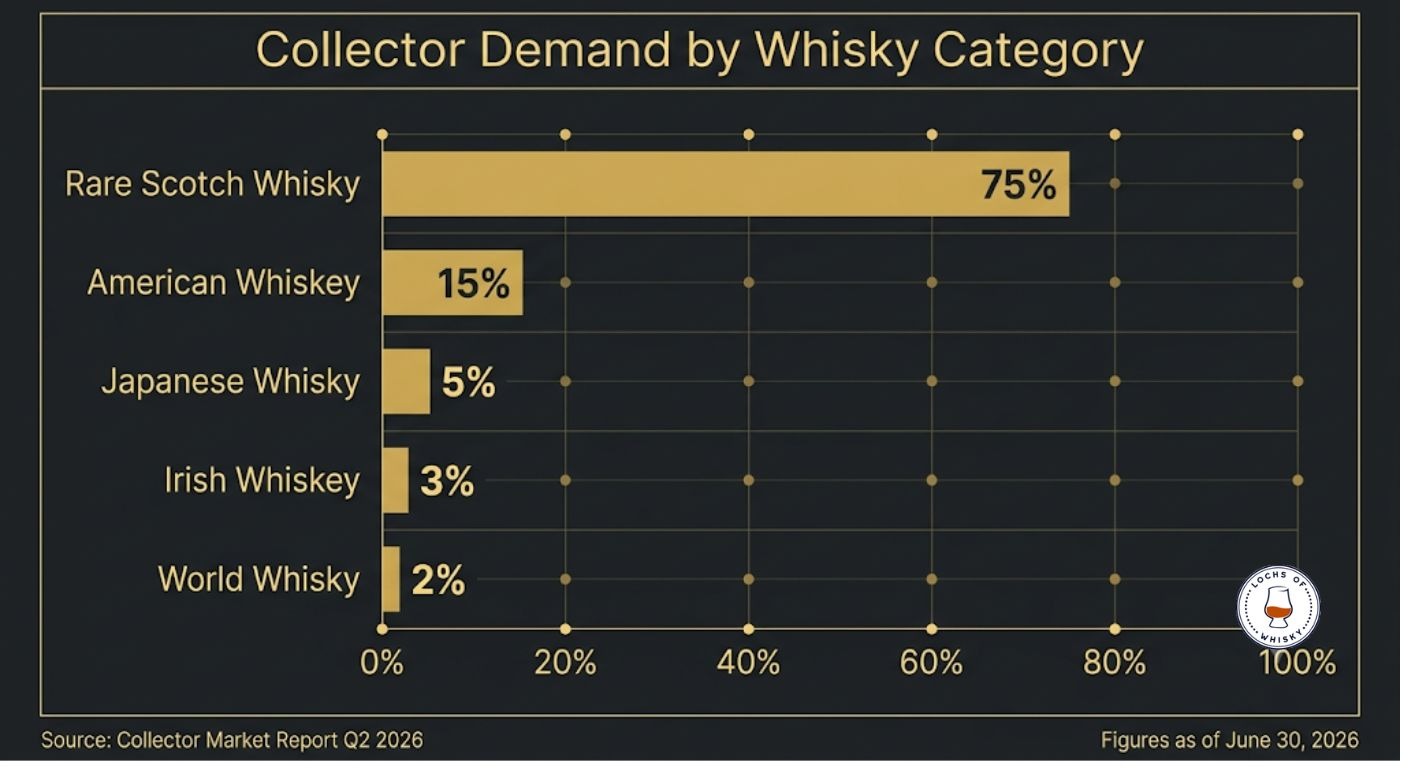
Collector demand is not distributed evenly across Scotch, American whiskey and world whisky. Each segment has its own release structures, terminology and scarcity drivers.
Rare Scotch whisky
Scotch has the most developed international secondary market. Demand covers old single malts, closed distilleries, historic blends, independent bottlings, limited official releases and discontinued presentations.
Speyside has deep collector recognition through producers such as Macallan, while Campbeltown demand has been strengthened by limited output and strong enthusiast interest. Islay attracts collectors interested in peated styles, closed distilleries and historically important vintages. These regional labels help organise the market, but the exact distillery and release remain more important than the region alone.
Collectors comparing active, closed and independently bottled Scotch can examine the rare Scotch whisky selection for bottle-level differences in age, vintage, strength and presentation.
Rare American whiskey
American whiskey collecting often centres on allocated Bourbon, discontinued labels, older bottlings, single-barrel releases and annual limited editions. Proof, mash bill, warehouse history and producer identity can all influence demand.
American age statements are not directly comparable with Scotch. A well-regarded limited Bourbon aged 10–15 years may attract stronger demand than an older bottle from a less established series. High proof can matter to enthusiasts, but recognisable provenance and release continuity usually have greater influence on long-term collectibility.
The rare American whiskey category brings together older and limited bottles where producer, proof and release context need to be assessed together.
Rare world whisky
World whisky includes markets with very different production histories and regulations. Japanese whisky has the most established collector presence outside Scotch and American whiskey, particularly for discontinued age statements and releases from closed distilleries. Some bottles achieved rapid price growth as international demand increased faster than the availability of aged stock.
Collectors should not apply Japanese market results to every emerging whisky country. A new distillery may receive attention without having a long sales history, mature stocks or an established collector base. Bottles from Australia, India, Taiwan and continental Europe need to be assessed individually.
For releases outside the major Scotch and American segments, the rare world whisky range provides context across Japanese and other internationally produced bottles.
Why Are Older Single Malt Prices Rising?
Older single malt prices rise when demand exceeds the limited supply of stock distilled decades earlier. A distillery cannot increase the amount of 18-, 25- or 30-year-old whisky available today. Evaporation reduces each cask’s contents, while producers may reserve mature stocks for limited editions or premium ranges rather than regular releases.
The supply constraint is historical. An 18-year-old bottle released in 2026 depends on production decisions made by 2008 or earlier. If the distillery produced less spirit at the time, closed temporarily or used much of its stock in younger releases, the amount available at the required age will be restricted.
Price increases can also reflect:
- Higher costs for barley, energy, glass, packaging and bonded storage
- Increased global demand for recognised distilleries
- Reduced availability of older casks with suitable quality
- Greater use of limited allocations
- Competition between drinkers and collectors for the same releases
- Repositioning of long-aged whisky within luxury price tiers
This premiumisation trend is examined separately in our report on the growth of £100-plus whisky. A higher retail price does not itself prove that a bottle is collectible, but it changes the cost and risk attached to purchasing older releases.
Bottles Versus Casks: Which Statistics Matter?
Bottle and cask ownership should be analysed separately. Bottles are finished consumer goods. Casks are maturing assets that require verified ownership records, bonded storage and continuing management.
| Factor | Whisky bottles | Whisky casks |
|---|---|---|
| Ownership evidence | Invoice, provenance and physical possession | Legal ownership documentation and warehouse acknowledgement |
| Storage risk | Light, heat, leakage, label and packaging damage | Evaporation, falling ABV, leakage and warehouse charges |
| Liquidity | Can be sold individually through established auctions | Requires a suitable buyer, broker, bottler or trade exit |
| Ongoing costs | Insurance and secure storage | Storage, insurance, regauging, samples and possible bottling costs |
| Condition measure | Fill level, closure, label and packaging | Bulk litres, ABV, remaining litres of alcohol and cask condition |
Before buying a cask, obtain and verify:
- The cask number
- The distillery and fill date
- The cask type and original fill volume
- The current bulk litres and ABV
- The remaining litres of alcohol
- The bonded warehouse location
- Written confirmation of ownership transfer
- Storage, insurance and regauging charges
- Any restrictions on sampling, moving or bottling the cask
Whisky casks are often described as wasting assets for UK Capital Gains Tax because their predictable useful life may be considered less than 50 years. Tax treatment depends on the exact ownership and transaction structure, and it should be confirmed with a qualified UK tax adviser rather than accepted from a cask seller’s promotional material.
Collector Risks Hidden by Headline Statistics
Authenticity and provenance
High prices attract counterfeiters. Buyers should be cautious where bottle history is unclear, labels appear inconsistent, closures have been disturbed or packaging does not match the release. Provenance becomes increasingly important as value rises.
For high-value bottles, retain invoices, correspondence, auction records and photographs. Where appropriate, compare details with verified examples from established retailers, auction houses or distillery archives.
Liquidity
Whisky is not a liquid asset in the financial sense. A bottle may have a published auction estimate without having an immediate buyer. Selling normally involves waiting for an auction, paying commission and accepting the result achieved on the day.
A bottle with regular transactions and a broad collector base is usually easier to sell than an obscure bottle with a high theoretical valuation. Before paying a premium, check how often the exact release has sold and whether demand depends on one unusually strong result.
Fees and transaction costs
Headline hammer prices can conceal buyer’s premium, seller’s commission, listing fees, insurance, payment charges, tax and delivery. A bottle bought for a £500 hammer price may cost the buyer materially more, while the seller receives materially less.
Calculate returns using the total acquisition cost and expected net sale proceeds. Comparing only the original hammer price with a later hammer price overstates performance.
Storage
Bottles should normally be stored upright, away from direct light and at a stable temperature. Unlike wine, whisky’s high alcohol content can damage a cork during prolonged horizontal storage. Excessive heat may increase evaporation and closure failure, while damp conditions can damage labels and presentation boxes.
Speculative release premiums
New limited editions sometimes trade above retail immediately after release. This reflects short-term scarcity and attention, not necessarily durable collector demand. Prices can fall once more bottles reach auction or buyers move to the next release.
Avoid treating an immediate resale premium as long-term rare whisky value growth data. Established demand is better demonstrated by repeated transactions across several years and different market conditions.
Decision Logic for Building a Whisky Collection
Collection decisions should begin with purpose. A drinking collection, a distillery archive and a resale-focused collection require different bottle choices.
- If you collect to drink: prioritise style, ABV, cask type and price rather than packaging perfection.
- If you collect one distillery: document vintages, presentation changes, bottlers and ownership periods before buying duplicates.
- If you want established resale demand: favour bottles with repeated auction results rather than relying on one record sale.
- If your budget is below £100: look for discontinued standard releases, small-batch independent bottlings and early editions from continuing series.
- If your budget is £100–£250: compare limited editions, older age statements and well-documented single-cask releases.
- If your budget exceeds £250: require stronger provenance, detailed condition evidence and several comparable sales.
- If you prefer lower risk: avoid bottles whose price depends mainly on launch-week demand.
- If you are buying a closed-distillery bottle: verify the distillation date and confirm that the spirit comes from the original operation.
- If a bottle is cask strength: check the exact ABV; releases above 55% will drink very differently from standard 40–46% bottlings.
- If packaging matters to the series: buy the most complete example you can reasonably afford.
Do not buy solely because a bottle is old, numbered or described as limited. Those characteristics matter only when collectors recognise the producer and continue to seek the exact release.
Frequently Asked Questions
Is every old bottle of whisky valuable?
No. Age alone does not determine value. Distillery reputation, provenance, condition, bottling period, packaging and genuine secondary-market demand are usually more important. An old bottle from an unknown blend may have limited demand, while a younger discontinued single malt from a strongly followed distillery may attract several collectors.
Is rare whisky still a good investment?
Selected bottles have produced strong historical returns, but the market is uneven and illiquid. Results from leading indices do not represent every bottle. Buyers must account for auction fees, storage, condition risk and the time required to sell. Collect whisky primarily because the bottle has clear historical, distillery or personal significance.
Is rare whisky a better investment than the S&P 500?
Some selected rare-whisky indices have reported ten-year growth of roughly 280%, compared with approximately 158% for the S&P 500 over a chosen comparison period. The figures are not directly equivalent. Equities are liquid and diversified, whereas whisky indices track selected bottles and exclude many unsuccessful purchases and transaction costs.
What makes a whisky bottle collectible?
A collectible bottle normally combines recognised producer demand, limited availability, documented provenance and good condition. Age, vintage, cask type, ABV, packaging and release history can strengthen interest. A bottle does not become collectible merely because it carries a number or uses the word “limited” on its label.
How can I identify a blue-chip whisky distillery?
Look for sustained international demand, repeated auction sales, recognised historic releases and collector interest across more than one bottling. Macallan has broad global recognition, while Springbank has strong enthusiast demand and restricted supply. A respected distillery name still requires bottle-level analysis because core and limited releases perform differently.
Why are 18-year-old single malt prices rising so quickly?
An 18-year-old whisky sold today depends on stock distilled at least 18 years earlier. Production cannot be increased retrospectively, and evaporation reduces available liquid during maturation. Rising production costs, global demand and distilleries reserving mature casks for limited releases can place additional pressure on prices.
Are whisky casks tax-free in the UK?
Some whisky casks may qualify as wasting assets for Capital Gains Tax purposes because their predictable life may be less than 50 years. This is not a universal promise of tax-free profit. Treatment depends on ownership, the transaction and current tax rules. Obtain advice from a qualified UK tax professional.
What are the warning signs of a whisky investment scam?
Warning signs include guaranteed returns, pressure to buy quickly, missing cask numbers, refusal to identify the warehouse, unclear ownership documents and valuations unsupported by completed sales. For casks, require written warehouse acknowledgement of ownership. For bottles, verify provenance, condition and recent results for the exact release.
Should collectible whisky bottles be stored upright?
Yes. Whisky bottles should normally be stored upright so high-strength spirit does not remain in prolonged contact with the cork. Keep them away from direct sunlight, major temperature changes and damp conditions. Check valuable bottles periodically for leakage, falling fill levels, closure damage and deterioration to labels or packaging.
Whisky Collecting Statistics: Key Rules and Decision Shortcuts
- Market data: use several completed sales, not one auction record or current asking price.
- Distillery: established collector demand generally matters more than age alone.
- Age: older whisky has a natural supply constraint, but it is not automatically desirable.
- ABV: cask-strength releases may appeal to enthusiasts, but strength does not guarantee value.
- Cask type: verify whether the bottle was fully matured or only finished in the stated cask.
- Provenance: retain invoices, photographs and ownership records.
- Condition: check fill level, closure, label and original packaging before buying.
- Scarcity: low production matters only when there is continuing demand.
- Liquidity: confirm that comparable bottles sell regularly before assuming an easy exit.
- Costs: calculate auction commission, delivery, insurance and storage when comparing returns.
Common mistakes include assuming every old bottle is valuable, confusing a retail asking price with a completed sale, overlooking auction fees and buying newly released bottles solely because they are difficult to obtain. Collectors should also avoid comparing casks with bottles without accounting for the different documentation, management and storage risks.
The most reliable shortcut is to identify the exact bottle first, then check its producer, release history, condition and repeated market demand. Collectors looking to compare established, discontinued and specialist bottles can continue through Lochs of Whisky’s collectible categories, including old Scotch, American whiskey and internationally produced releases.


Comments