
 Chat with us on WhatsApp


Bourbon vs Whiskey: What's The Actual Difference?
Bourbon is whiskey, but not every whiskey is bourbon. Whiskey is the wider category: a spirit made from fermented grain, distilled, matured, and bottled under rules that vary by country and style. Bourbon is a specific American whiskey with tighter legal requirements around grain recipe, production strength, barrel type, and origin.
This guide explains the bourbon vs whiskey difference clearly, without turning it into a brand debate. It covers what makes bourbon legally distinct, how it compares with Scotch and other whiskey styles, why bourbon usually tastes sweeter, and how to choose between them as a UK buyer.
If you are browsing American whiskey for the first time, it helps to understand the rules before comparing bottles. Lochs of Whisky carries a wider American whiskey selection, but the decision starts with knowing what is actually in the bottle.
-
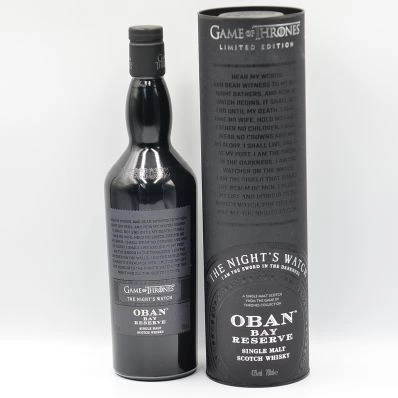 Game of Thrones Whisky Oban Bay Reserve The Night's WatchSpecial Price £72.98 Regular Price £84.99 Inc VATSaving £12.01
 -
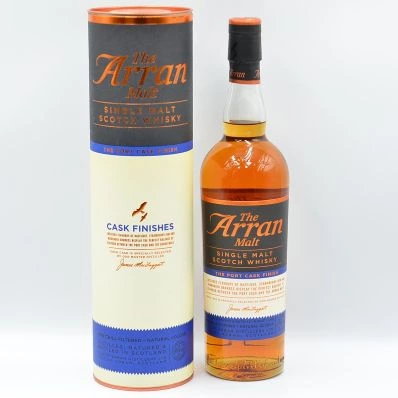 Arran Cask Finishes Port Scotch WhiskySpecial Price £87.98 Regular Price £97.99 Inc VATSaving £10.01
 -
-
-
-
-
-
 Chivas Regal 12 Year Old Scotch Whisky 75 Proof 1970sSpecial Price £47.98 Regular Price £59.99 Inc VATSaving £12.01
 -
-

-
 Game of Thrones Whisky Singleton Glendullan House TullySpecial Price £73.98 Regular Price £84.99 Inc VATSaving £11.01
The simple answer: bourbon is a type of whiskey
The easiest way to understand it is this: whiskey is the family; bourbon is one member of that family. Scotch whisky, Irish whiskey, rye whiskey, Tennessee whiskey, Japanese whisky and Canadian whisky are also part of the wider whiskey world, but each has its own rules, traditions and flavour profile.
For a whiskey to be bourbon, it must meet specific American legal standards. The most important are:
- It must be made in the United States.
- It must use a mash bill of at least 51% corn.
- It must be matured in new charred oak containers.
- It must be distilled to no more than 160 proof, or 80% ABV.
- It must enter the barrel at no more than 125 proof, or 62.5% ABV.
- It must be bottled at a minimum of 80 proof, or 40% ABV.
These standards are set out in US federal regulations, including the official standards of identity for whisky. That matters because bourbon is not just a flavour style. It is a legally defined whiskey category.
Bourbon and whiskey difference explained
The main difference is legal definition. Whiskey can be made in many countries from different grains and matured under different rules. Bourbon must be American, corn-led, matured in new charred oak, and bottled at 40% ABV or above. Those rules shape both the label and the flavour.
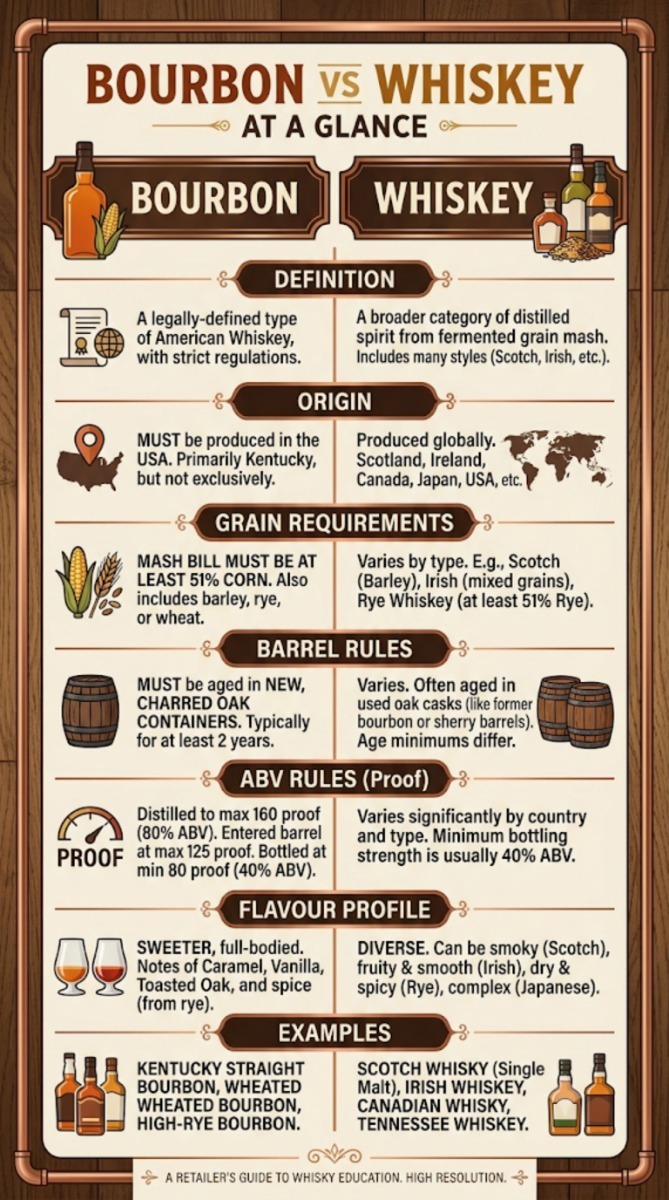
| Category | Origin | Main grain rule | Barrel rule | Typical flavour direction |
|---|---|---|---|---|
| Bourbon | United States | At least 51% corn | New charred oak | Vanilla, caramel, oak, spice |
| Scotch whisky | Scotland | Malted barley or grain whisky, depending on type | Oak casks, often refill or ex-bourbon | Fruit, malt, smoke, sherry, coastal notes |
| Irish whiskey | Ireland | Varies by style | Oak casks | Soft grain, orchard fruit, honey, spice |
| Rye whiskey | Usually United States or Canada | US rye must use at least 51% rye | Usually new charred oak for US rye | Pepper, spice, dry oak, herbs |
The legal rules explain why bourbon has a more consistent identity than many other whiskey styles. You can find big differences between producers, but most bourbon sits somewhere around sweet oak, vanilla, brown sugar, baking spice and charred barrel character.
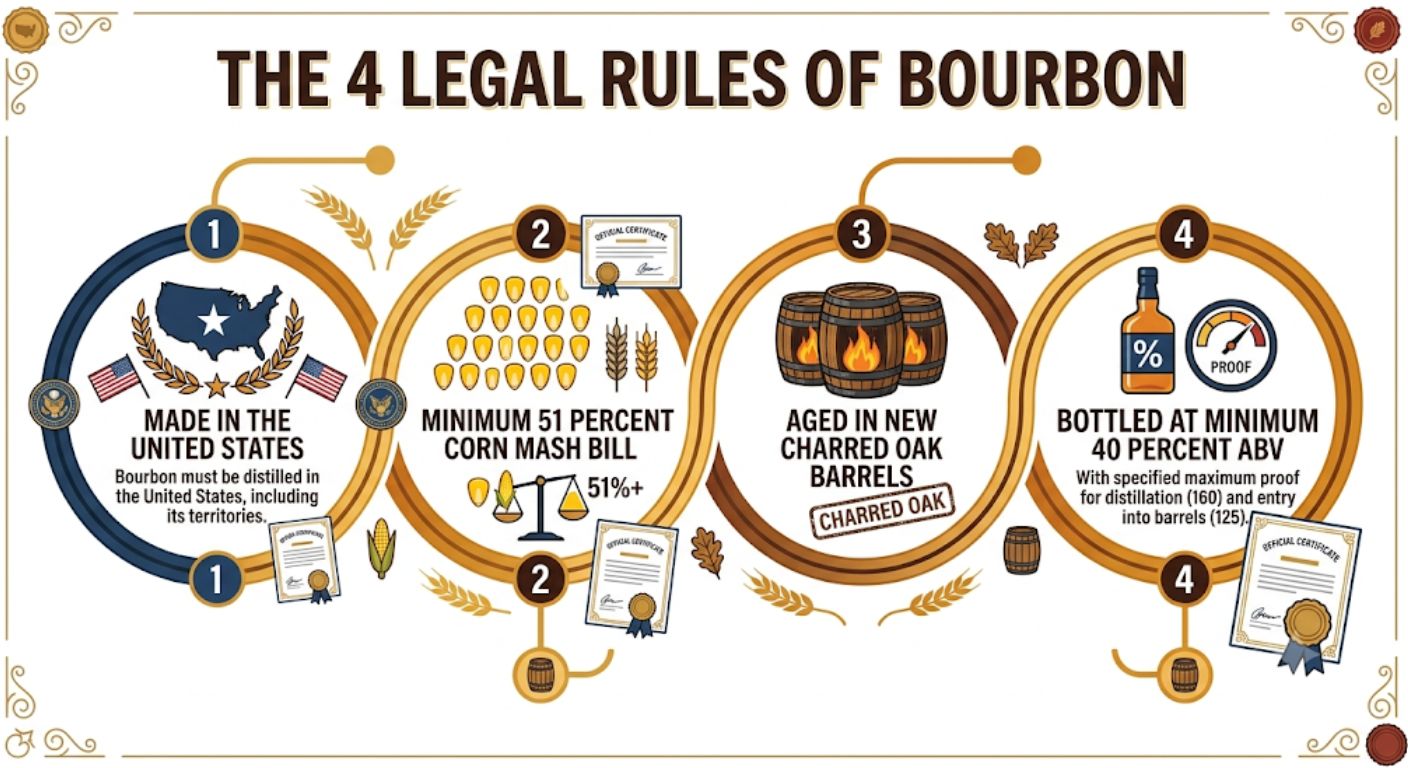
What legally makes bourbon bourbon?
Bourbon is defined by measurable production rules, not marketing language. A whiskey does not become bourbon because it tastes sweet, comes from Kentucky, or has an American label. It must satisfy the legal requirements around grain, origin, proof, oak and bottling strength.
1. Bourbon must be made in the United States
Bourbon does not have to come from Kentucky, but it does have to be made in the United States. Kentucky dominates bourbon production because of its history, climate, limestone-rich water associations and distilling infrastructure, but bourbon can legally be made in other US states.
This is a common point of confusion for UK buyers. “Kentucky bourbon” is a regional description. “Bourbon” is the legal category. A bottle from New York, Texas or Indiana can still be bourbon if it meets the same federal standards.
2. Bourbon must use at least 51% corn
The mash bill is the grain recipe. Bourbon must contain at least 51% corn, with the rest usually made up of rye, wheat and malted barley. Corn gives bourbon much of its rounded sweetness and weight, while rye brings spice, wheat softens the profile, and malted barley helps fermentation.
That remaining 49% matters. Two bourbons can both be legal bourbon but taste very different because one uses a high-rye mash bill and another uses wheat as the main secondary grain.
3. Bourbon must mature in new charred oak
Bourbon has to be matured in new charred oak. This is one of the biggest reasons bourbon tastes different from Scotch. A fresh charred barrel gives the spirit strong oak influence from the start: vanilla, caramel, toasted sugar, coconut, spice and char.
Scotch whisky is usually matured in oak casks that have already held another liquid, often bourbon or sherry. That refill cask system usually gives slower, more layered maturation. Bourbon gets a bigger hit of new oak earlier in life.
4. Bourbon has strict proof and ABV limits
Bourbon cannot be distilled above 160 proof, which is 80% ABV. It cannot enter the barrel above 125 proof, or 62.5% ABV. It must be bottled at no less than 80 proof, or 40% ABV. These numbers help preserve grain and barrel character rather than producing a neutral spirit.
As a buyer, ABV is not just a technical detail. A 40% bourbon will usually feel softer and easier to drink neat. A 50% bourbon will carry more weight, spice and alcohol heat. A cask-strength bottle can be excellent, but it is rarely the easiest starting point.
Is bourbon considered whiskey?
Yes. Bourbon is considered whiskey because it is a grain-based distilled spirit matured in oak. More specifically, it is an American whiskey category with its own legal rules. The correct statement is: all bourbon is whiskey, but not all whiskey is bourbon.
This distinction matters when comparing bottles. If a label says “whiskey”, it may be Scotch, Irish, American, Canadian, Japanese or another world whisky style. If it says “bourbon”, it should meet the American bourbon rules.
Bourbon vs Scotch vs whiskey
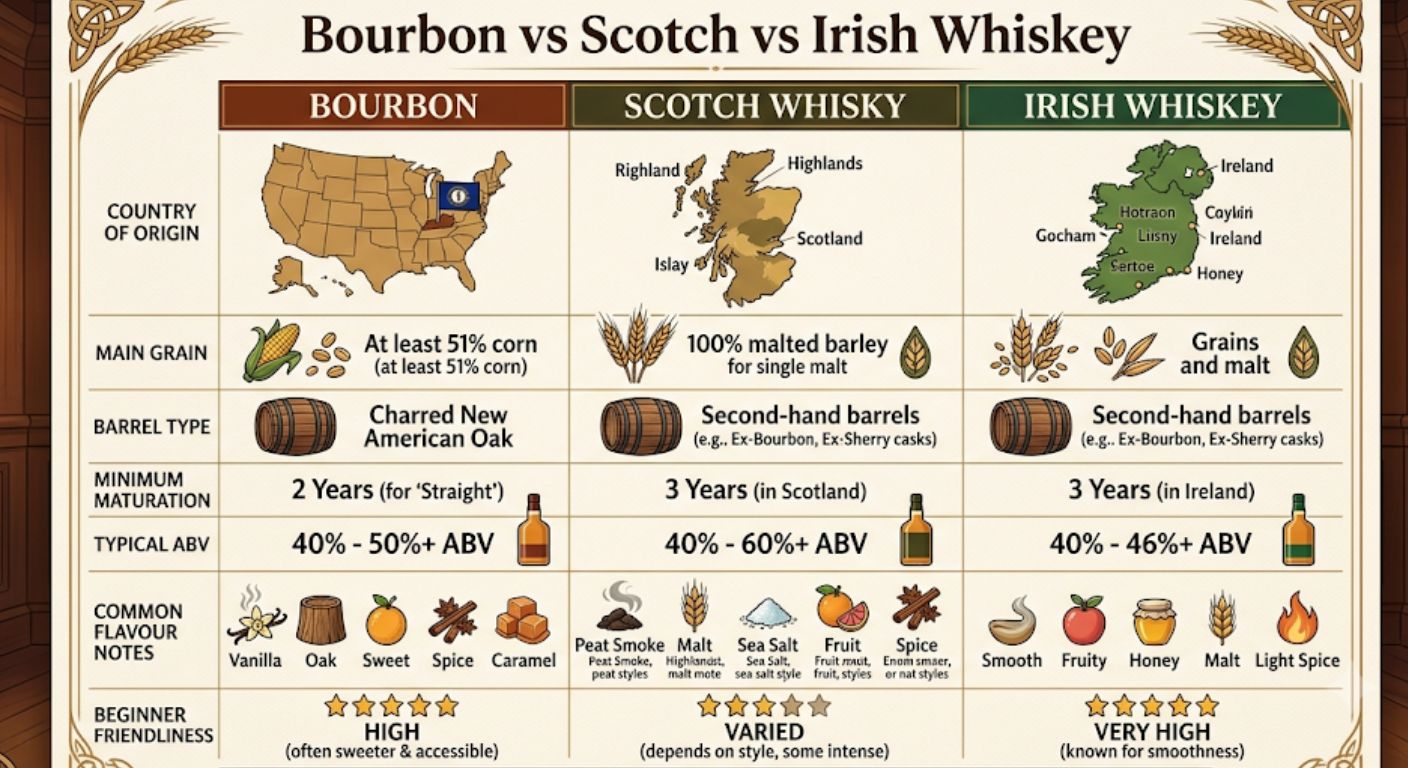
Whiskey is the broad category. Bourbon and Scotch are two different legally defined branches within it. Bourbon must be made in the United States and use at least 51% corn. Scotch whisky must be made in Scotland and matured in oak for at least three years.
The flavour difference usually follows from those rules. Bourbon is often sweeter, fuller and more oak-forward. Scotch is more varied. A Speyside single malt may be fruity and honeyed. An Islay whisky may be smoky and coastal. A sherry-cask Highland whisky may be rich, dried-fruit led and spicy.
| Point of comparison | Bourbon | Scotch whisky |
|---|---|---|
| Country | United States | Scotland |
| Core grain | Minimum 51% corn | Malted barley for single malt |
| Barrels | New charred oak | Oak casks, often refill bourbon or sherry |
| Minimum age | No general minimum for bourbon; straight bourbon requires at least two years | Minimum three years |
| Typical flavour | Vanilla, caramel, oak, spice | Malt, fruit, smoke, sherry, coastal notes |
The important point is not which one is “better”. They solve different drinking preferences. Bourbon gives a reliable route into sweet oak and American barrel character. Scotch offers wider regional and cask variation.
Why does bourbon usually taste sweeter?
Bourbon usually tastes sweeter because it is corn-led and matured in new charred oak. Corn gives the spirit body and natural sweetness, while new oak adds vanilla, caramel, toasted sugar and spice. Scotch often uses refill casks, so the wood influence can be softer and more varied.
This does not mean bourbon contains sugar. Standard bourbon should not rely on added flavouring or colouring. The sweetness is flavour perception created by grain, fermentation, distillation and oak maturation.
High-rye bourbon may taste drier and spicier. Wheated bourbon may feel softer and rounder. Older bourbon can become oakier and more tannic. Higher ABV bottlings can feel hotter, even when the underlying flavour is sweet.
Bourbon vs whiskey for beginners
For beginners, bourbon is often easier to understand than whiskey as a whole because the category has clearer flavour signposts. Expect vanilla, caramel, oak and spice. Whiskey more broadly can include smoky Scotch, light Irish blends, spicy rye, sherried single malts and many other styles.
If you are choosing your first bottle, use flavour preference rather than category loyalty:
- If you like vanilla, caramel and soft oak, start with bourbon around 40–45% ABV.
- If you like pepper and spice, try rye whiskey or high-rye bourbon.
- If you like honeyed fruit and malt, try an unpeated Speyside Scotch.
- If you like smoke, sea air and medicinal peat, move towards Islay Scotch.
- If alcohol burn is a concern, avoid cask strength until you know the style.
One thing our customers often underestimate is how much ABV changes the first impression: the same style at 40% and 50% can feel like two completely different drinks.
How age statements differ between bourbon and Scotch
Age statements do not work in exactly the same way across whiskey styles. Scotch must be matured for at least three years. If it carries an age statement, the number refers to the youngest whisky in the bottle. Bourbon has no general minimum age, but straight bourbon must be aged for at least two years.
If straight bourbon is less than four years old, it must usually carry an age statement. Many everyday bourbons do not show an age because they are made for consistency rather than age-led collecting.
For UK buyers, age is useful but not decisive. A young bourbon from active new oak can show more intense wood and vanilla than an older Scotch from tired refill casks. Cask quality, warehouse conditions and ABV can matter as much as the number on the label.
What about Tennessee whiskey?
Tennessee whiskey is closely related to bourbon, but it is normally filtered through sugar maple charcoal before maturation, a step known as the Lincoln County Process. Many Tennessee whiskeys meet the technical production profile of bourbon, but they are labelled and marketed as Tennessee whiskey.
This is why “Is Jack Daniel’s bourbon?” gets a complicated answer. It broadly fits many bourbon-style rules, but the producer identifies it as Tennessee whiskey because of its regional identity and charcoal mellowing process.
Key bourbon distilleries worth knowing
Understanding producer context helps buyers make better decisions. Bourbon is not just one flavour. Large Kentucky distilleries often produce multiple mash bills, age profiles and bottling styles under different labels.
Four Roses is known for its structured approach to recipes, using different mash bills and yeast strains to create distinct flavour profiles. Heaven Hill has long been important in Kentucky bourbon, with a broad range covering everyday bottles, bottled-in-bond releases and older expressions. Jim Beam is one of the major names in American whiskey, with scale, history and wide global recognition.
These guides are useful when a bottle name is familiar but the production context is not. A distillery page helps explain where a whiskey comes from, what style it usually follows, and why certain releases are priced differently.
Bourbon vs whiskey UK guide: how to choose
For UK buyers, the best choice depends on flavour, budget and how the bottle will be used. Bourbon is often strong value at £30–60 because American whiskey production can deliver bold flavour without needing long age statements. Scotch can offer more regional variety, but entry single malts often start higher.
If you prefer sweet and smooth
Choose bourbon or a softer Irish whiskey. Look for 40–45% ABV, avoid very high rye content at first, and do not start with cask strength. Wheated bourbon can be a good direction if you want a rounder profile.
If you prefer spice and structure
Choose rye whiskey, high-rye bourbon or a firmer Scotch. Rye brings pepper, grain spice and a drier finish. Bourbon with a higher rye content keeps the vanilla and oak but adds more bite.
If you prefer smoke
Choose Scotch, not bourbon. Bourbon can show charred oak and barrel smoke, but it is not usually peated. If you want medicinal, coastal or bonfire smoke, that belongs much more clearly to peated Scotch whisky.
If you are buying for cocktails
Bourbon is usually the safer choice for Old Fashioneds, Whiskey Sours and Mint Juleps. Rye is often better for a drier Manhattan. Avoid very expensive bottles for mixed drinks unless the recipe is built around that specific whiskey.
If your budget is £30–60
Look for clear category fit rather than age. In bourbon, this range can still give strong flavour. In Scotch, it often means younger single malts, blends, or entry-level regional styles. If the bottle is for someone who already drinks bourbon, browse the bourbon whiskey category rather than buying a generic American whiskey at random.
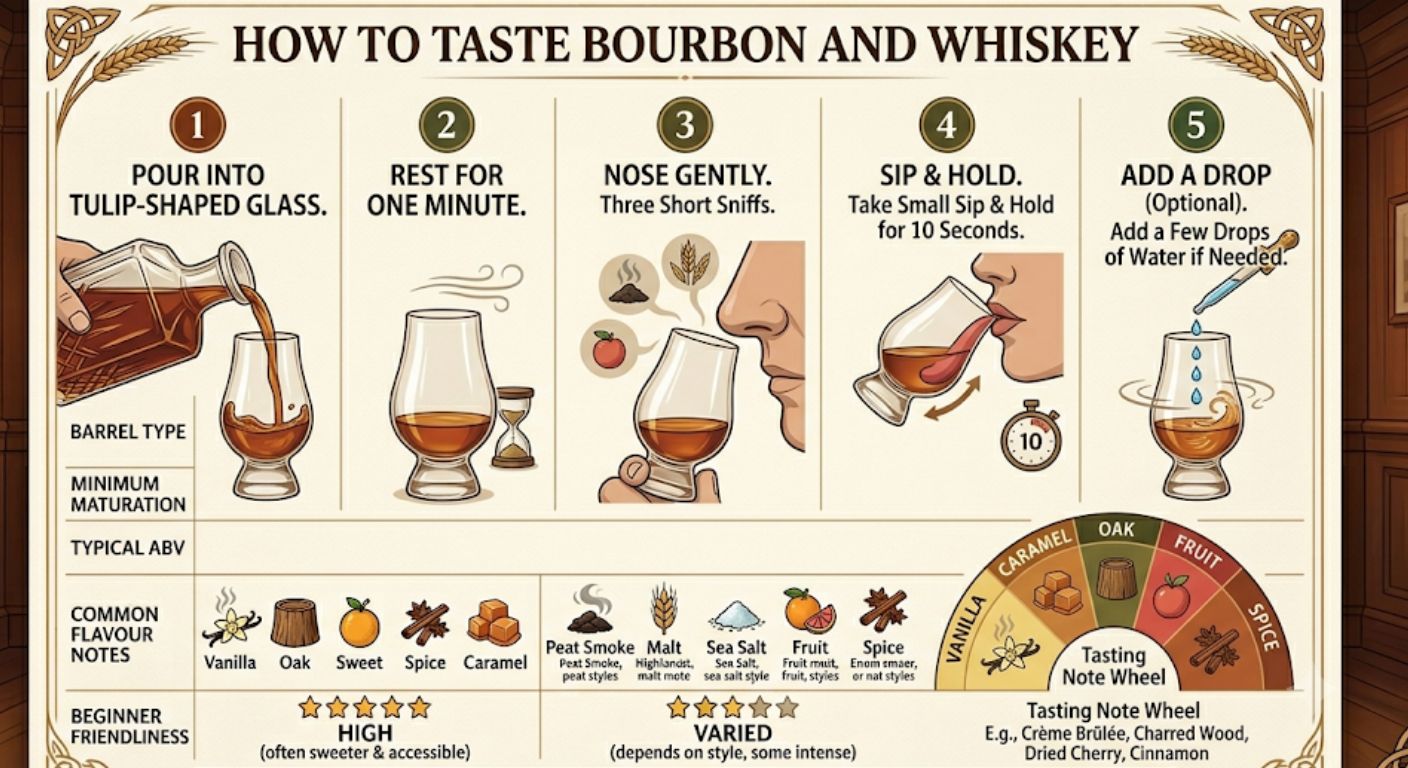
How to taste bourbon and whiskey correctly
A simple tasting method reduces alcohol burn and helps you compare styles properly. Use a small pour, give the glass time, nose slowly, sip lightly, then add water only if needed. Do not judge the bottle from the first hot sip.
- Use a tulip-shaped glass if possible. It concentrates aroma better than a tumbler.
- Pour a small measure. Around 20–25ml is enough for comparison.
- Let it sit for a minute. This helps alcohol vapour settle.
- Nose in short passes. Do not bury your nose in the glass.
- Take a small first sip. Let your palate adjust before judging flavour.
- Add a few drops of water if needed. This can reduce heat and open aroma.
For bourbon, look for vanilla, caramel, brown sugar, oak spice, orange peel, cinnamon, leather or toasted nuts. For Scotch, the range is wider: orchard fruit, malt, honey, dried fruit, peat smoke, sea salt, wax, chocolate or sherry spice depending on region and cask.
Common mistakes when comparing bourbon and whiskey
- Assuming bourbon must be from Kentucky. It must be American, but not necessarily Kentuckian.
- Thinking all whiskey tastes like bourbon. Bourbon is only one branch of the category.
- Ignoring ABV. A 50% whiskey will feel very different from a 40% bottle.
- Assuming older is always better. Oak quality and balance matter more than age alone.
- Confusing smoke with char. Bourbon barrel char is not the same as peated Scotch smoke.
- Buying by label familiarity only. Distillery, mash bill and cask type tell you more.
FAQ
What is the main difference between bourbon and whiskey?
Whiskey is the broad category. Bourbon is a specific American whiskey that must be made in the United States, use at least 51% corn, mature in new charred oak, and be bottled at a minimum of 40% ABV. In simple terms, all bourbon is whiskey, but not all whiskey is bourbon.
Is all bourbon whiskey?
Yes. Bourbon is a type of whiskey. It is made from grain, distilled, matured in oak and bottled under specific American rules. The word “bourbon” narrows the category by origin, mash bill, barrel type and proof limits.
Is bourbon only made in Kentucky?
No. Bourbon can be made anywhere in the United States if it meets the legal requirements. Kentucky is historically and commercially dominant, but it is not the only legal production location. A bourbon from another US state can still be genuine bourbon.
Why does bourbon taste sweeter than Scotch?
Bourbon usually tastes sweeter because it must use at least 51% corn and mature in new charred oak. Corn gives body and sweetness, while new oak adds vanilla, caramel and toasted sugar notes. Scotch often matures in refill casks, so the flavour can be less oak-sweet and more varied.
Is Jack Daniel’s officially considered bourbon?
Jack Daniel’s is generally described as Tennessee whiskey, not bourbon. It shares many bourbon-style production features, but it goes through charcoal mellowing, known as the Lincoln County Process, before maturation. That regional identity is why it is labelled as Tennessee whiskey.
What is straight bourbon?
Straight bourbon is bourbon aged for at least two years. If it is younger than four years, it generally needs an age statement. Straight bourbon must also follow the usual bourbon rules on mash bill, US production, new charred oak and bottling strength.
Is bourbon better than whiskey for beginners?
Bourbon can be easier for beginners because the flavour profile is often clearer: vanilla, caramel, oak and spice. Whiskey as a whole is broader and can include smoky Scotch, spicy rye, soft Irish whiskey or sherried single malt. Start with flavour preference, not category reputation.
What is the best way to drink bourbon?
Start neat in a small measure, then add a few drops of water if the alcohol feels too hot. Ice can make bourbon softer but may mute aroma. For cocktails, bourbon works especially well in an Old Fashioned, Whiskey Sour or Mint Julep.
What is the difference between single malt and blended Scotch?
Single malt Scotch is made from 100% malted barley at one distillery. Blended Scotch combines whiskies from more than one source and may include malt and grain whisky. Single malt highlights distillery character; blends are usually built for consistency and balance.
Structured summary: bourbon vs whiskey rules
- Category: Bourbon is a type of whiskey, not a separate spirit family.
- Origin: Bourbon must be made in the United States.
- Mash bill: Bourbon must contain at least 51% corn.
- Barrel: Bourbon must mature in new charred oak.
- ABV: Bourbon must be bottled at 40% ABV or higher.
- Age: Straight bourbon must be aged for at least two years.
- Flavour: Bourbon usually leans towards vanilla, caramel, oak and spice.
- Scotch comparison: Scotch is usually more varied by region, cask and peat level.
Decision shortcuts
- If you want sweet oak and vanilla, choose bourbon.
- If you want smoke, choose peated Scotch.
- If you want spice, choose rye whiskey or high-rye bourbon.
- If you want a softer first bottle, stay around 40–45% ABV.
- If you are buying for cocktails, bourbon is usually the most flexible starting point.
- If you are buying for an enthusiast, check distillery, ABV and mash bill before price alone.
The practical answer is simple: bourbon is the American, corn-led, new-oak branch of whiskey. If that flavour profile suits the drinker, a focused selection such as best selling bourbon is a sensible place to compare bottles without drifting into unrelated whiskey styles.

Comments