
 Chat with us on WhatsApp


Mash Bill Explained: Corn, Rye, Wheat & Their Impact On Flavour
A bourbon mash bill is the grain recipe used to produce a bourbon before fermentation and distillation. It sets out the proportion of corn, rye, wheat and malted barley in the mixture. Bourbon must contain at least 51% corn, while the remaining grains allow the distiller to shape its sweetness, spice, texture and overall character.
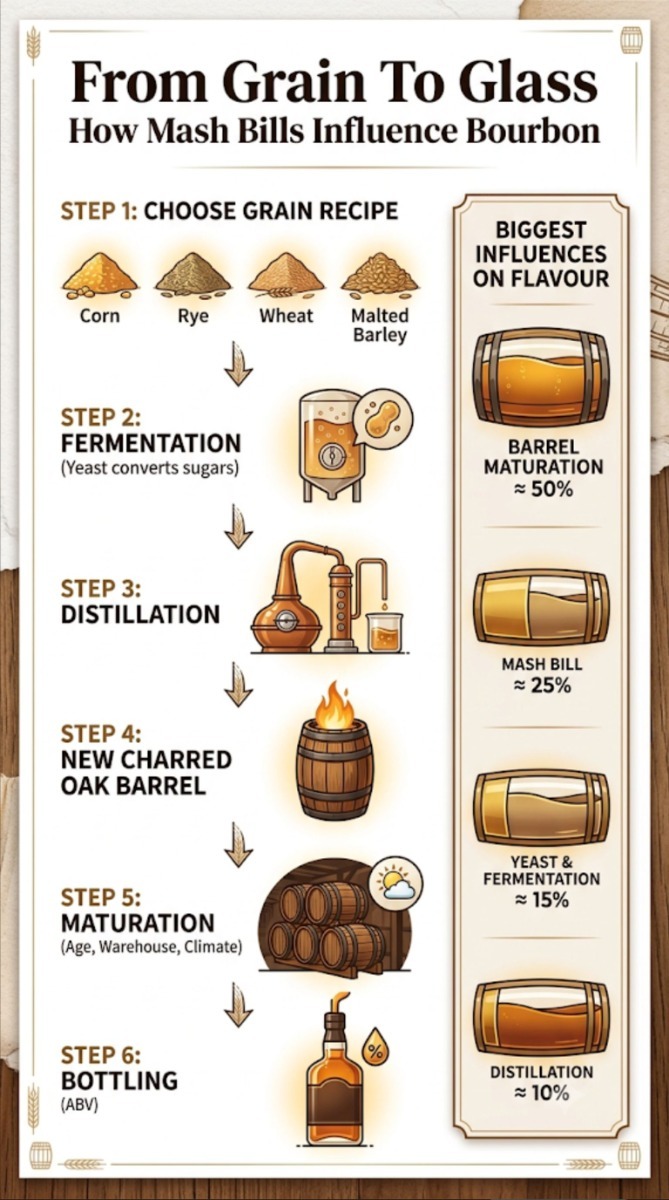
The mash bill is one of the most useful details to consider when exploring American whiskey. A high-rye recipe can produce a firmer, spicier style, while replacing rye with wheat often creates a softer and rounder profile. However, the recipe is only one influence. Yeast, distillation, maturation, barrel char, age and bottling strength can all change how the final whiskey tastes.
What Is A Bourbon Mash Bill?
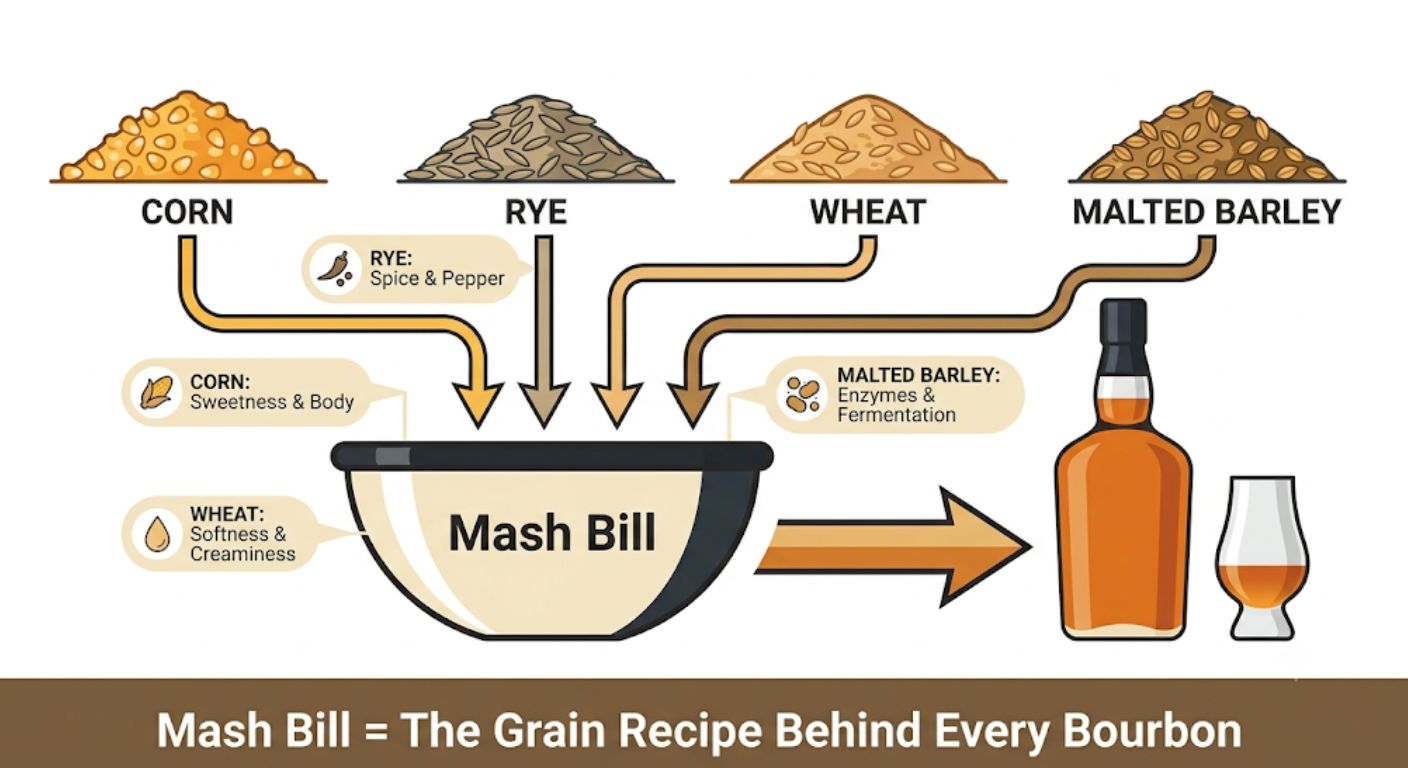
A bourbon mash bill is the percentage breakdown of cereal grains cooked together to create the fermentable mash. Corn must form the majority, while rye, wheat and malted barley normally fill the remaining portion. Each grain performs a practical role during production and contributes different flavours and textures to the finished bourbon.
The term may also be described as a grain bill, grain recipe or formula. A mash bill written as 75/13/12, for example, normally means:
- 75% corn
- 13% rye
- 12% malted barley
These percentages describe the grains entering production, not a guaranteed tasting formula. Two distilleries using similar proportions can produce noticeably different whiskeys because they may use different grain varieties, yeast strains, fermentation times, stills, barrel specifications and maturation conditions.
The Legal Requirements For A Bourbon Mash Bill
Under US standards, bourbon must be made from a fermented mash containing at least 51% corn. The exact proportions of the other grains are not fixed, and producers are not generally required to disclose the complete recipe on the bottle label.
For a whiskey to be labelled bourbon, it must:
- Be produced in the United States
- Contain at least 51% corn in its fermented grain mash
- Be distilled at no more than 80% ABV
- Enter the barrel at no more than 62.5% ABV
- Be stored in new, charred oak containers
- Be bottled at no less than 40% ABV
The official definitions are set out in the US standards of identity for whisky. These regulations establish what bourbon must be, but they leave distillers considerable freedom over the secondary grains and production methods.
A recipe containing 80% or more corn may instead fall within the regulatory definition of corn whisky, depending on how it is matured and labelled. This is why bourbon recipes typically use enough rye, wheat or malted barley to keep the corn proportion below that threshold.
How Corn Shapes Bourbon Flavour
Corn supplies the foundation of every bourbon. It produces fermentable sugars and is commonly associated with flavours such as caramel, vanilla, honey, sweetcorn and soft fruit. These notes are not created by corn alone, because maturation in new charred oak also contributes substantial sweetness, vanilla and toasted character.
A higher percentage of corn can create a broad, sweet base, but it does not automatically make a bourbon sweeter in the glass. An older high-corn bourbon may taste dry and oak-led, while a younger high-rye bourbon may still show plenty of caramel and vanilla.
Corn also tends to give bourbon a fuller and rounder centre. It establishes the core sweetness around which rye or wheat can add contrast. The percentage matters, but so do the variety and quality of the corn, the cooking process and the efficiency of fermentation.
What Does Rye Add To A Bourbon Mash Bill?
Rye commonly adds pepper, baking spice, herbal notes and a firmer structure. In a bourbon mash bill, it acts as a secondary flavouring grain rather than the majority grain. As its proportion increases, the bourbon may become drier, more aromatic and more assertive through the finish.
There is no legally defined percentage at which bourbon becomes “high rye”. The term is generally used when a recipe contains noticeably more rye than a conventional bourbon mash bill. One producer might consider 15% rye relatively high, while another may use 25% or more.
Common high-rye characteristics include:
- Black pepper and clove
- Cinnamon and nutmeg
- Mint or herbal notes
- A drier mid-palate
- A more persistent, spicy finish
High-rye bourbon often works well where greater structure is required, including in an Old Fashioned or Manhattan. It can retain its identity alongside sugar, bitters and vermouth more effectively than a particularly delicate wheated bourbon.
It should not be confused with rye whiskey, which must be made from a mash containing at least 51% rye. Our bourbon and rye whiskey comparison examines that distinction in greater detail.
What Does Wheat Add To Bourbon?
Wheat usually creates a softer, rounder and less peppery bourbon than rye. Wheated bourbon still contains at least 51% corn, but wheat replaces rye as the main secondary grain. The resulting whiskey may show honey, soft bread, vanilla, caramel and gentle fruit rather than pronounced spice.
Wheat is often described as making bourbon smoother, although “smooth” is not a technical category. The softer impression usually comes from lower levels of rye-driven pepper and herbal character. Alcohol strength, age and oak extraction still have a major effect on how gentle or forceful the bourbon feels.
Wheated bourbon can suit drinkers who prefer:
- A rounded rather than peppery profile
- Soft caramel, honey and bread notes
- Less obvious spice through the finish
- A bourbon for drinking neat or with a small amount of water
Maker’s Mark is one of the clearest examples of a distillery associated with wheated bourbon. Its recipe uses red winter wheat in place of rye, helping to create the soft, rounded character for which its core releases are known.
We regularly find that our customers notice the difference between wheat and rye more clearly in the finish than in the initial sweetness: wheat tends to fade gently, while rye often leaves a firmer pepper or spice note.
Wheated Bourbon Vs High-Rye Bourbon Flavour
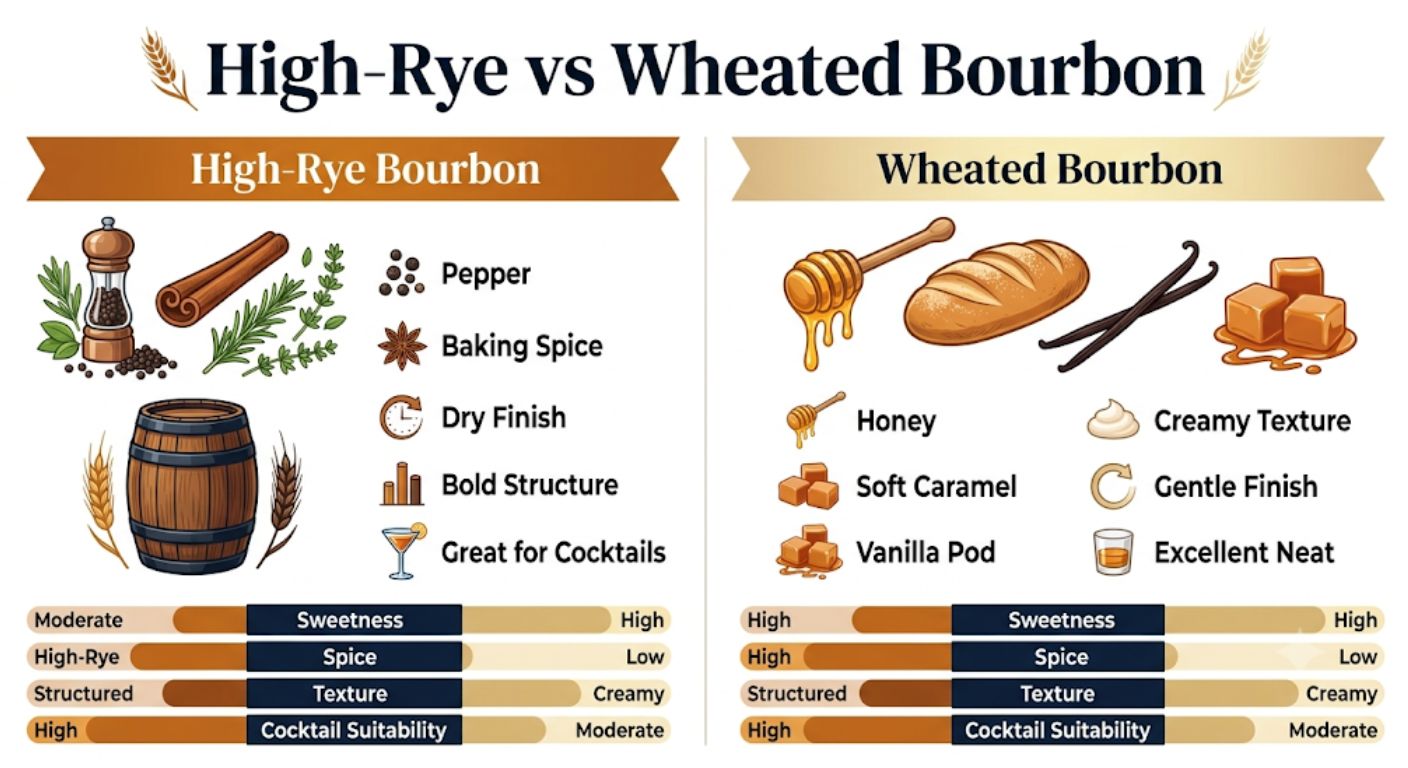
Wheated bourbon generally tastes softer, rounder and more bread-led, with honey, caramel and gentle fruit. High-rye bourbon is usually drier and more structured, with pepper, cinnamon, herbs and a longer spicy finish. Neither style is inherently sweeter or better; the difference is mainly one of texture, contrast and flavour emphasis.
| Mash bill style | Typical grain structure | Common flavour direction | Often suits |
|---|---|---|---|
| Traditional bourbon | Corn, moderate rye, malted barley | Balanced caramel, vanilla and spice | General-purpose sipping and mixing |
| High-rye bourbon | Corn with a larger rye proportion | Pepper, cinnamon, herbs and firmer structure | Drinkers seeking spice or cocktail presence |
| Wheated bourbon | Corn, wheat and malted barley | Honey, soft bread, caramel and rounded fruit | Drinkers seeking a gentler neat pour |
| Four-grain bourbon | Corn, rye, wheat and malted barley | A combination of sweetness, spice and softness | Drinkers interested in layered grain character |
What Is The Role Of Malted Barley?
Malted barley provides enzymes that convert grain starches into fermentable sugars during mashing. Its contribution is primarily functional, although it can also add cereal, biscuit, nutty and lightly malty notes. Most bourbon recipes use considerably less malted barley than corn or the main secondary flavouring grain.
During malting, barley begins to germinate, activating enzymes including alpha-amylase and beta-amylase. These enzymes help break long starch molecules into smaller sugars that yeast can ferment into alcohol.
Modern distilleries can use commercial enzyme preparations, which gives them more freedom to reduce the malted barley percentage or experiment with other grains. However, malted barley remains a standard component in many established bourbon recipes.
How Four-Grain Bourbon Works
Four-grain bourbon uses corn, rye, wheat and malted barley in the same mash bill. The aim is usually to retain rye’s spice while introducing some of wheat’s softer texture. It does not guarantee greater complexity, because fermentation, distillation and maturation still determine whether those grain influences remain distinct.
A successful four-grain recipe may combine:
- Corn-led sweetness and body
- Rye-derived spice and structure
- Wheat-derived softness
- Malted barley’s enzymatic function and cereal character
Producers such as Willett have worked with several recipes and whiskey styles, illustrating how a distillery can build different flavour profiles without relying on a single house mash bill.
Why Similar Mash Bills Can Taste Different
The mash bill provides a starting point, not a complete prediction of flavour. Two bourbons with similar recipes can taste markedly different if they are made or matured under different conditions.
Important variables include:
- Yeast strain: Influences fruit, floral and spice compounds during fermentation.
- Fermentation: Temperature and duration affect the range of flavour compounds created.
- Distillation: Still design and cut points determine which compounds pass into the new make spirit.
- Barrel specification: Oak seasoning, toast and char levels affect sweetness, tannin and smoke.
- Warehouse location: Temperature variation changes the rate of extraction and oxidation.
- Age: Longer maturation can increase oak, leather and drying spice while reducing fresh grain character.
- ABV: A bourbon at 50% ABV can present more weight and spice than a related release bottled at 40% ABV.
Buffalo Trace, for example, produces multiple bourbon families from a relatively small number of underlying mash bills. Age, barrel selection, warehouse placement and bottling strength help distinguish the resulting releases.
The barrel is especially important because new charred oak can contribute vanilla, caramelised sugar, coconut, toast, tannin and spice. Our guide to charred oak and American whiskey flavour explains this influence separately.
Why Is The Exact Mash Bill Missing From The Label?
Distilleries are not generally required to print the exact grain percentages on a bourbon label. Some disclose the recipe voluntarily, while others treat it as proprietary production information. Published percentages may come from the producer, technical sheets, historical records or informed third-party research, so the source should always be checked.
A familiar recipe does not prove that a whiskey came from a particular distillery. Several producers can use identical or near-identical percentages. Sourced whiskey should therefore be assessed using confirmed producer information, the stated distillation location and, where available, the distilled spirits plant number rather than the mash bill alone.
How To Compare Bourbon Mash Bills At Home
The clearest way to understand grain influence is to taste three bourbons side by side: one traditional recipe, one wheated bourbon and one high-rye bourbon. Keep the age and bottling strength reasonably similar so that oak and alcohol do not overwhelm the comparison.
- Pour 15–20ml of each bourbon into separate tasting glasses.
- Arrange them from the softest expected style to the spiciest: wheated, traditional, then high rye.
- Smell each glass before tasting, noting grain, fruit, caramel and spice aromas.
- Take a small sip of each and compare the mid-palate texture.
- Pay particular attention to the finish, where rye spice and wheat softness are often clearest.
- Add a few drops of water and repeat the comparison.
A Glencairn or another tulip-shaped glass makes aroma comparison easier, but identical glasses are more important than the specific design. Avoid comparing a 40% ABV young wheated bourbon against a heavily aged high-rye release at 60% ABV, as strength and maturation will dominate the result.
How To Choose A Bourbon By Mash Bill
Choose a wheated bourbon when you prefer rounded texture, restrained spice and flavours such as honey, soft bread and caramel. Choose a high-rye bourbon when you want pepper, cinnamon, herbal notes and enough structure to stand out in mixed drinks.
A traditional rye-based bourbon is the safest starting point when you want balance rather than an extreme style. Four-grain bourbon is worth considering when the producer provides useful recipe details and you want to examine how wheat and rye can work together.
Do not use the mash bill as the only buying criterion. Check the ABV, age statement, producer, maturation details and whether the whiskey was distilled by the brand named on the label. These factors can matter as much as the grain percentages.
Frequently Asked Questions
Does More Corn Make Bourbon Sweeter?
Not necessarily. Corn creates a naturally sweet foundation, but the finished flavour also depends on yeast, distillation, oak, age and ABV. A high-corn bourbon can become dry and tannic after extended maturation, while a lower-corn, high-rye recipe may still taste rich in caramel and vanilla.
What Percentage Makes A Bourbon Wheated?
There is no legal minimum percentage of wheat for wheated bourbon. The term normally means that wheat has replaced rye as the principal secondary flavouring grain. The whiskey must still contain at least 51% corn to qualify as bourbon.
What Percentage Makes A Bourbon High Rye?
High rye has no fixed legal definition. It indicates that the bourbon contains a larger rye proportion than a conventional recipe, often around 15% or more. Producer recipes vary, so the phrase is best treated as a style description rather than a regulated threshold.
Is Wheated Bourbon Always Smoother?
Wheated bourbon often feels softer because it lacks rye’s prominent pepper and herbal notes. However, a high bottling strength, young spirit or heavily tannic barrel can still make it feel forceful. Wheat influences the shape of the flavour but does not override every other production variable.
Does The Mash Bill Matter More Than The Barrel?
The mash bill establishes the spirit’s grain character, but maturation often has the greater influence on the finished bourbon. New charred oak contributes substantial vanilla, caramel, toast, tannin and spice. The most useful approach is to consider the grain recipe and barrel history together.
-
-
-
-
-
-
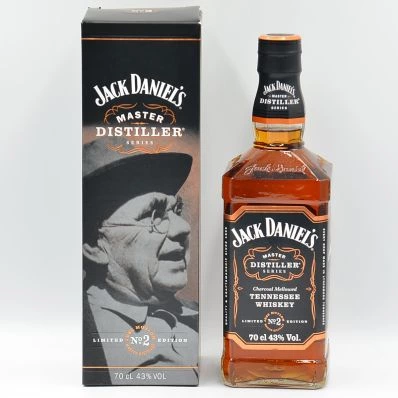 Jack Daniel's - Master Distiller Batch 2 Jess Motlow Limited Edition Bourbon Whiskey£164.99 Inc VATOut of stock
 -
 Game Of Thrones Whisky Dalwhinnie Winter's Frost House StarkSpecial Price £104.98 Regular Price £134.99 Inc VATSaving £30.01Out of stock
 -
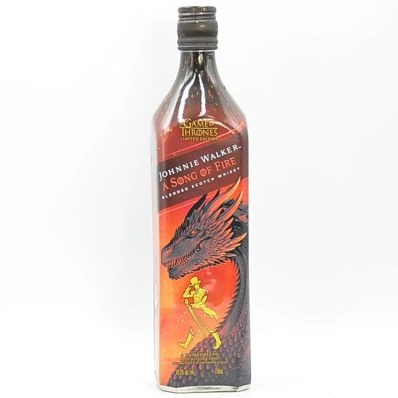 Game of Thrones Whisky Johnnie Walker A Song Of FireSpecial Price £139.98 Regular Price £144.99 Inc VATSaving £5.01
 -
-
-
Understanding The Recipe Behind The Bourbon
A bourbon mash bill explains the grain foundation of the whiskey. Corn provides the required base and much of the underlying sweetness. Rye usually adds spice and structure, wheat creates a softer profile, and malted barley helps convert starch into fermentable sugar.
These distinctions can make it easier to predict whether a bourbon is likely to suit your palate, but they are not a substitute for checking its age, ABV, producer and maturation. Used alongside those details, the mash bill becomes a practical tool for comparing bottles and understanding why bourbons from different distilleries can show such different character.


Comments