
 Chat with us on WhatsApp

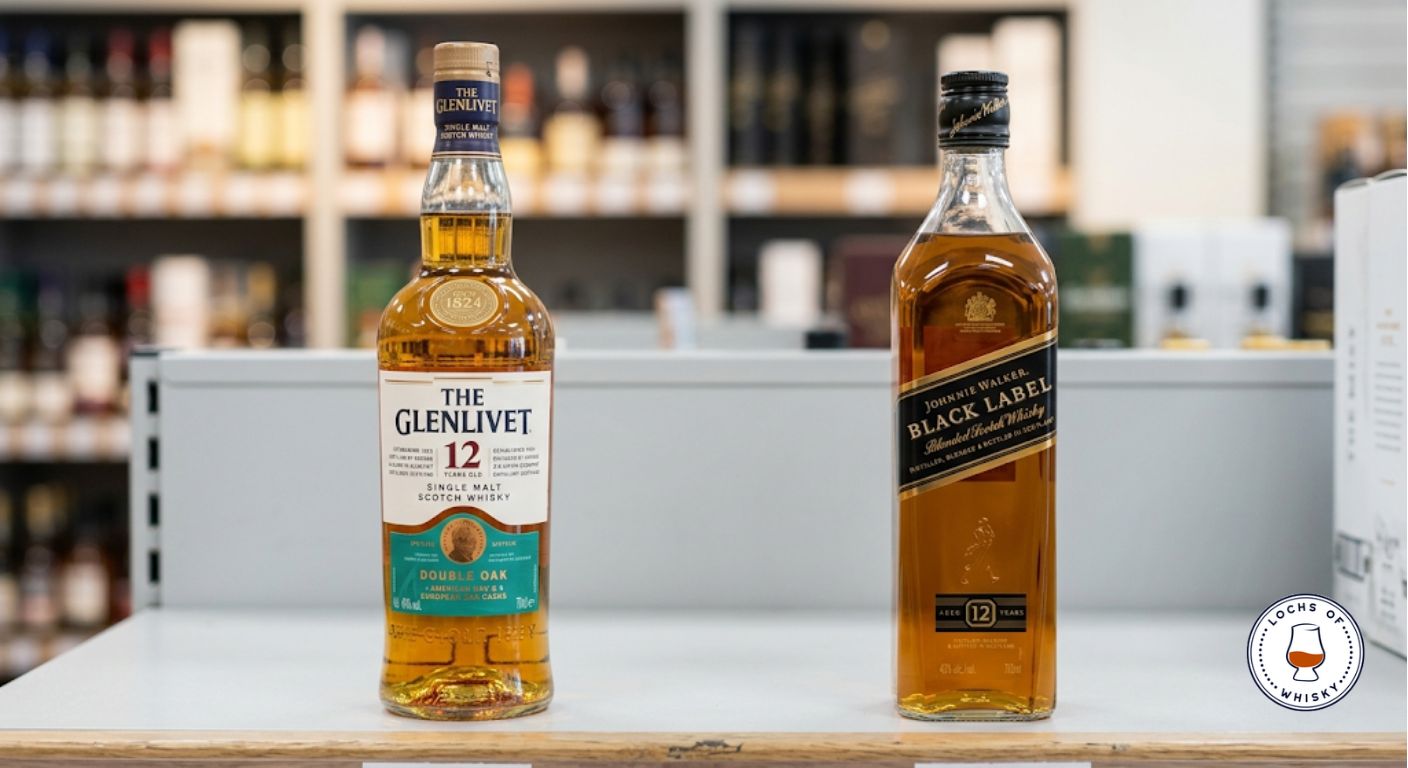
Single Malt vs Blended Scotch: Statistics, Market Share & Trends
Single malt and blended Scotch are often compared as if one is automatically superior to the other. That is too simple. The real difference is how each category is made, how it performs in the market, and how buyers use it when choosing a bottle.
Blended Scotch still dominates Scotch whisky by volume because it is accessible, consistent, and widely distributed. Single malt carries more weight in premium, collector, and distillery-led buying because it offers clearer provenance and a stronger sense of place.
This guide explains the practical difference between single malt and blended Scotch, how their market share differs by volume and value, and what those trends mean when choosing a bottle. For buyers comparing everyday blends with more provenance-led bottles, the Blended Scotch Whisky category is the natural commercial starting point.
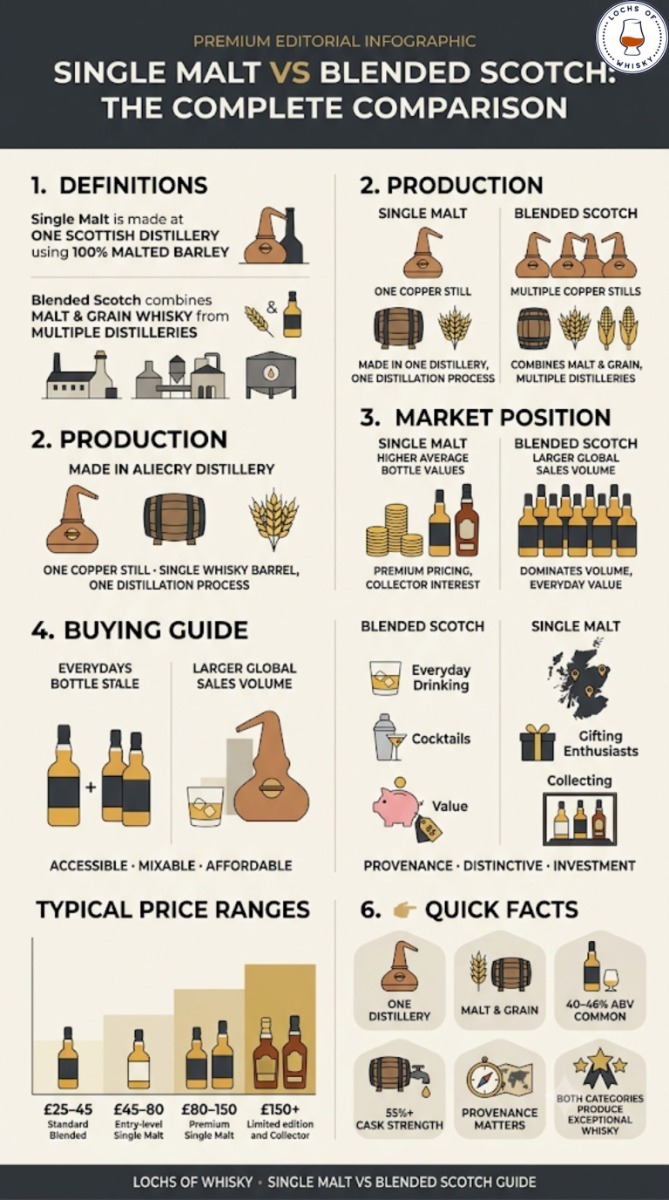
Single Malt vs Blended Scotch: Statistics At A Glance
- Blended Scotch dominates by volume because it is widely distributed, consistent, and usually more affordable.
- Single malt is stronger by value because buyers pay more for distillery identity, age statements, cask details, and limited releases.
- “Single” means one distillery, not one cask or one bottle batch.
- Blended Scotch can include malt and grain whisky from multiple distilleries to create a consistent house style.
- Collector interest usually favours single malt because provenance, bottler, age, ABV, and cask type are easier to identify.
Single Malt vs Blended Scotch: By The Numbers
Single malt Scotch comes from one Scottish distillery.
Blended Scotch usually combines malt whisky and grain whisky.
Most standard Scotch bottlings sit around this strength.
Common for enthusiast-focused single malt releases.
Typical territory for many cask-strength Scotch whiskies.
A common budget range for quality blended Scotch.
A typical starting range for many entry and mid-level single malts.
Scotland has more than one hundred operating whisky distilleries.
What Is The Difference Between Single Malt And Blended Scotch?
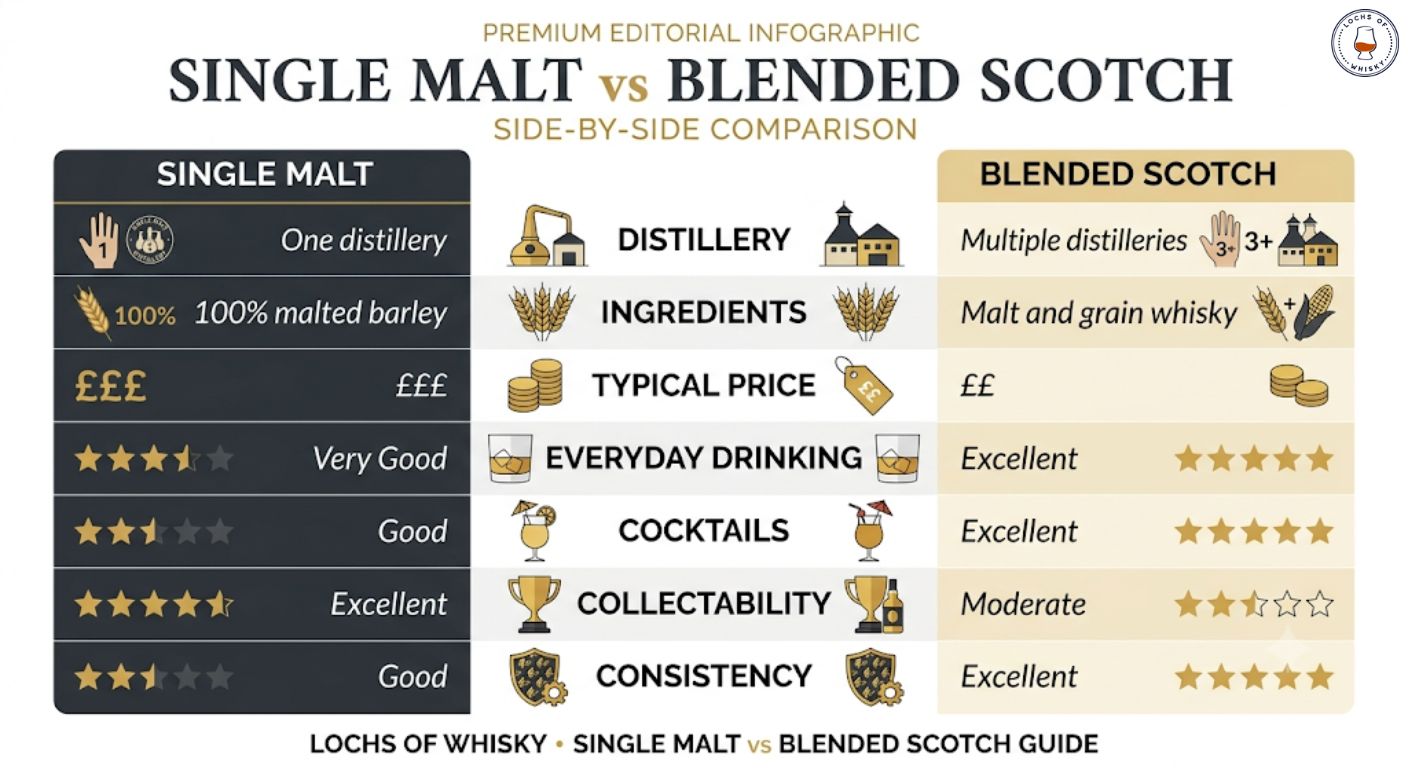
Single malt Scotch is whisky made at one Scottish distillery using malted barley and pot still distillation. Blended Scotch combines whiskies from more than one distillery, usually including malt whisky and grain whisky, to create a consistent house style.
The word “single” does not mean one cask or one bottle batch. It means one distillery. A single malt can still contain whisky from many casks, different ages, and different wood types, provided all the whisky comes from the same distillery.
Blended Scotch is broader. It can include malt whisky from several distilleries alongside lighter grain whisky. This gives blenders more control over flavour, cost, and consistency. Large blended Scotch brands are built around repeatability. The aim is that a bottle bought this year tastes broadly like a bottle bought next year.
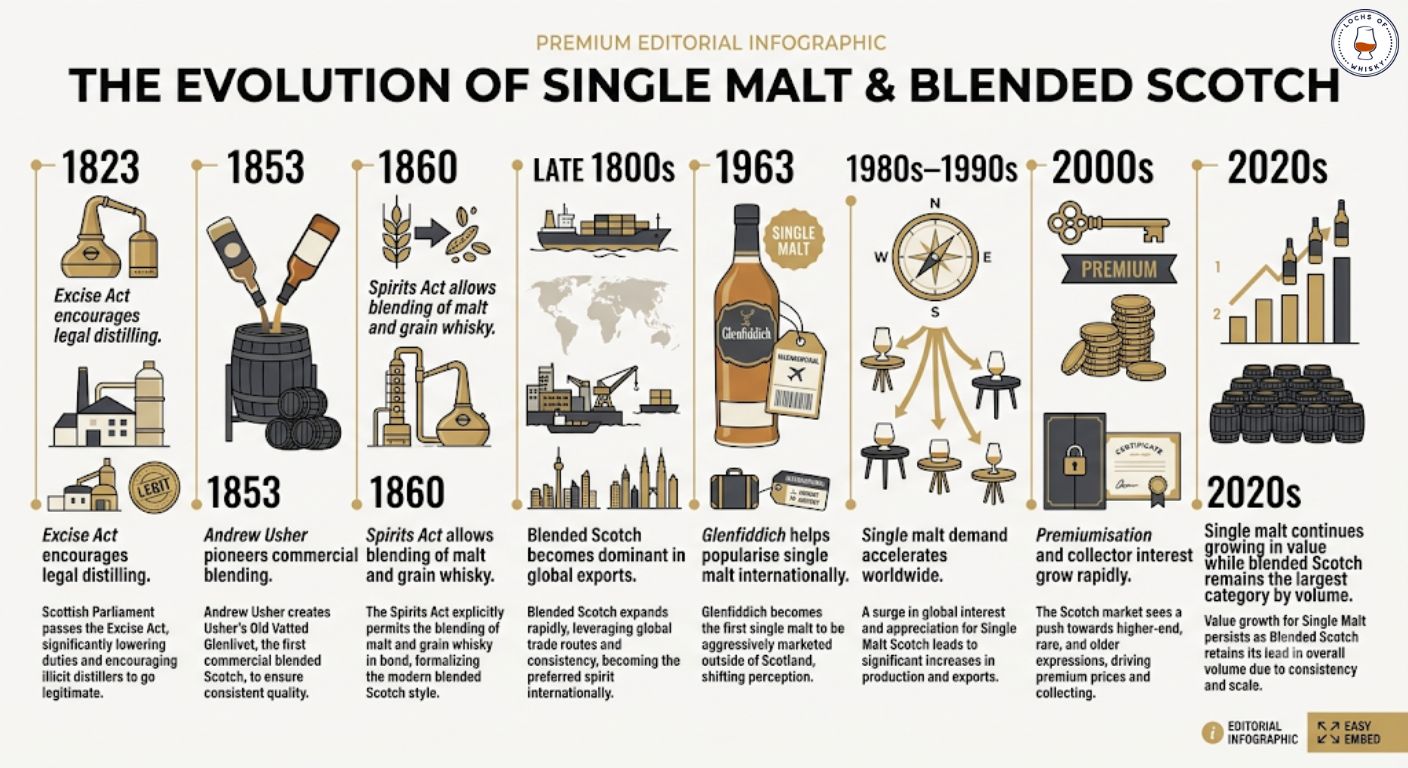
Single Malt vs Blended Scotch Market Share
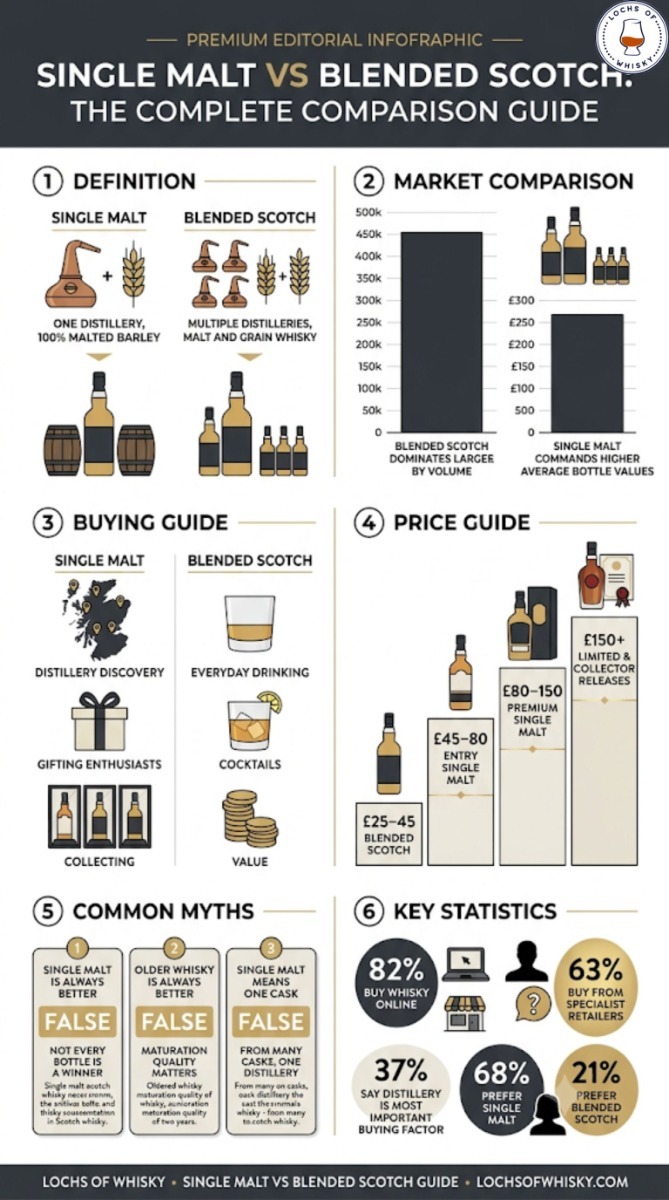
Blended Scotch remains the larger category by volume, while single malt carries more weight in premium and collector-led buying. The gap matters because Scotch market share looks very different depending on whether you measure bottles sold or value generated.
Single Malt vs Blended Scotch: Market Share At A Glance
| Category | Typical Volume Position | Typical Value Position | Main Buyer Motivation |
|---|---|---|---|
| Blended Scotch | Dominant by volume | Lower average bottle value | Consistency, accessibility, value |
| Single Malt Scotch | Smaller by volume | Higher average bottle value | Provenance, distillery identity, collectability |
In simple terms, blended Scotch sells in larger quantities because it is scalable, familiar, and usually more affordable. Single malt sells fewer bottles overall, but often commands a higher price because buyers attach value to distillery identity, age statements, cask type, ABV, and limited releases.
This is why a market can be blend-led by volume but still show strong premium growth through single malt. Volume shows what people buy most often. Value shows where buyers are willing to spend more.
Why Volume And Value Tell Different Stories
- Volume share shows how many bottles or litres are sold.
- Value share shows how much money the category generates.
- Blended Scotch usually leads on volume because it is accessible and widely distributed.
- Single malt Scotch usually performs more strongly by value because provenance and bottle detail carry a premium.
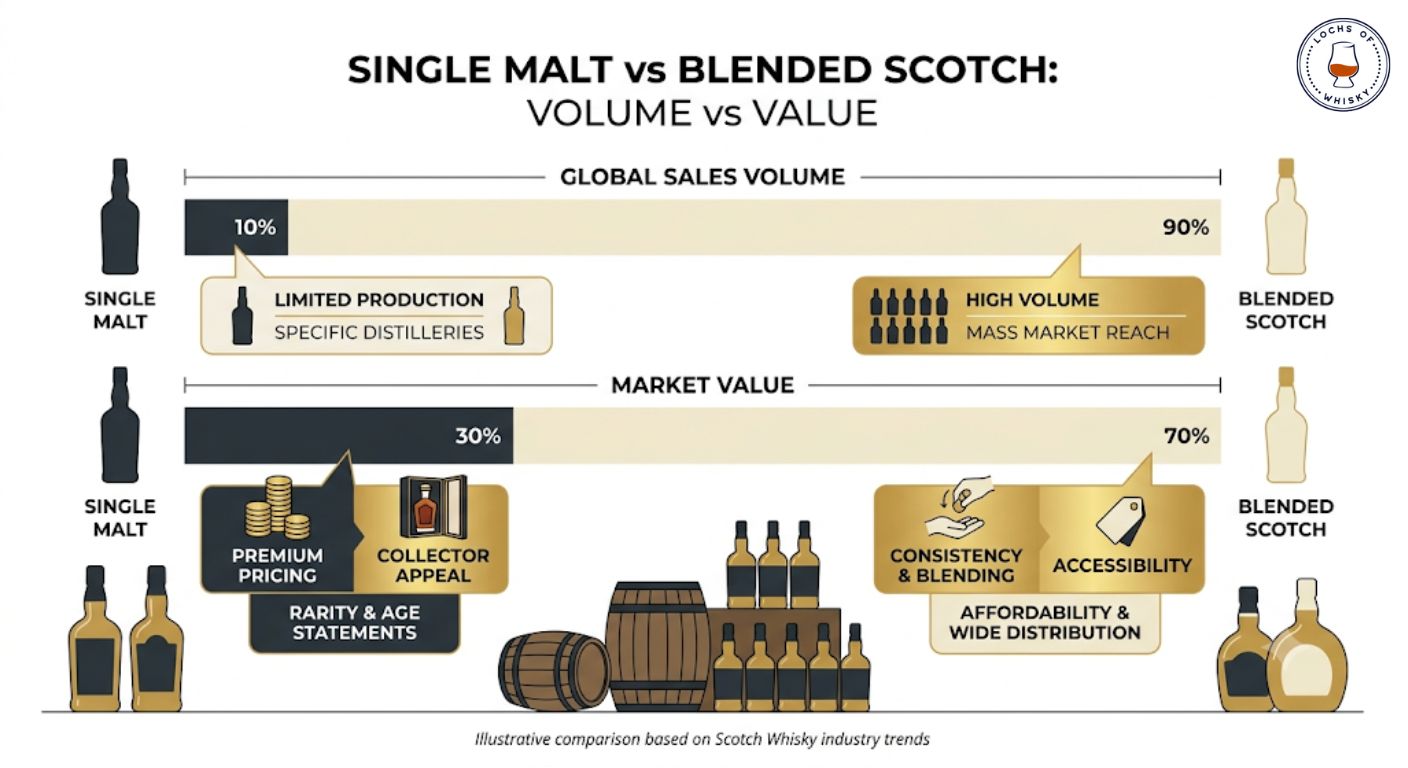
Why Blended Scotch Still Dominates Volume
Blended Scotch dominates volume because it is built for scale. Grain whisky can be produced efficiently in continuous stills, while malt whisky adds body, flavour, and character. This structure allows producers to create dependable bottles at accessible price points.
For many buyers, especially in export markets, blended Scotch is the entry point into Scotch whisky. It is familiar, mixable, and usually easier to drink neat than higher-strength or heavily peated single malts.
Brands such as Johnnie Walker helped define blended Scotch globally because they offered recognisable flavour and consistent presentation across markets.
Expert Context: Why Blending Matters
“Blended Scotch is not simply a cheaper alternative to single malt. Its purpose is consistency, balance, and repeatability, which is why it became the dominant Scotch category by volume.”
This is important because blended Scotch should not be judged only against single malt. A well-made blend is designed to deliver a recognisable house style across different batches, markets, and years.
Why Single Malt Carries More Premium And Collector Weight
Single malt carries more premium weight because it gives the buyer a clearer answer to where the whisky comes from. Distillery identity matters. A bottle from Islay, Speyside, the Highlands, or the Lowlands gives the buyer a stronger expectation of style before they open it.
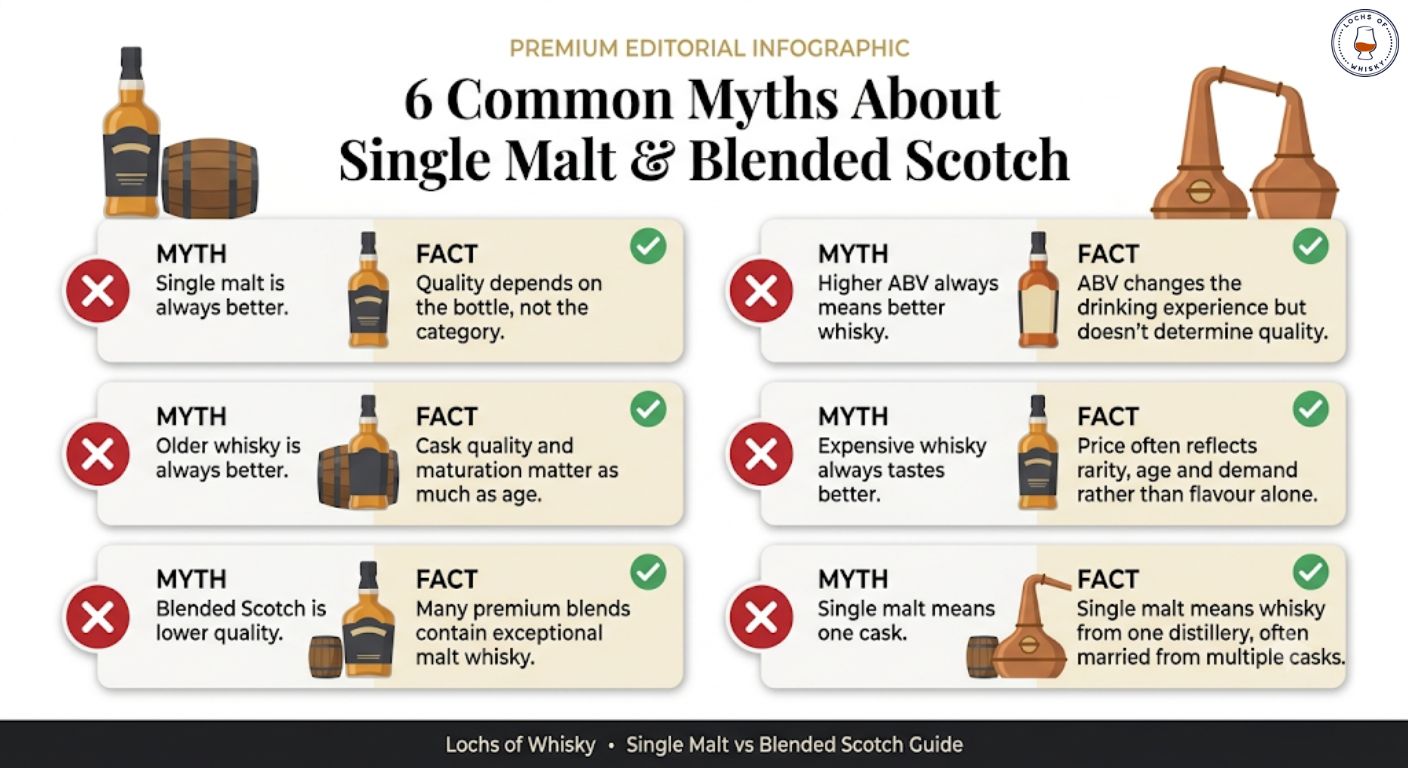
Age statements, cask details, ABV, and bottling type also matter more in single malt. A 12-year-old Speyside at 40% ABV is a different buying decision from a cask-strength Islay matured in sherry wood. Both are single malt, but the drinking experience and price logic can be very different.
Our customers often underestimate how much ABV changes the experience; a cask-strength single malt at 56% can feel like a different category beside a 40% blend, even before region or cask type comes into play.
Premiumisation And The £100+ Bottle Market
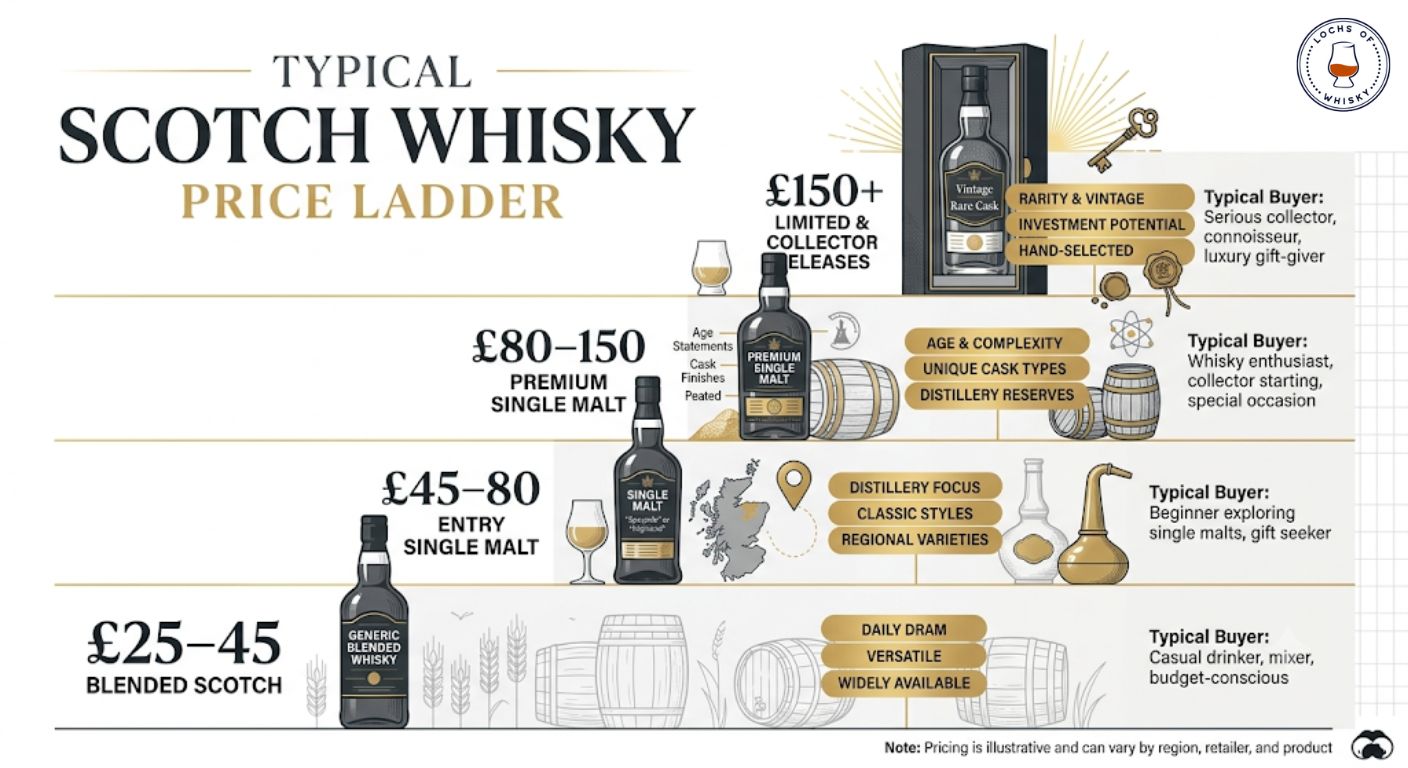
Premiumisation has helped single malt grow in value, but the market is more selective than it was. Buyers are still willing to pay more for provenance, age, cask quality, and limited releases. They are less willing to pay inflated prices for vague premium positioning.
This matters most in the £100+ bottle range. A higher price needs a reason: older stock, stronger distillery reputation, limited outturn, unusual cask type, higher ABV, or clear collector relevance. Without those details, buyers are more cautious.
How Scotch Whisky Exports Shape The Category Split
Export markets strongly influence the balance between single malt and blended Scotch. Blends tend to perform well where Scotch is bought for familiarity, gifting, mixing, or broad accessibility. Single malts often perform better where buyers are more engaged with distillery identity and premium bottle selection.
The Scotch Whisky Association publishes official export data and industry figures through its Facts & Figures resource, which is one of the most useful authority sources for understanding Scotch’s global footprint.
India is an important volume market, while the United States has historically been one of the most important value markets. This distinction matters because volume growth does not always mean premium growth. A market can buy a large number of bottles while still being led by accessible blends.
Lochs of Whisky Survey 2026: Where Do People Buy Scotch Whisky?
Lochs of Whisky asked Scotch whisky buyers where they most commonly purchase their bottles. While online shopping is now the dominant channel, specialist whisky retailers remain the preferred choice over supermarkets for many enthusiasts.
Survey finding: 82% of respondents buy Scotch whisky online, while 63% purchase from specialist whisky retailers compared with 41% who buy from supermarkets.
| Where People Buy Scotch Whisky | % of Respondents |
|---|---|
| Buy whisky online | 82% |
| Buy from specialist retailers | 63% |
| Buy in supermarkets | 41% |
| Buy at auctions | 17% |
Lochs of Whisky Survey 2026: What Matters Most When Buying Scotch?
To understand what actually influences whisky buying decisions, Lochs of Whisky asked Scotch buyers which factor mattered most when choosing a bottle.
Survey finding: 37% of Scotch buyers said the distillery was the most important factor when choosing a bottle, ahead of price, age statement, cask type, ABV, region, and packaging.
| Factor When Buying Scotch | % of Respondents |
|---|---|
| Distillery | 37% |
| Price | 23% |
| Age Statement | 14% |
| Cask Type | 11% |
| ABV | 8% |
| Region | 5% |
| Packaging | 2% |
How Tariffs And Trade Barriers Affect Single Malt And Blends
Tariffs affect Scotch differently depending on price tier. A 10% tariff on a lower-priced blend may be absorbed or passed on with less visible impact. The same percentage on a premium single malt can push an already expensive bottle into a price band where buyers hesitate.
The US tariff environment and the UK-India trade deal both matter because they influence the price buyers see on shelves. The planned India tariff reduction is especially relevant for future Scotch growth, with tariffs expected to move from very high levels towards a lower staged rate over time.
For buyers, the practical point is simple: trade costs can change value perception. A bottle that feels fairly priced at £60 may feel expensive at £75 if nothing about the liquid, age, ABV, or cask specification has changed.
Production Capacity And Oversupply Risk
Scotch whisky production has expanded significantly over the past decade. More distilleries, larger capacity, and increased warehousing all create more future stock. That does not automatically mean poor quality or falling prices, but it does increase the need to separate ordinary releases from genuinely distinctive ones.
This is especially important for single malt. More capacity means more bottlings competing for attention. Distillery name alone is not enough. Buyers should check age statement, cask type, ABV, bottler, batch size, and whether the release adds anything meaningful to what is already available.
Smaller or newer distilleries such as Lochlea can still build strong interest, but the buying logic should be based on production detail and release quality rather than novelty alone.
How To Choose Between Single Malt And Blended Scotch
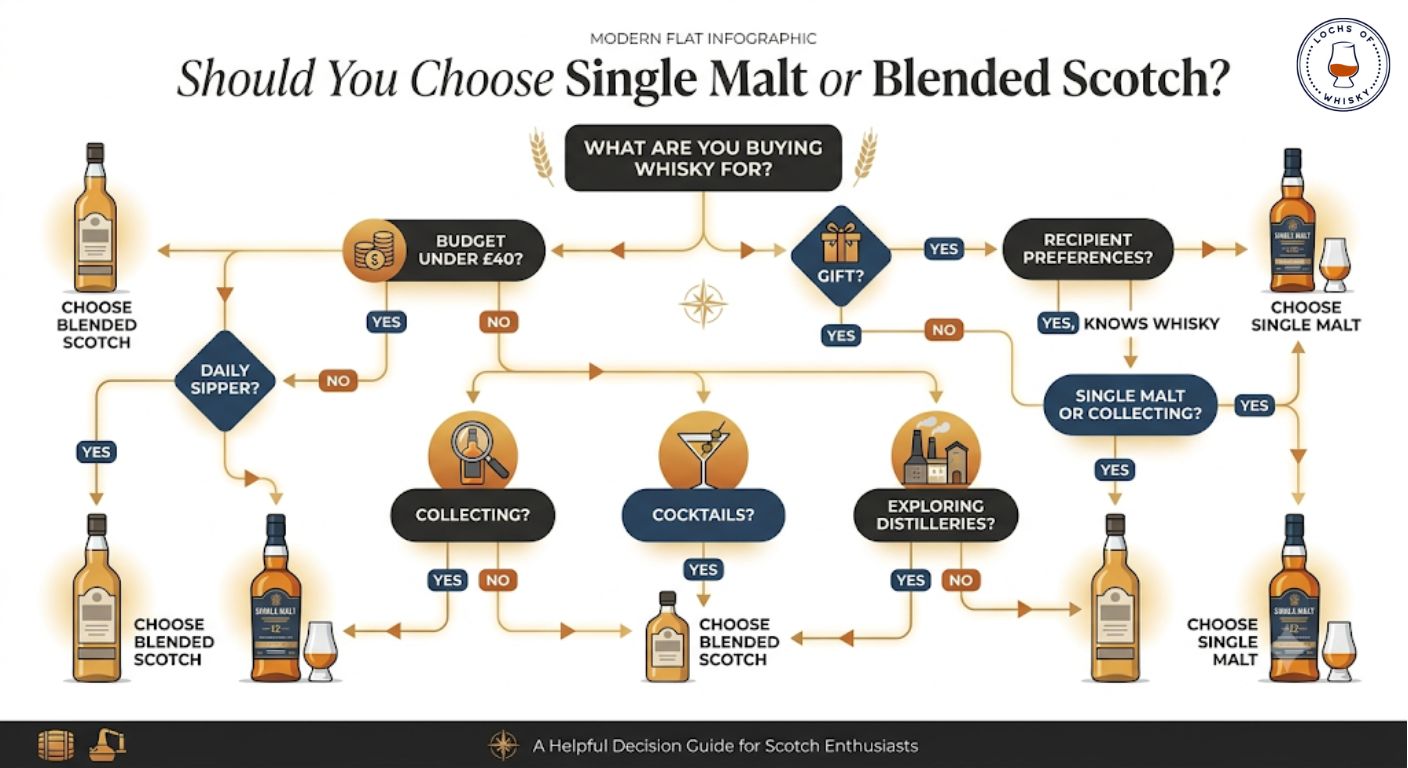
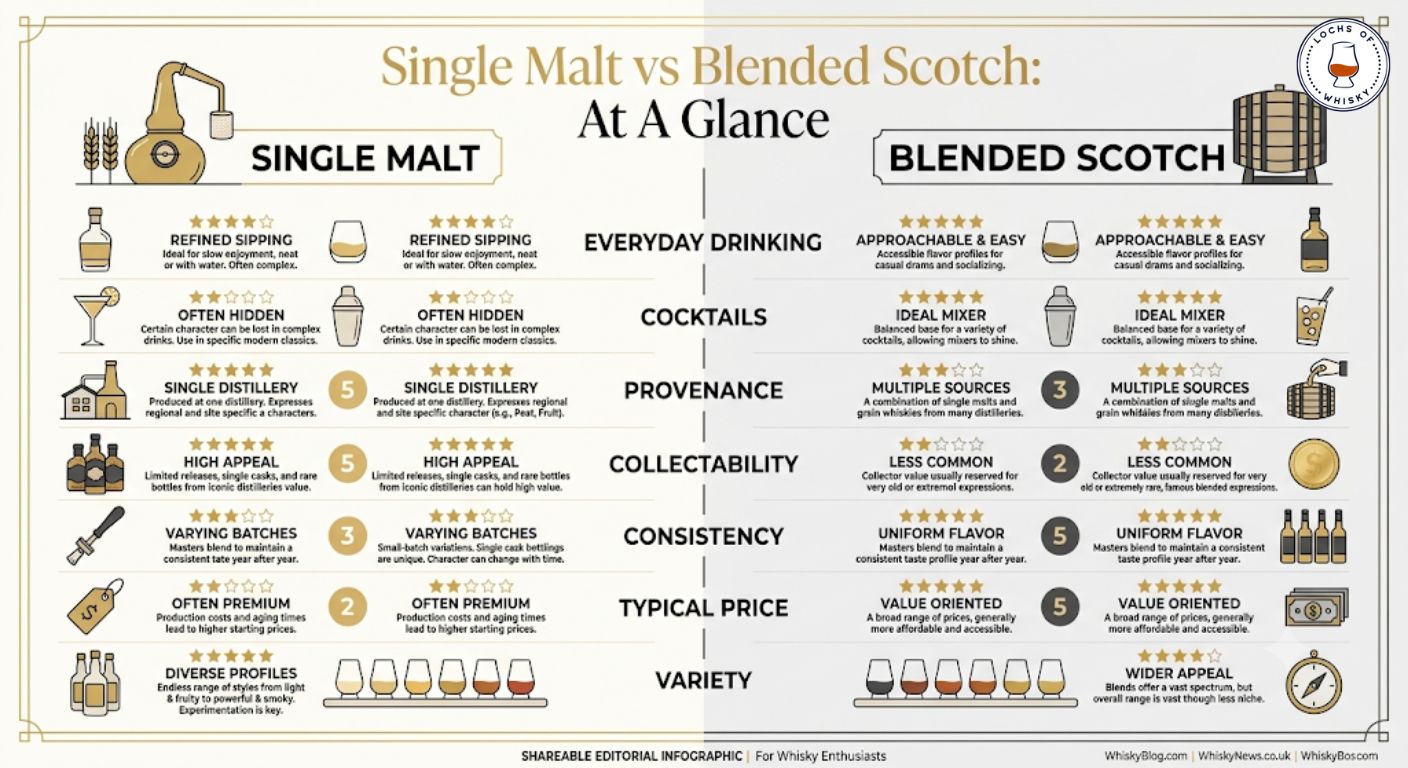
If you want consistency, value, and easy drinking, choose blended Scotch. If you want provenance, distillery identity, and more variation between bottles, choose single malt.
- If your budget is £25–£45, blended Scotch often gives better value.
- If your budget is £45–£80, entry and mid-range single malts become more compelling.
- If you want a gift for a casual whisky drinker, a quality blend is usually safer.
- If the recipient follows specific distilleries, choose single malt.
- If you are collecting, prioritise distillery, bottler, cask type, age, and condition.
Buyers exploring Scotch broadly should start with Scotch Whisky before narrowing by style, region, distillery, or bottle type.
Decision Logic: Single Malt Or Blended Scotch?
| Buyer Need | Better Choice | Reason |
|---|---|---|
| Reliable everyday drinking | Blended Scotch | Consistent profile and accessible pricing |
| Distillery discovery | Single Malt | Clearer provenance and regional identity |
| Collector interest | Usually Single Malt | More emphasis on age, cask, bottler, and distillery reputation |
| Mixing or highballs | Blended Scotch | Better value and easier balance in mixed serves |
| Premium gifting | Depends | Single malt for enthusiasts; premium blend for safer broad appeal |
Single Malt vs Blended Scotch Statistics 2026
The following statistics summarise key differences between single malt and blended Scotch whisky. This table can be updated annually as new industry data and Lochs of Whisky survey results become available.
| Statistic | 2026 Result |
|---|---|
| Scotch category with highest sales volume | Blended Scotch |
| Scotch category with highest average bottle value | Single Malt |
| Most important buying factor | Distillery — 37% |
| Consumers buying whisky online | 82% |
| Consumers buying from specialist retailers | 63% |
| Consumers buying from supermarkets | 41% |
| Consumers buying at auction | 17% |
| Preferred whisky category | Single Malt — 68% |
| Typical entry-level blended Scotch budget | £25–45 |
| Typical entry-level single malt budget | £45–80 |
Last updated: July 2026.
FAQ
Is single malt always better than blended Scotch?
No. Single malt is not automatically better. It offers clearer distillery identity, but blended Scotch can be more consistent, balanced, and better value. For collectors, single malt usually carries more provenance. For casual drinking, gifting, or mixing, a well-made blend may be the better choice.
Why does blended Scotch dominate by volume?
Blended Scotch dominates by volume because it is scalable, consistent, and usually more affordable. It can combine malt and grain whisky from multiple distilleries, allowing producers to maintain a recognisable house style at a lower average bottle price than most single malts.
Why do single malts often cost more?
Single malts often cost more because they are tied to one distillery and commonly carry stronger provenance signals, including age statement, cask type, limited batch details, and regional identity. Older single malts also require longer maturation, which increases production cost and scarcity pressure.
What ABV should I look for?
Most standard Scotch is bottled at 40% to 43% ABV. Many enthusiast-focused single malts sit around 46%. Cask-strength bottles can exceed 55% and are much more intense. Newer buyers should usually start around 40% to 46% before moving into cask strength.
Is blended Scotch collectible?
Some blended Scotch is collectible, especially older discontinued bottles, historic premium blends, limited editions, and releases linked to major houses such as Chivas Bros. However, most collector attention still sits with single malts because distillery provenance is clearer.
Should beginners start with single malt or blended Scotch?
Most beginners should start with an approachable blend or a softer single malt around 40% to 43% ABV. Avoid heavily peated, cask-strength, or very expensive bottles until you know whether you prefer smoke, sherry casks, bourbon casks, or lighter fruit-led styles.
Summary: Key Rules For Single Malt vs Blended Scotch
- Blended Scotch dominates volume because it is accessible, consistent, and scalable.
- Single malt carries more value weight because provenance, age, cask type, and distillery identity matter.
- ABV changes the experience: 40% is approachable, 46% is often enthusiast-friendly, and cask strength needs more care.
- Age matters, but cask quality matters more once whisky reaches mature drinking age.
- For collectors, check distillery, bottler, cask type, age statement, release size, and condition.
- For everyday drinking, do not dismiss blends. They often deliver better value below £45.
The common mistake is treating single malt as automatically superior and blended Scotch as basic. The better approach is to match the bottle to the purpose. Choose blends for consistency and value. Choose single malts for provenance, exploration, and distillery-led discovery.
For readers comparing styles across the wider category, the best next step is to explore Scotch by type, region, and producer rather than price alone.

Comments