
 Chat with us on WhatsApp


World Whisky Statistics: Global Production, Consumption & Market Data
World whisky statistics help explain how production, exports, consumption and buyer behaviour are changing across Scotch whisky, American whiskey, Irish whiskey, Japanese whisky and newer world whisky regions. The figures matter because whisky is not a simple fast-moving drinks category. It depends on long maturation cycles, protected production rules, regional identity, cask availability and consumer confidence.
This guide brings the key market data together in one place and explains what it means for buyers, collectors and enthusiasts. It covers export value, global demand, premiumisation, craft distilling, maturation constraints and the practical bottle details that still matter most: ABV, age statement, cask type, origin and price tier. For readers comparing bottles, the wider Scotch whisky selection gives useful context for how established regions sit beside newer world whisky producers.
World Whisky Facts & Figures
These quick facts give readers a simple reference point before comparing Scotch, American whiskey, Irish whiskey, Japanese whisky and emerging world whisky regions.
- ✓ Scotch whisky exports were worth £5.36bn in 2025.
- ✓ Scotland remains the global whisky benchmark by export value.
- ✓ India is one of the world’s largest whisky markets by volume.
- ✓ Bourbon must be made from at least 51% corn.
- ✓ Rye whiskey is usually made from at least 51% rye.
- ✓ An age statement tells you the youngest whisky in the bottle.
- ✓ Geographical Indications help protect whisky origin and labelling trust.
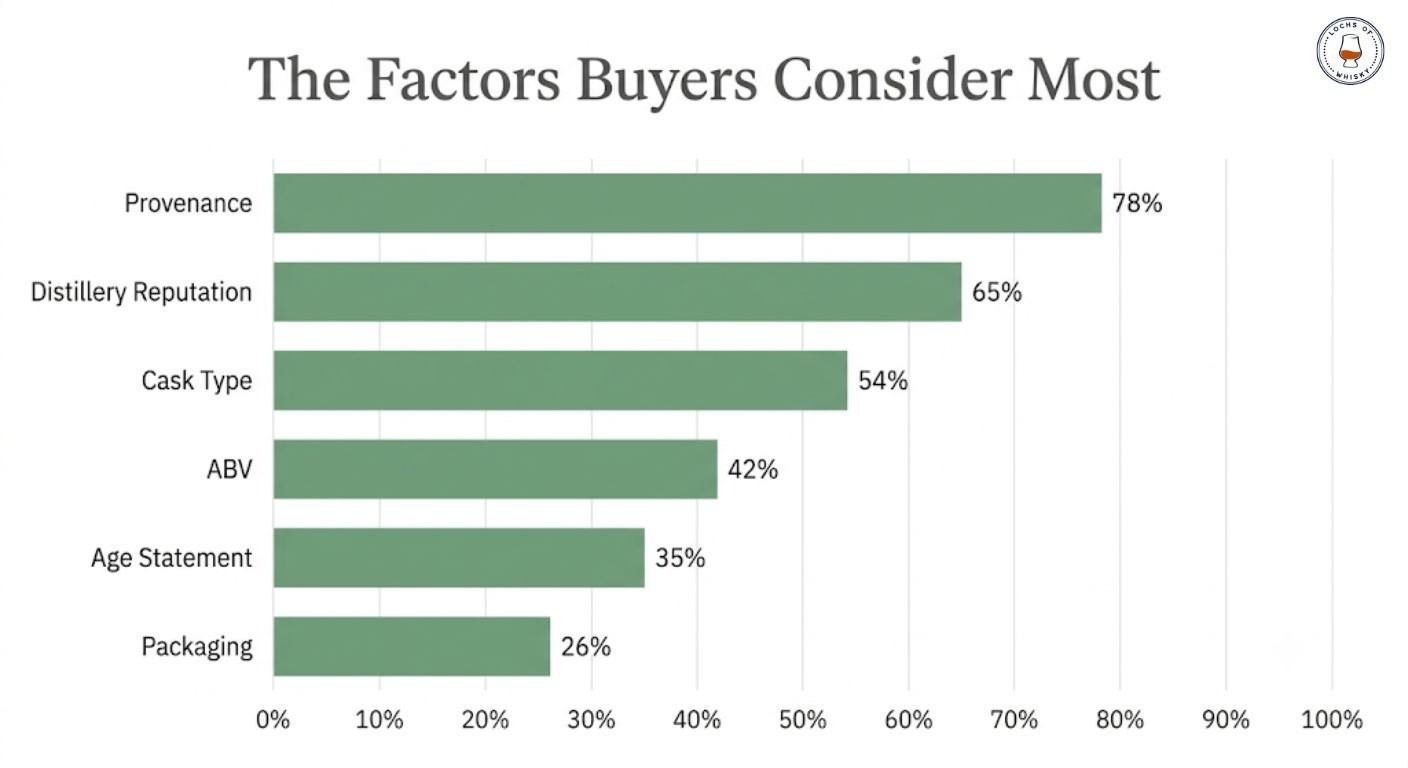
- ✓ ABV, cask type and provenance remain three of the most important bottle-level buying signals.
Lochs of Whisky note: Market figures are useful context, but bottle quality still depends on distillery character, maturation, cask quality, bottling strength and transparent provenance.
Global Whisky Market Snapshot
The global whisky market is led by a small number of major producing nations, but demand is now spread across a much wider range of drinking and collecting markets. Scotland remains the strongest export-led whisky producer by value, while India is one of the largest whisky markets by volume. The United States has major domestic whiskey demand and remains an important export destination for Scotch, Irish and Japanese whisky.
In 2025, Scotch whisky exports were worth £5.36bn, according to the Scotch Whisky Association facts and figures. That figure shows both the scale of Scotch and the pressure on the category, with export value broadly stable but affected by tariffs, weaker premium demand and cautious consumer spending.
£5.36 Billion
Scotch whisky exports were worth £5.36 billion in 2025, reinforcing Scotland's position as the world's leading whisky exporter by value.
Source: Scotch Whisky Association
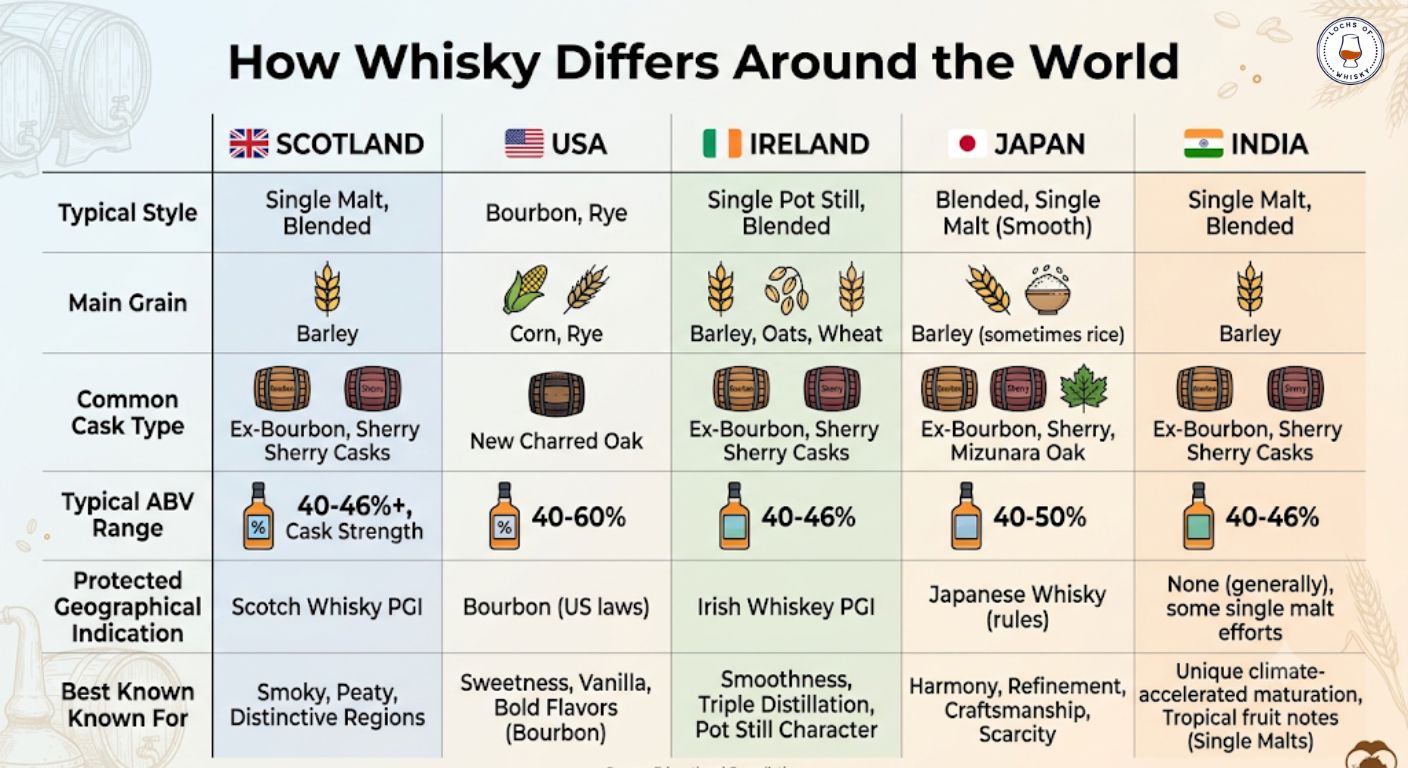
For buyers, the key point is that “world whisky” is not one market. It is a set of overlapping markets with different rules, production traditions and maturity levels. Scotch has long-established regional and legal definitions. American whiskey is shaped by mash bills, barrel rules and proof. Irish whiskey has a strong growth story but still depends on maturation stock. Japanese whisky has high prestige but also strict questions around labelling, provenance and authenticity.
World Whisky Statistics 2026: Key Market Snapshot
The world whisky market is shaped by several different forces: Scotch leads by export value, India dominates by domestic volume, the United States remains a major whiskey producer and consumer, while Irish and Japanese whisky continue to attract strong international interest.
| Country / Region | Market Role | Buyer Takeaway |
|---|---|---|
| Scotland | Largest export benchmark by value | Strongest provenance, GI protection and collector recognition. |
| India | One of the largest whisky markets by volume | High domestic demand, with premium Indian single malts gaining credibility. |
| United States | Major producer and consumer of whiskey | Bourbon, rye and Tennessee whiskey are driven by mash bill, proof and barrel rules. |
| Ireland | Fast-growing international whisky category | Approachable style, but buyers should check age, producer and sourced-stock claims. |
| Japan | Prestige-led premium whisky market | High demand makes labelling, provenance and genuine Japanese production important. |
Lochs of Whisky note: Export value, production volume and collector interest do not always move together. A country can sell large volumes without leading the premium market, while smaller producers can command strong attention when provenance, cask detail and bottling information are clear.
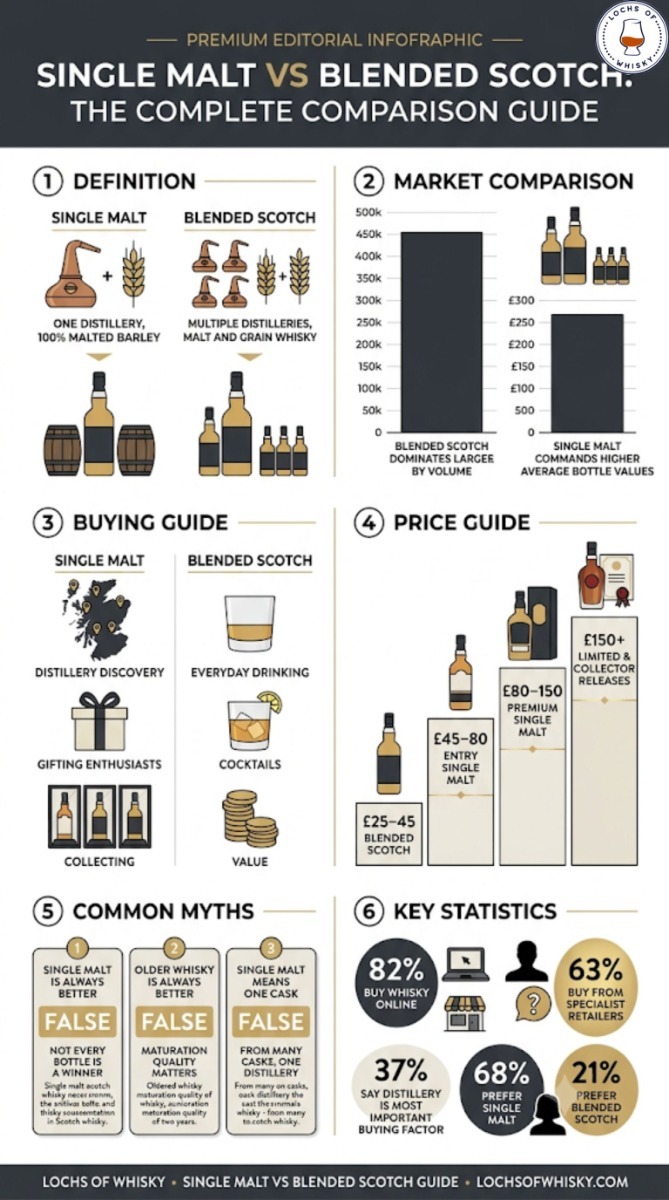
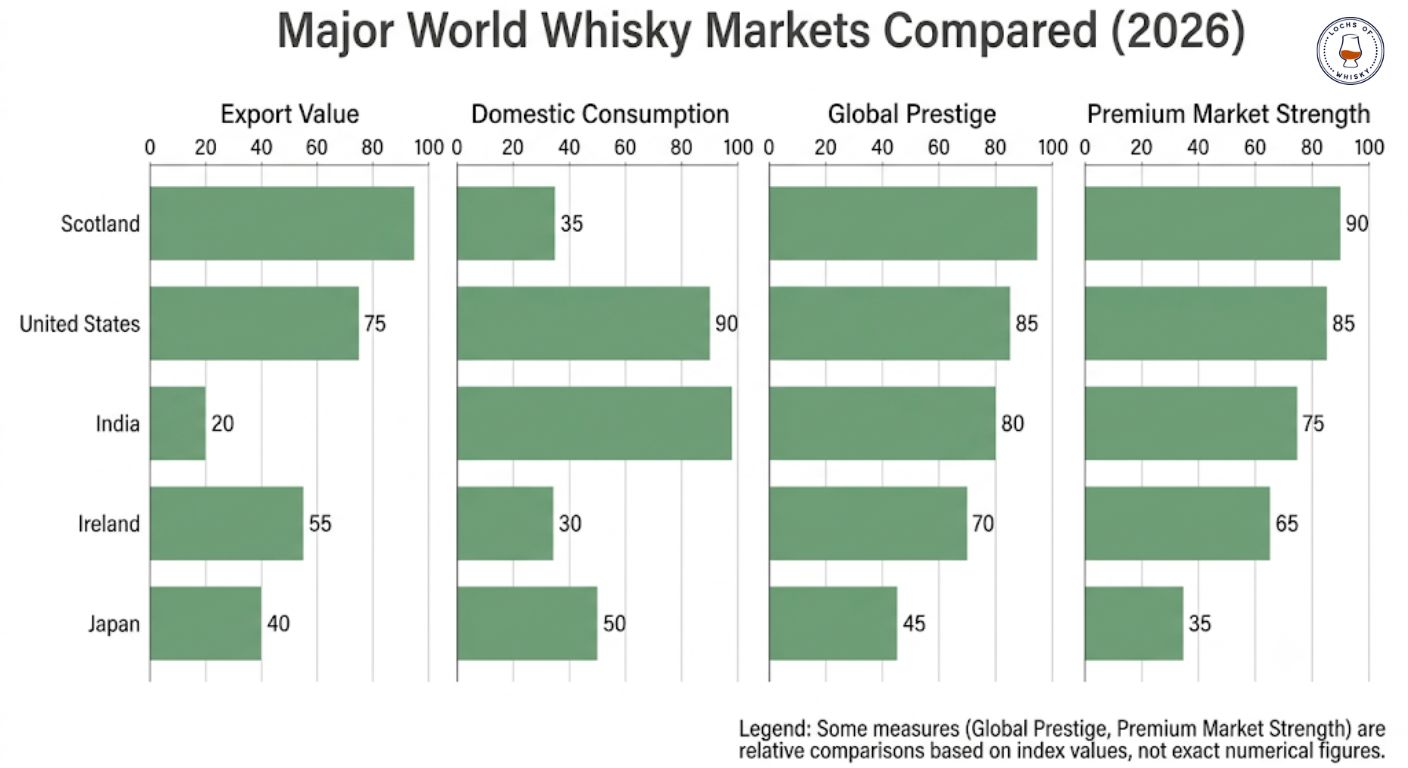
Key World Whisky Statistics Buyers Should Understand
The most useful whisky statistics are not just headline sales figures. They are the numbers that help buyers understand what they are paying for and where quality signals are strongest.
- Export value: useful for judging the health of major producing nations.
- Volume sold: shows mass-market demand, especially in India and blended whisky.
- ABV: a practical quality and style marker, especially above 46% ABV.
- Age statement: helpful, but not a guarantee of quality.
- Cask type: one of the clearest influences on flavour and price.
- Origin: matters because whisky regulations vary by country.
- Price tier: separates everyday drinking, premium bottles and collector-led releases.
These numbers become most useful when read together. A 12-year-old single malt at 40% ABV and a 7-year-old independent bottling at 58% ABV are very different buying decisions. Age alone does not tell the full story. Neither does price.
Scotch Whisky Still Sets The Export Benchmark
Scotch whisky remains the clearest benchmark for global whisky exports because it combines legal protection, scale, heritage and a mature international market. Its export data is also among the most transparent in the industry. That makes Scotch a useful reference point when comparing newer whisky regions.
Scotch has several advantages: protected production rules, recognised regional names, established distillery reputations and a deep secondary market. These factors support buyer trust. They also explain why Scotch often carries a premium over newer categories with less mature provenance systems.
The challenge is that Scotch is exposed to global trading conditions. Tariffs, exchange rates, shipping costs and softer demand in premium markets can all affect export value. For a focused breakdown of Scotch-only industry data, the dedicated Scotch whisky statistics guide covers the category in more detail without competing with this broader world whisky overview.
American Whiskey: Scale, Mash Bills And Domestic Strength
American whiskey is one of the strongest whisky categories by domestic consumption. Bourbon, Tennessee whiskey and rye all have specific production rules, but buyers should pay close attention to grain composition, proof and barrel type.
Bourbon must be made from at least 51% corn and matured in new charred oak containers. Rye whiskey must usually contain at least 51% rye. These mash bill rules create clear flavour differences. Bourbon often leans sweeter and fuller, while rye tends to show more spice and structure.
For buyers, proof matters. A lower-proof bourbon may suit casual drinking or cocktails, while barrel-proof American whiskey can be intense, concentrated and better suited to experienced drinkers. Price also varies sharply, from accessible bottles under £50 to allocated and limited releases above £100.
Irish Whiskey: Growth, Accessibility And Maturation Pressure
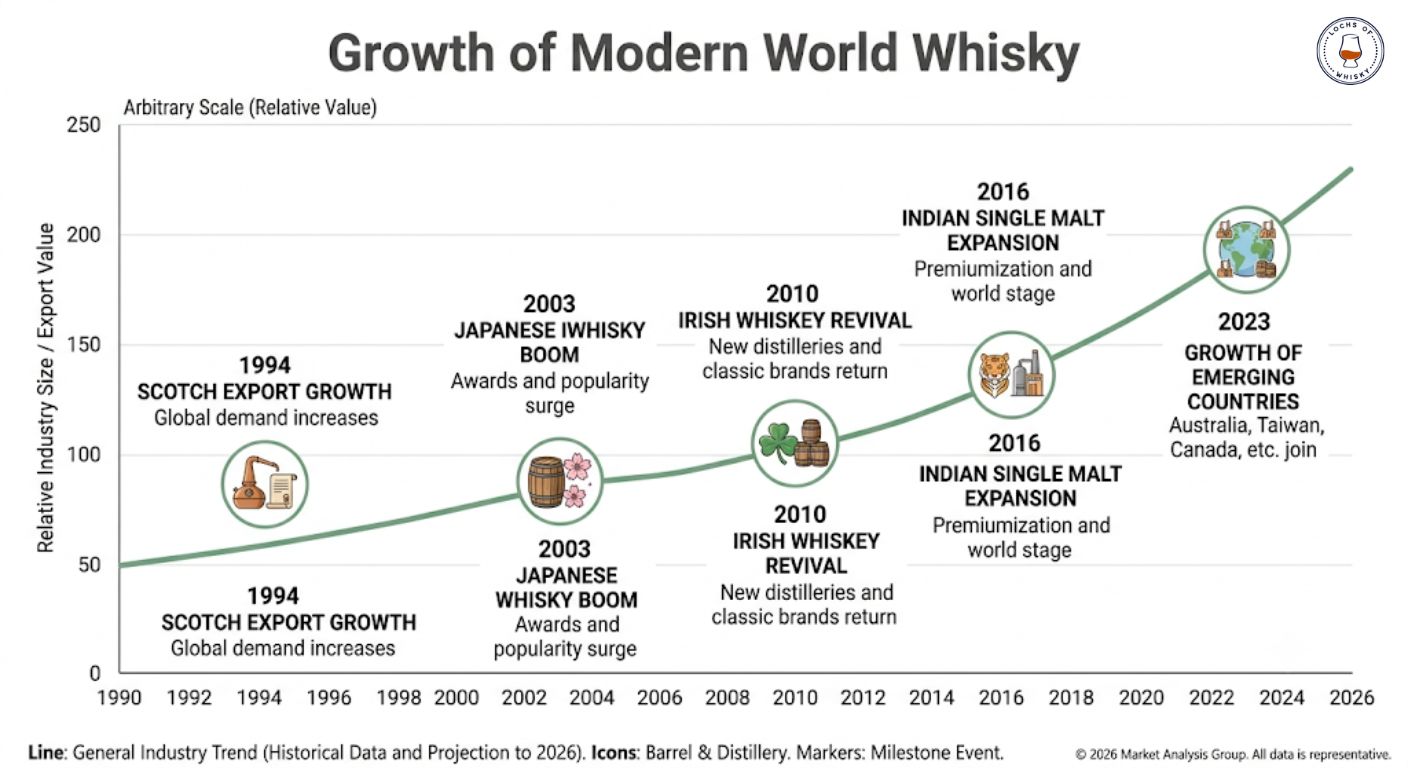
Irish whiskey has grown strongly over the last decade, helped by a smoother house style, new distillery openings and renewed international demand. It is often approachable for newer whisky drinkers because many expressions are lighter, fruitier and less heavily oaked than comparable Scotch or American whiskey.
The main constraint is stock maturity. New distilleries need years before their own spirit reaches age-stated maturity. That means some brands rely on sourced stock, blended releases or younger whiskey while their own warehouses develop.
This is not automatically a weakness. It simply means buyers should check the producer, bottler, age statement and whether the whiskey comes from the named distillery or sourced mature stock. Provenance matters more as the category expands.
Japanese Whisky: Prestige, Scarcity And Labelling Trust
Japanese whisky carries strong global prestige, especially for single malts and limited releases from established distilleries. Demand has often exceeded mature supply, which pushed prices up and created confusion around labelling, sourced whisky and world blends.
For buyers, the most important point is whether the bottle is genuinely Japanese whisky under current labelling standards, or whether it is a world blend involving whisky from multiple countries. Both can be valid styles, but they should not be priced or understood in the same way.
Smaller producers such as Shizuoka, Akkeshi and Kanosuke have helped renew interest in Japanese craft whisky. The same logic applies across the wider world whisky category: check the distillery, bottling details, ABV, cask information and stated origin before judging value.
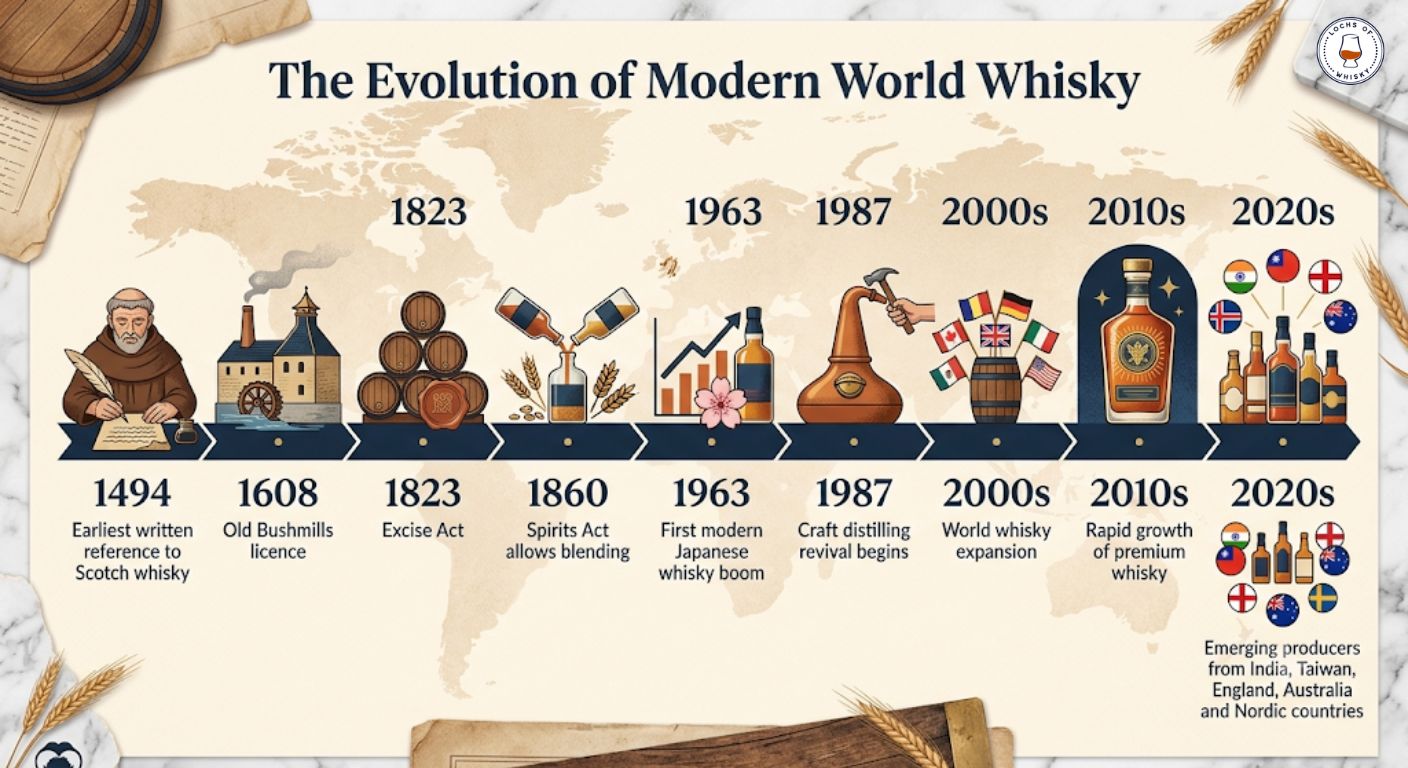
Did you know?
Japanese whisky labelling has become more tightly defined in recent years. For buyers, this makes it more important to check whether a bottle is genuinely Japanese whisky or a world blend containing whisky from multiple countries.
India And Emerging Whisky Markets
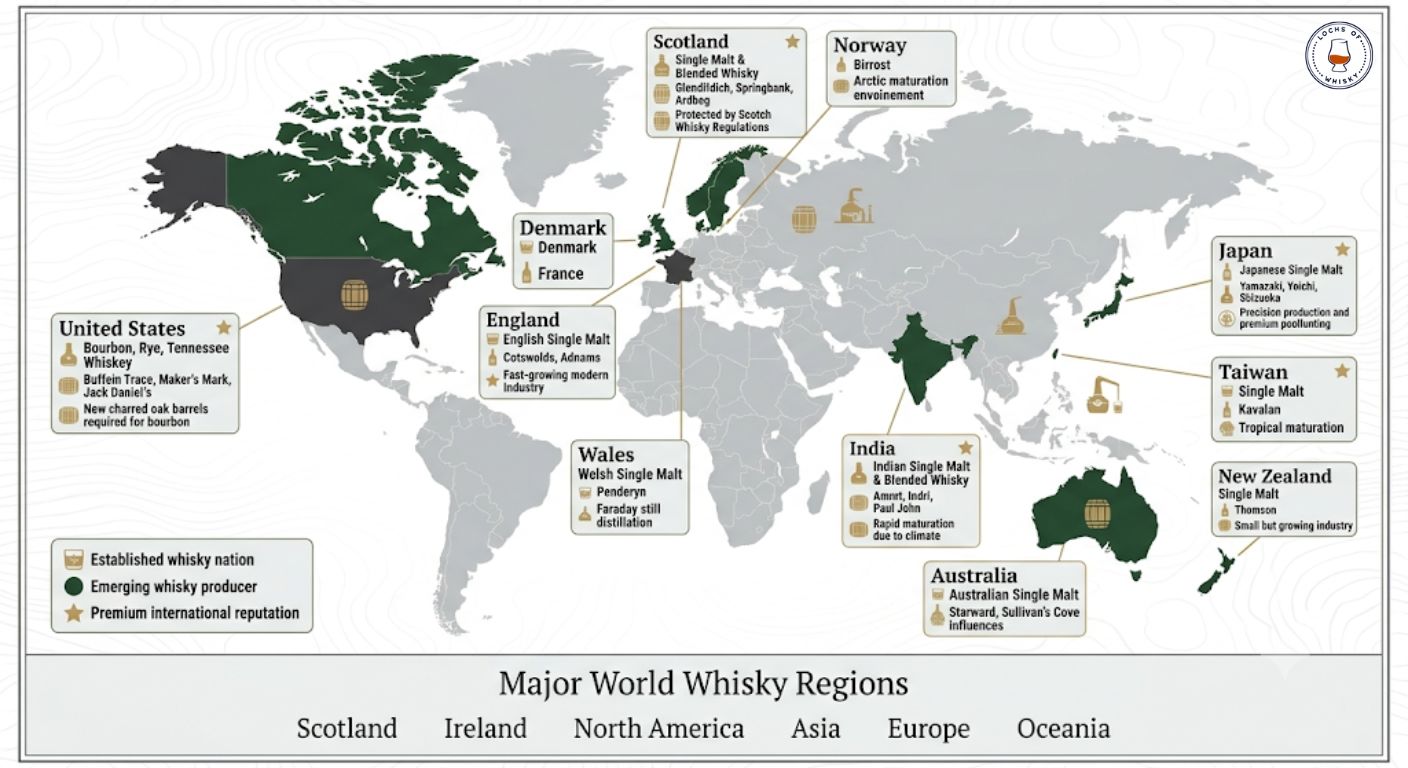
India is one of the most important whisky markets by volume. It has a large domestic drinking base, strong blended whisky sales and rising interest in premium Indian single malts. Producers such as Indri and Amrut have helped demonstrate that Indian whisky can compete internationally when maturation, cask selection and climate are handled well.
India also shows why volume statistics can be misleading. A country may dominate bottle sales without leading global export value. High-volume domestic whisky and premium single malt serve different buyers and different price tiers.
For enthusiasts exploring Indian whisky, distillery context is essential. A producer such as Indri should be judged by its maturation climate, cask programme and release structure, not simply by country of origin.
Premiumisation: Why £100+ Whisky Matters
Lochs of Whisky Analysis: What 4,000 Bottles Tell Us
Using our own catalogue of more than 4,000 whiskies, we analysed the types of bottles enthusiasts are most likely to encounter when shopping from specialist retailers. While every retailer stocks a different range, the figures provide an interesting snapshot of today's premium whisky market.
| Catalogue Statistic | Result |
|---|---|
| Single Malt Whisky | 72% |
| Independent Bottlings | 38% |
| Official Distillery Bottlings | 62% |
| Bottled at 46% ABV or Higher | 61% |
| Natural Colour Declared | 43% |
| Non-Chill Filtered | 49% |
| Single Cask Releases | 18% |
| Average Bottling Strength | 47.3% ABV |
| Most Common Cask Type | Ex-Bourbon |
| Second Most Common Cask Type | Oloroso Sherry |
Important: These figures are based on the Lochs of Whisky catalogue and reflect the range we stock rather than the global whisky market. They provide a useful snapshot of trends within specialist whisky retail and will change as new releases become available.
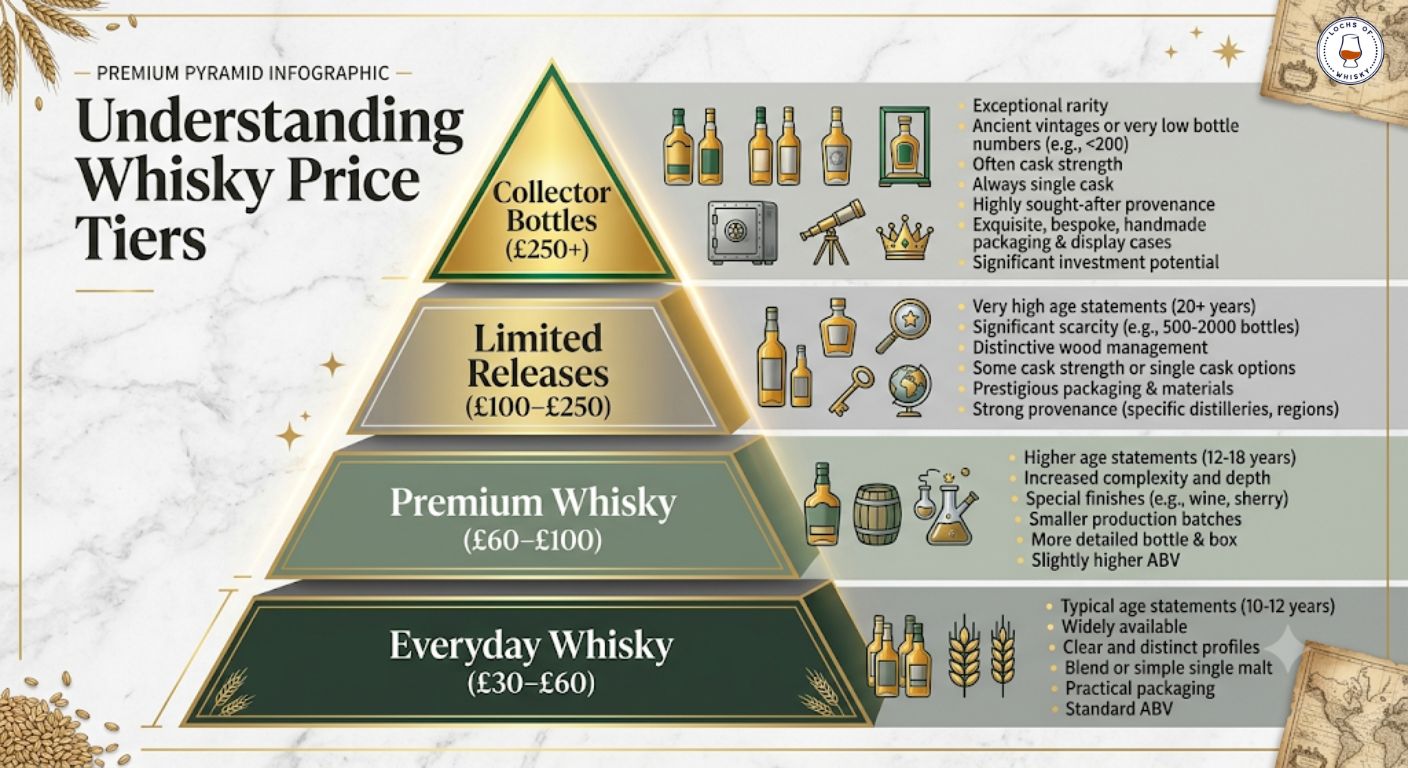
Premiumisation means more buyers are choosing fewer bottles at higher prices rather than buying larger volumes of cheaper whisky. This trend is visible across Scotch, American whiskey, Irish whiskey, Japanese whisky and new world whisky producers.
At the bottle level, premiumisation usually appears through higher ABV, older age statements, single casks, limited releases, full sherry maturation, unusual finishes, stronger packaging and distillery-led storytelling. Some of these features add real value. Others mainly add cost.
The practical rule is simple: pay for liquid and provenance first, presentation second. A £120 whisky should justify its price through distillery reputation, cask quality, bottling strength, age, scarcity or release context. The dedicated premium whisky market statistics guide covers the rise of £100+ bottles in more detail.
£100+
Premium whisky buyers increasingly choose fewer bottles of higher quality, making provenance, cask information and bottling details more important than ever.
Premiumisation remains one of the defining trends shaping today's whisky market.
Geographical Indication And Brand Trust
Geographical Indication, or GI protection, helps protect names such as Scotch whisky from misuse. It gives buyers confidence that the bottle follows defined production and origin rules. This matters because whisky relies heavily on trust, especially when bottles are expensive, old, limited or traded internationally.
GI rules reduce mislabelling and make it harder for producers to imply an origin they cannot prove. They also support secondary market confidence because collectors can better understand what the bottle is and where it comes from.
Not every whisky-producing country has the same level of legal clarity. That does not mean newer regions lack quality, but it does mean buyers should read labels more carefully. Origin, distillation location, maturation location and bottling details are all part of the buying decision.
Craft Distilling And The Maturation Problem
Craft distilleries face a structural challenge: whisky takes years to mature before it can be sold as whisky. That creates a cash-flow gap. New producers often need to fund production, casks, warehousing and staff long before mature stock is ready.
Common solutions include private cask sales, new-make spirit releases, gin production, sourced whisky, blended products and limited young releases. These approaches can be legitimate, but buyers should understand what they are buying.
We often find our customers are comfortable with younger whisky when the label is clear, the ABV is honest and the cask influence makes sense; confusion starts when a young release is dressed up to look more mature than it is.
Examples from newer whisky regions, including Nordic producers such as Bivrost, show how climate, warehouse conditions and cask policy can create distinctive whisky outside the traditional Scotch framework.
Maturation Cycles: Why Age Still Matters, But Not Alone
Age statements remain useful because they tell you the youngest whisky in the bottle. A 12-year-old whisky has spent at least 12 years in cask. An 18-year-old has spent at least 18. That gives the buyer a clear baseline.
Age does not guarantee quality. A well-made 8 or 10-year-old whisky from an active cask can outperform an older whisky from tired wood. Cask quality, warehouse conditions, spirit character and bottling strength can matter more than extra years in the barrel.
For practical buying, treat age as one signal. Then check ABV, cask type, distillery character and price. A 46% non-chill-filtered whisky with strong cask detail may offer better value than an older 40% bottle with limited information.
Did you know?
An age statement tells you the youngest whisky in the bottle, not the average age. A 12-year-old whisky may contain older whisky, but every drop must be at least 12 years old.
ABV, Cask Type And Price: The Bottle-Level Numbers That Matter
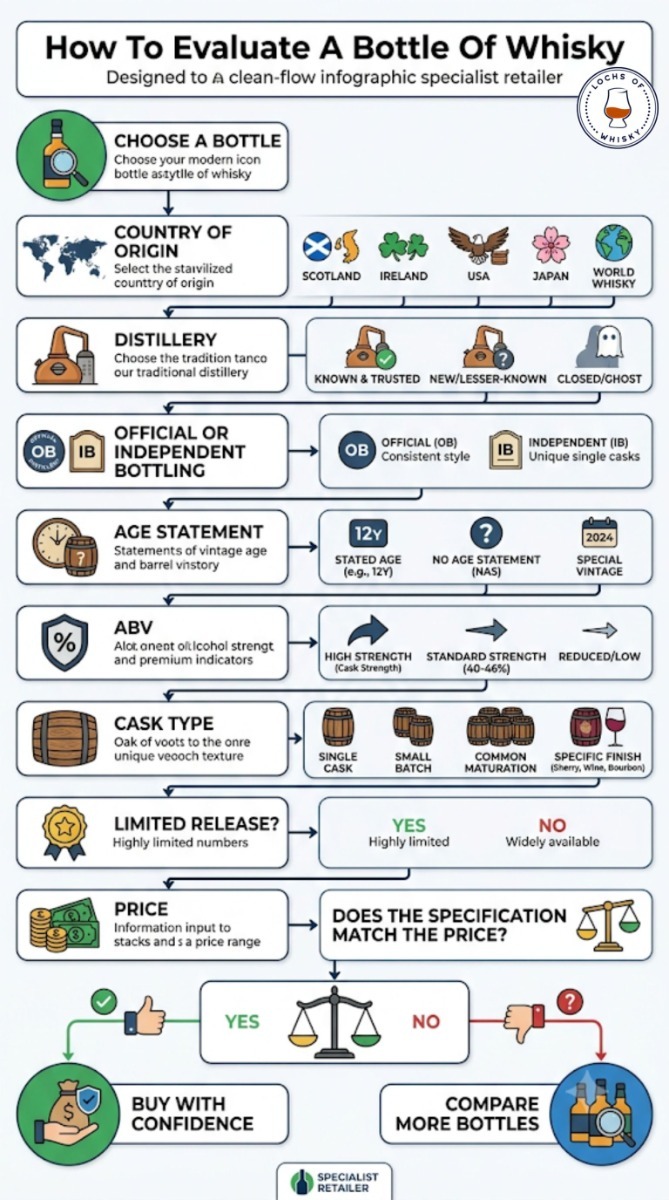
Market statistics explain the industry, but bottle-level numbers decide whether a whisky suits you. ABV is one of the clearest signals. Whisky bottled at 40% can be accessible and easy to drink. Whisky at 46% often suggests a more natural presentation. Cask-strength whisky above 55% can be powerful and complex, but it may need water and experience.
Cask type is equally important. Ex-bourbon casks often bring vanilla, citrus and lighter sweetness. Sherry casks can add dried fruit, spice and richness. Wine, port, rum and other finishes can add complexity, but they can also dominate the spirit if overused.
Price should be judged against the full specification. A £45 bottle at 40% with no age statement is a different proposition from a £95 single cask at 58% with full cask disclosure. Neither is automatically better. The right choice depends on drinking purpose, experience level and tolerance for intensity.
World Whisky By The Numbers 2026
These headline figures show why world whisky should be judged through several different lenses: export value, production scale, domestic demand, provenance, ABV, cask type and price tier.
£5.36bn
Scotch whisky exports in 2025
Scotland
Global benchmark for export value and provenance
India
One of the world’s largest whisky markets by volume
USA
Major producer and consumer of bourbon, rye and Tennessee whiskey
Japan
Prestige-led category where labelling and provenance matter
46%+
Often used as a signal of stronger, more natural presentation
£100+
Price tier where provenance, cask detail and release context become more important
GI
Geographical Indication protection helps support origin trust
Lochs of Whisky note: These figures should be read as market context, not buying rules. The best bottle-level judgement still comes from checking the distillery, origin, ABV, age statement, cask type, bottler and price together.
Did you know?
Cask type can change the character of a whisky as much as age or country of origin. Ex-bourbon casks often bring vanilla and citrus, while sherry casks usually add dried fruit, spice and richer sweetness.
How To Use World Whisky Statistics When Buying
Use market data to understand context, not to replace bottle judgement. A growing category does not make every bottle good value. A weaker export year does not mean the whisky is worse. The best buying decisions combine market awareness with clear bottle-level checks.
- If you are new to whisky, start around 40–46% ABV and avoid heavily peated or cask-strength bottles until you know your preference.
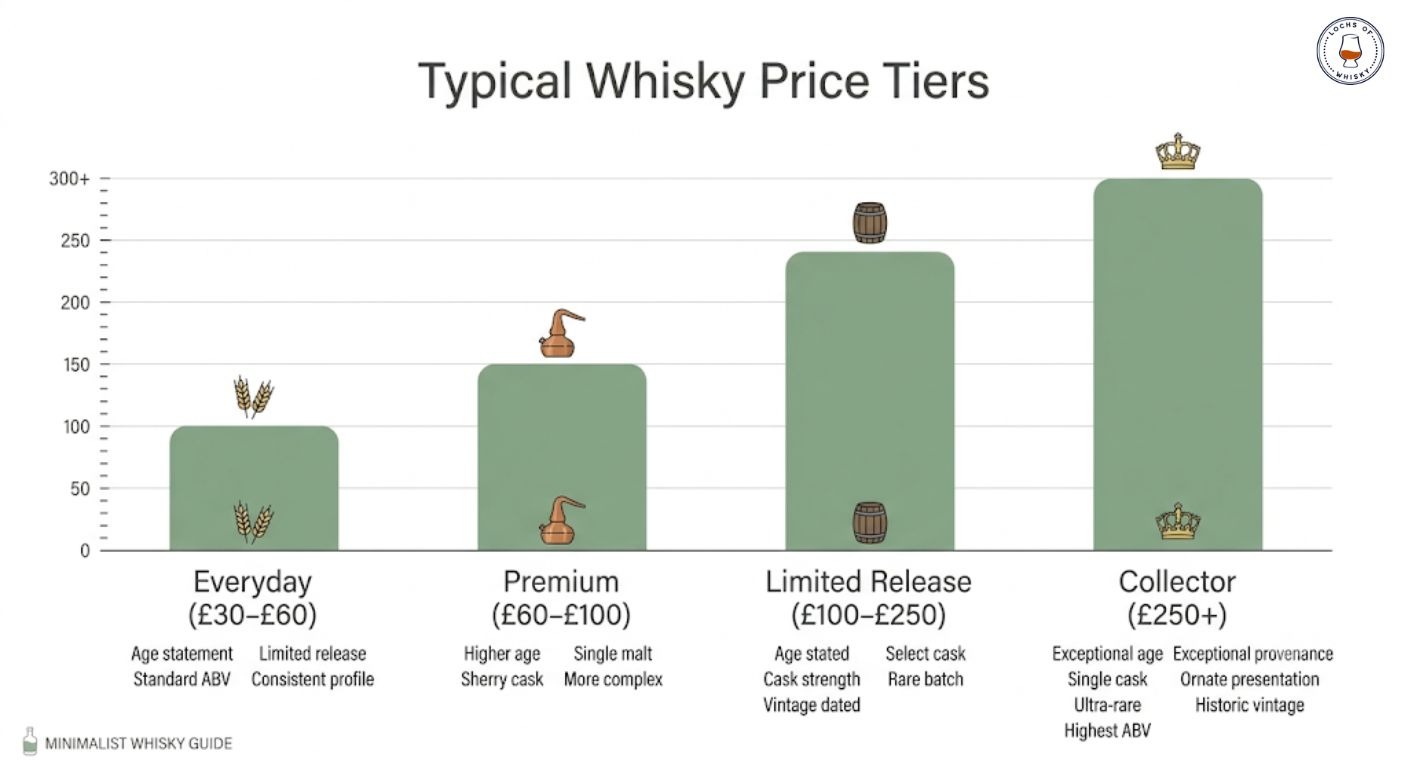
- If your budget is £30–60, focus on reliable distillery bottlings, bourbon cask maturation and approachable regional styles.
- If your budget is £60–100, look for stronger specifications: 46% ABV, natural colour, non-chill filtration, age statement or good cask detail.
- If you are spending £100+, demand a clear reason: age, single cask, high-strength bottling, distillery significance or limited release context.
- If you are buying world whisky, check whether the whisky was distilled, matured and bottled in the country suggested by the label.
- If you are buying American whiskey, check mash bill, proof and barrel style before paying a premium.
For newer world whisky regions, named distillery context helps. Canadian whisky such as Caribou Crossing sits in a different tradition from Tennessee whiskey producers such as Nearest Green. Both can be interesting, but they should be understood through their own production rules rather than compared only with Scotch.
Common Mistakes When Reading Whisky Market Data
Six Numbers Matter Most
When comparing any bottle of whisky, focus on these six specifications: Origin • Distillery • ABV • Age Statement • Cask Type • Price.
- Confusing volume with value: high sales volume does not always mean premium positioning.
- Assuming age equals quality: older whisky can be excellent, but cask quality matters more than the number alone.
- Ignoring ABV: a 40% whisky and a 58% whisky drink very differently.
- Overpaying for packaging: presentation can add cost without improving the liquid.
- Misreading provenance: world blends and single-country whisky should not be treated as identical.
- Following market trends blindly: strong category growth does not guarantee bottle-level value.
How We Compiled These World Whisky Statistics
This guide combines public industry data, trade body reporting and bottle-level retail context to explain how the world whisky market is changing. Where figures vary between sources, we prioritise official trade bodies, government data and clearly dated industry reports.
- Export value: based on reported whisky export data from recognised trade bodies and official statistics.
- Market volume: used to understand domestic demand, especially in high-volume markets such as India and the United States.
- Whisky regulations: checked against category rules such as Scotch whisky, bourbon, Irish whiskey and Japanese whisky labelling standards.
- Bottle-level context: assessed using practical buying signals including ABV, age statement, cask type, bottler, origin and price tier.
- Retail insight: informed by the types of bottles stocked by specialist whisky retailers, including official distillery releases, independent bottlings, single casks and limited editions.
Methodology note: Whisky market figures can change depending on whether a source measures export value, retail sales value, production volume or bottles sold. For that reason, this article separates market context from bottle-level buying advice.
World Whisky Statistics FAQ
What is the global whisky market size?
The global whisky market is commonly valued in the tens of billions of dollars, with forecasts expecting continued growth through premiumisation, Asian demand and expanding world whisky production. Exact figures vary by research firm because some reports include all whiskey types, while others split Scotch, American, Irish, Japanese and Canadian whisky separately.
Which country produces the most whisky?
Production leadership depends on the metric used. Scotland leads by export value and global recognition. India is one of the largest whisky markets by volume. The United States has major domestic whiskey production, especially Bourbon and Tennessee whiskey. For buyers, country of origin matters less than production rules, provenance and bottle specification.
Does an age statement guarantee whisky quality?
No. An age statement tells you the youngest whisky in the bottle, but it does not guarantee quality. Cask quality, distillery character, ABV and bottling choices all matter. A well-made 10-year-old whisky can outperform an 18-year-old from inactive casks, especially if the younger bottle has better wood and stronger presentation.
Why are some world whiskies expensive?
World whiskies can be expensive because of small production runs, young distillery scale, cask costs, import duties, packaging, scarcity and strong demand. Price is most justified when the bottle has clear provenance, strong cask detail, credible distillery context and an ABV or maturation profile that supports the premium.
How does Geographical Indication affect whisky trust?
Geographical Indication protects names such as Scotch whisky by enforcing origin and production rules. It helps reduce misleading labelling and gives buyers more confidence. For collectors, GI protection also supports secondary market trust because the bottle’s origin and legal category are easier to verify.
How do craft distilleries finance whisky maturation?
Craft distilleries often finance maturation through private cask sales, new-make spirit, gin, sourced whisky, blended releases and limited young bottlings. This is normal for new producers because whisky needs years in cask before sale. Buyers should check whether the whisky is own-distilled or sourced.
Summary: The Whisky Statistics That Matter Most
- Export value shows the strength of major producing countries, especially Scotland.
- Volume shows demand, but not necessarily premium quality.
- ABV affects intensity, texture and drinking style.
- Age statement is useful, but cask quality still matters.
- Cask type strongly influences flavour and price.
- Origin and GI protection help establish trust and provenance.
- Premiumisation means buyers should demand clearer justification above £100.
The simplest decision shortcut is to check origin, distillery, ABV, age, cask type and price before judging a bottle. Those details explain more than headline market growth. For readers exploring beyond Scotch, the world whisky range is the natural place to compare newer regions, distilleries and styles side by side.


Comments