
 Chat with us on WhatsApp


How Many Distilleries Are There In Scotland?
As of May 2026, there are around 154 operating Scotch whisky distilleries in Scotland, including both malt and grain production sites. The exact number can shift because new distilleries open, silent distilleries restart, and some sites pause production without fully closing.
This count matters because Scotland’s distillery landscape is no longer just a map of famous names. It includes long-established producers, reopened sites such as Rosebank and Port Ellen, newer craft distilleries, and large-scale grain whisky plants. For anyone exploring Scotch whisky, the number is useful, but the real value comes from understanding where those distilleries sit, what they make, and how they fit into Scotland’s five recognised whisky regions.
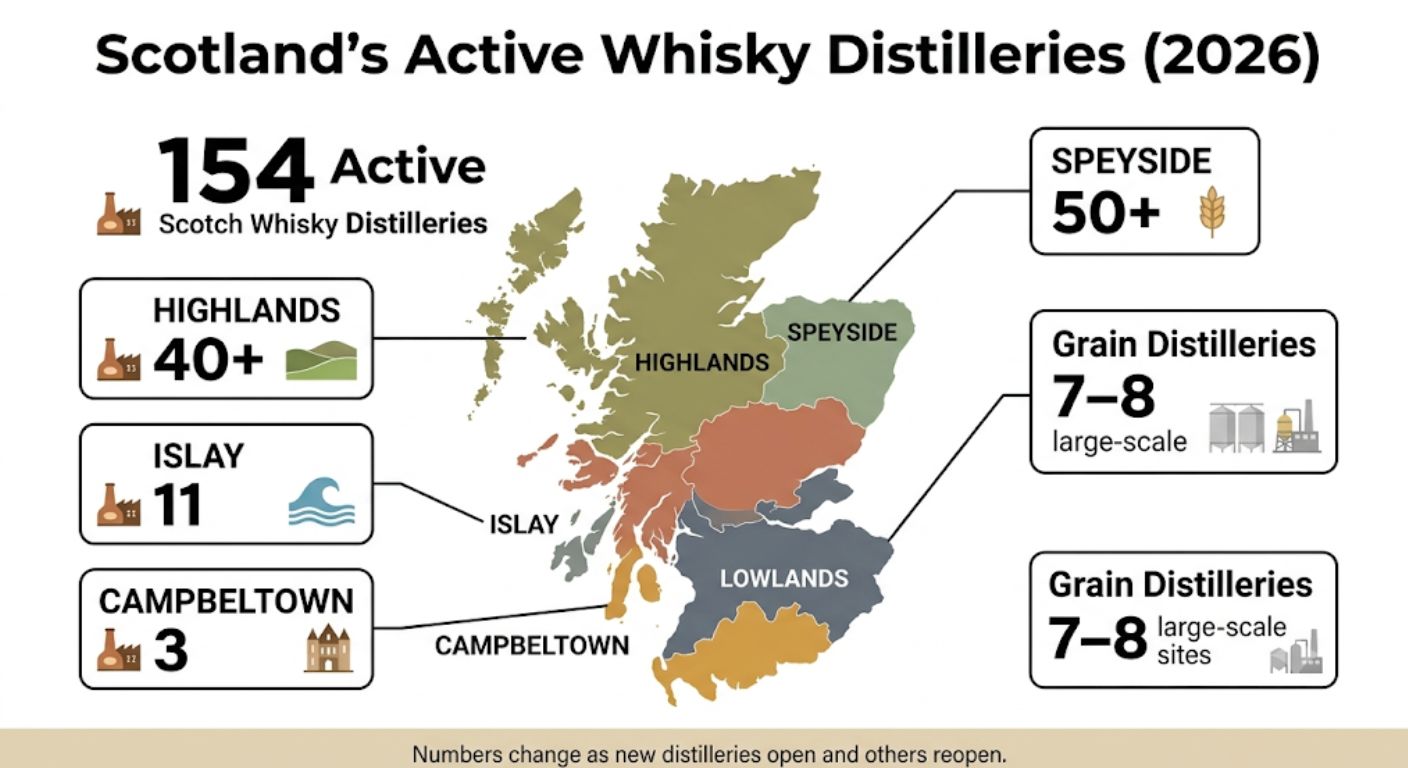
How Many Scotch Whisky Distilleries Are Currently Operating?
Scotland has approximately 154 operating Scotch whisky distilleries as of May 2026. Most are malt whisky distilleries, while a smaller number produce grain whisky on a much larger industrial scale.
The Scotch Whisky Association remains the best external reference point for the legal definition, industry structure, and official Scotch whisky context.
There is no single permanent number because “operating” can be defined in slightly different ways. Some lists count only malt distilleries. Others include grain whisky plants. Some include distilleries that have restarted production but have not yet released mature whisky. That is why you may see figures such as 152, 154, or simply “over 150” across current sources.
The 5 Scotch Whisky Regions
The five protected Scotch whisky regions are Highland, Lowland, Speyside, Islay, and Campbeltown. These regions help organise Scotch by place of production, although they should be treated as guides rather than strict flavour rules.
- Highland: the largest and most varied region by geography.
- Speyside: dense concentration of malt distilleries, often associated with fruit, honey, and sherry-cask styles.
- Lowland: historically linked with lighter, grassy, and sometimes triple-distilled styles.
- Islay: famous for peated, coastal, medicinal, and smoky whisky, though not every Islay whisky is heavily peated.
- Campbeltown: small in number but historically significant, with a distinctive oily, coastal, and often robust profile.
For a fuller explanation of how the regions work, use our guide to the five Scotch whisky regions. This article stays focused on the distillery count and what that number actually means.
Why Do Distillery Counts Vary?
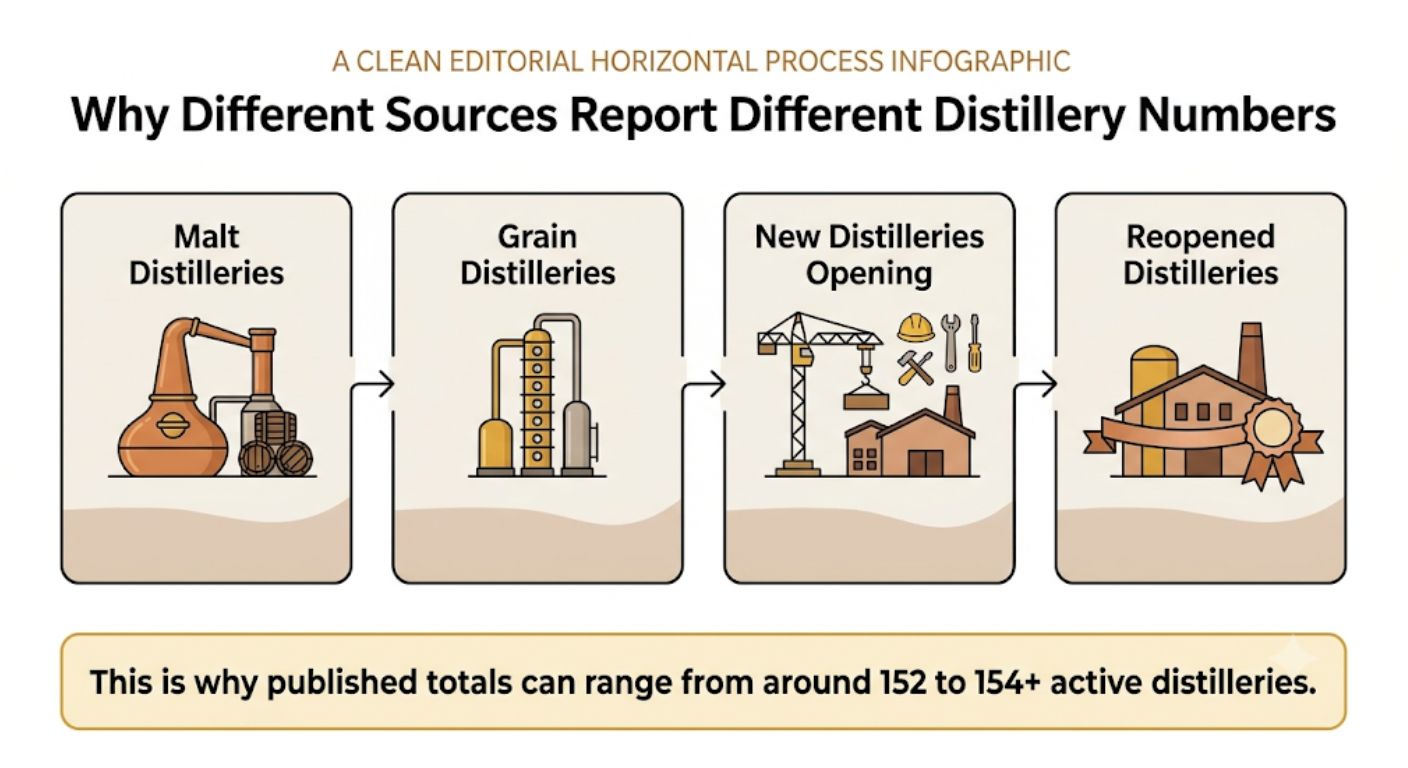
Distillery counts vary because people do not always count the same thing. A whisky site may include only single malt distilleries, while an industry source may include grain whisky sites, new production sites, or recently reopened distilleries.
There are three main reasons the number changes:
- Malt vs grain production: malt distilleries are more visible to drinkers, but grain distilleries are central to blended Scotch.
- New openings: several modern distilleries begin production before their first whisky is legally old enough to sell.
- Reopened distilleries: revived names can be counted once production restarts, even before new mature releases appear.
We see this with our customers: people often search by famous distillery name first, but once they understand how many active producers there are, they start looking more closely at region, bottler, age, and cask type.
Malt Whisky Distilleries vs Grain Whisky Distilleries
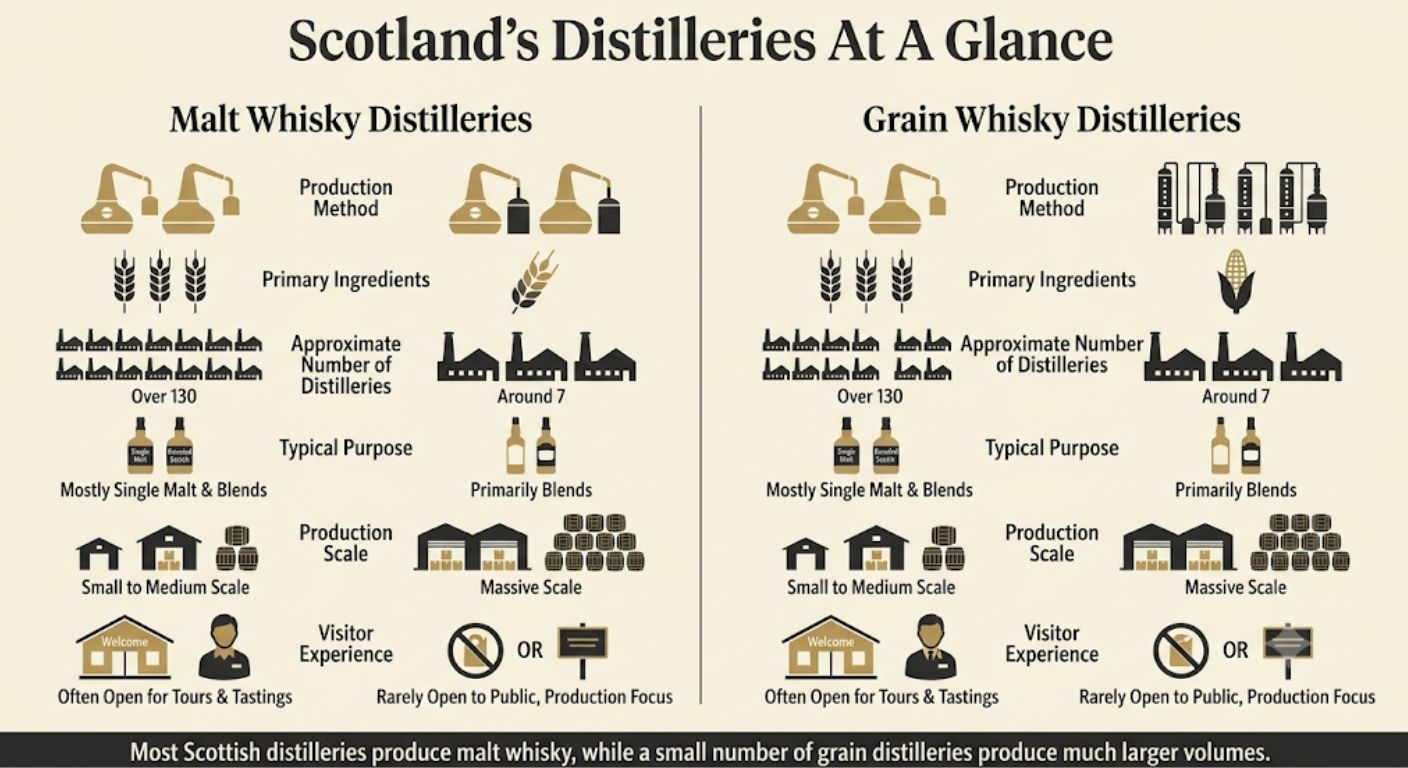
Most Scottish distilleries produce malt whisky using malted barley and copper pot stills. Grain whisky distilleries are fewer in number but can produce huge volumes using continuous stills and grains such as wheat or maize alongside malted barley.
This distinction matters because a distillery count can make Scotland look like a mostly single malt industry. In bottle terms, single malt has the strongest identity for collectors and enthusiasts. In production terms, grain whisky is essential because it supports blended Scotch, which remains a major part of global Scotch whisky sales.
Examples Of Distilleries That Show Scotland’s Range
Scotland’s distillery count is not just a statistic. It reflects a wide range of histories, production styles, and collector interest.
Rosebank is important because it represents the return of a highly regarded Lowland name after years of silence. Its revival shows why distillery counts can change quickly when closed or mothballed sites restart production.
Tomintoul gives a different view of the landscape. It sits in Speyside and is known for a softer, approachable style, which helps explain why Speyside remains such a strong starting point for many drinkers.
Linkwood is another useful example because much of its reputation has been built through blending and independent bottlings, not only through mainstream official releases.
What The Distillery Count Means For Buyers
A high distillery count gives buyers more choice, but it also makes context more important. Two bottles may both say “Single Malt Scotch Whisky” on the label, yet differ completely by region, cask type, ABV, age statement, and bottler.
The count matters most when it helps you make better decisions:
- For beginners: start with region and style rather than trying to learn every distillery at once.
- For collectors: closed, revived, and independently bottled distilleries often need closer label reading.
- For gift buyers: a recognisable region or distillery can make the bottle easier to understand.
- For enthusiasts: newer distilleries can offer useful discovery, but age and cask detail still matter.
FAQ
How many distilleries are there in Scotland?
There are around 154 operating Scotch whisky distilleries in Scotland as of May 2026. The figure changes depending on whether the count includes malt distilleries only, grain whisky distilleries, new producers, and reopened sites that have restarted production.
How many grain whisky distilleries are there in Scotland?
Scotland has a small number of grain whisky distilleries compared with malt distilleries, commonly counted at around seven or eight depending on classification. They produce whisky at much larger scale and are especially important for blended Scotch.
What are the five Scotch whisky regions?
The five recognised Scotch whisky regions are Highland, Lowland, Speyside, Islay, and Campbeltown. The Islands are often discussed as a separate style group, but legally they sit within the Highland region rather than forming a separate Scotch whisky region.
Which Scotch whisky region has the most distilleries?
Speyside usually has the highest concentration of malt whisky distilleries. The Highland region is larger geographically, but Speyside’s density of producers makes it one of the most important areas for anyone trying to understand Scotch whisky by distillery.
Are new whisky distilleries opening in Scotland?
Yes. Scotland continues to see new distillery projects, alongside revived names such as Port Ellen and Rosebank. New distilleries usually need at least three years before their spirit can legally be sold as Scotch whisky.
-
-
-
-
-
-
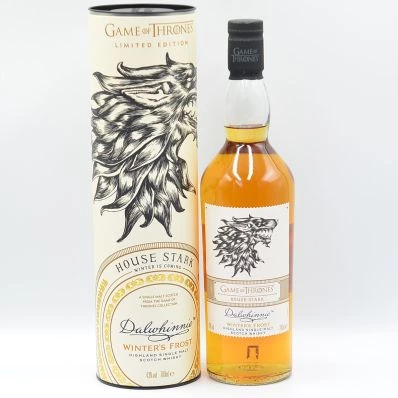 Game Of Thrones Whisky Dalwhinnie Winter's Frost House StarkSpecial Price £104.98 Regular Price £134.99 Inc VATSaving £30.01Out of stock
 -
-
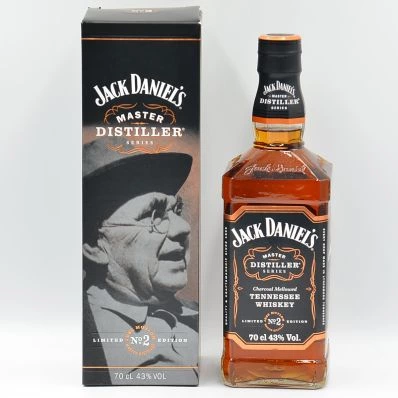 Jack Daniel's - Master Distiller Batch 2 Jess Motlow Limited Edition Bourbon Whiskey£164.99 Inc VATOut of stock
 -
-
-
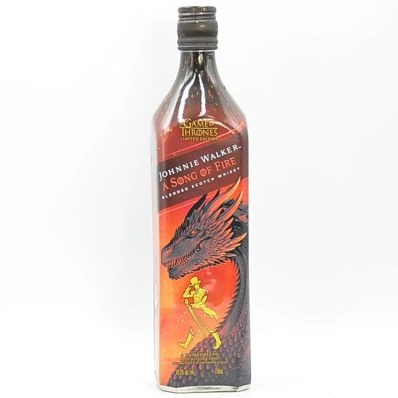 Game of Thrones Whisky Johnnie Walker A Song Of FireSpecial Price £139.98 Regular Price £144.99 Inc VATSaving £5.01
 -
Final Takeaway
Scotland has around 154 operating Scotch whisky distilleries, but the number is only the starting point. The more useful question is how those distilleries divide by region, production type, and whisky style.
Use the count as a map, not a shortcut. From there, explore the regions, compare distillery identities, and look at the bottle details that matter: age, ABV, cask type, bottler, and provenance.

Comments